The Trump Admin Just Won The Mask Decision… Now It Should Appeal
California Gov. Gavin Newsom has become increasingly Orwellian in his declarations of success.
Last week, Newsom was proclaiming the great success of his high-speed train to nowhere – a project delayed by decades, reduced to a fraction of the original plan, and set to cost tens of billions over budget.
This week, he is proclaiming victory after a court struck down his signature law requiring federal agents to unmask. The preliminary injunction issued Monday by Senior status Judge Christine Snyder against California’s No Secret Police Act was a victory for the Trump Administration.
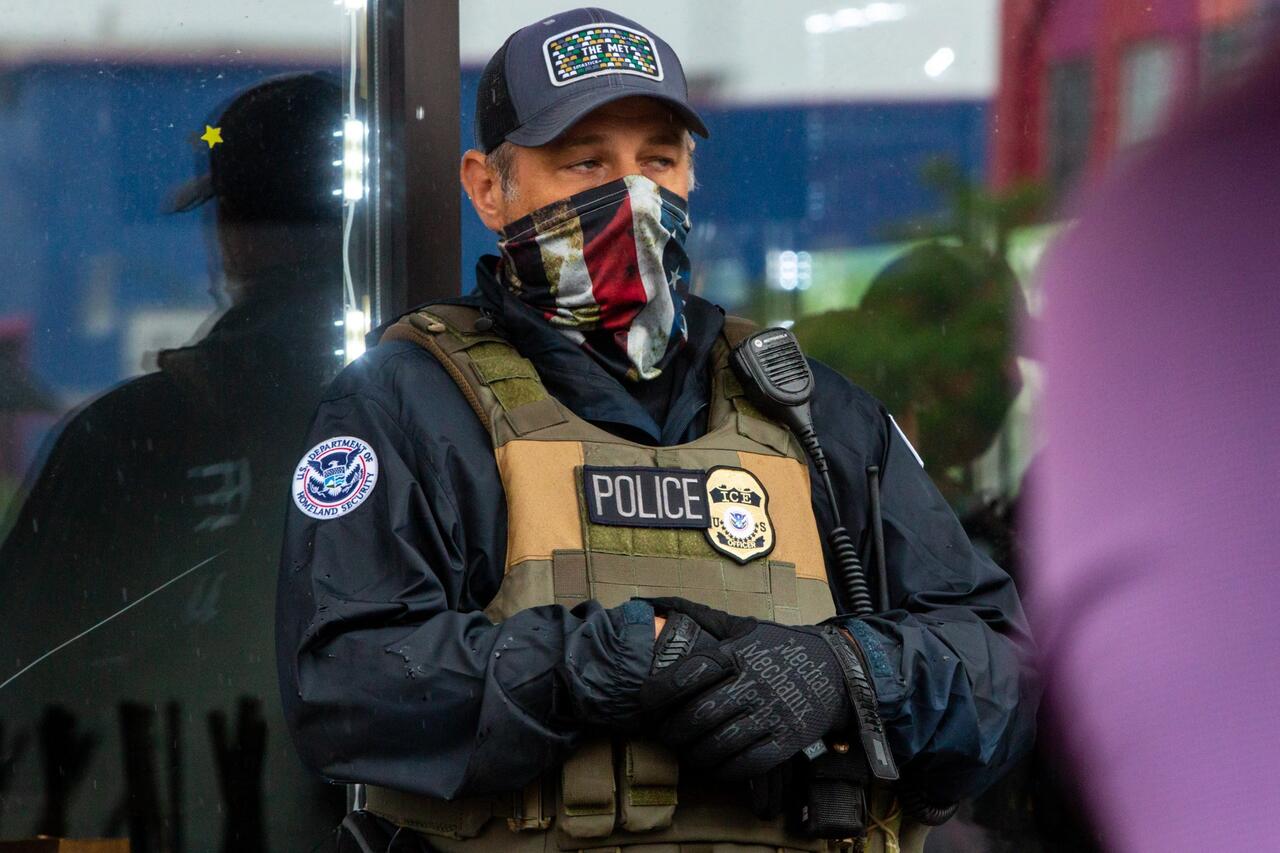
However, it should still appeal Judge Snyder’s flawed decision. In other words, the Administration won for the wrong reason.
Snyder, an Obama appointee, faced two laws passed in September 2025 with great fanfare in California: the Secret Police Act and the No Vigilante Act. As their titles indicate, they are not serious efforts at legislating but unconstitutional acts designed to pander to the politics of the moment.
In the oral argument, some of us were concerned over the curious position staked out by Judge Synder.
DOJ counsel Tiberius Davis tried to explain how such state laws usurp federal authority and violate the Supremacy Clause.
He drove that point home by asking “Why couldn’t California say every immigration officer needs to wear pink, so it’s super obvious who they are? The idea that all 50 states can regulate the conduct and uniforms of officers … flips the Constitution on its head.”
That would seem an unassailable point, but not to Judge Synder.
She asked, “Why can’t they perform their duties without a mask? They did that until 2025, did they not? How in the world do those who don’t mask manage to operate?”
I remarked at the time that the court seemed to miss the central point.
The question is not whether the federal government can continue to function under limitations imposed by various states, but whether those states have the authority to impose such conditions.
I do not believe that they do.
Nevertheless, Judge Synder came to the right conclusion for the wrong reason.
She enjoined the mask requirement, but did so on the basis that California exempted its own officers.
“Even though the United States has failed to demonstrate that the facial covering prohibition of the No Secret Police Act unduly interferes with federal functions, the court acknowledges that it is nonetheless an incidental regulation on law enforcement officers. The intergovernmental immunity doctrine prohibits imposing such a regulatory burden, albeit minimal and incidental to operations, in a discriminatory manner against the federal government.”
By adopting this narrow basis, the court was able to enjoin the No Secret Police Act while rejecting an injunction against the No Vigilantes Act and certain other provisions of the No Secret Police Act.
I think the court is wrong and should be reversed.
Snyder rejected the rationale of the federal government that these masks are being used to protect ICE agents from “doxing,” even though various agents have been targeted and threatened. Synder waved off the concern and said that the government had not shown by such masking is essential to carrying out such functions. Her opinion relies on broad, unsupported assumptions. Because officers are facing these security concerns, she concludes that they will continue regardless: “Security concerns exist for federal law enforcement officers with or without masks. If anything, the court finds that the presence of masked and unidentifiable individuals, including law enforcement, is more likely to heighten the sense of insecurity for all.”
It is a bizarre rationalization. The court is simply imposing its judgment on what will make officers safer, rather than emphasizing whether these agencies have the discretion to make such judgments in the execution of federal law. Yet the court still enjoins the law because it discriminates between federal and state officers. (Not surprisingly, Democratic state Sen. Scott Wiener, the author of the mask ban, immediately declared that they would amend the law to add state law enforcement).
The Court then upheld a state requirement that federal officers cannot conceal their identities in a discussion more befitting a legislative committee than a court:
“The Court finds that these Acts serve the public interest by promoting transparency, which is essential for accountability and public trust. Moreover, the Court finds no cognizable justification for law enforcement officers to conceal their identities during their performance of routine, non-exempted law enforcement functions and interactions with the general public.”
In my view, Judge Snyder twists the analysis into knots to try to preserve as much of these laws as possible while giving the Administration the minimum level of deference.
Under the intergovernmental immunity doctrine, the Supreme Court has mandated in cases such as McCulloch v. Maryland, 17 U.S. 316, 317 (1819), that “the states have no power, by taxation or otherwise, to retard, impede, burden, or in any manner control, the operations of the constitutional law enacted by congress to carrying into execution the powers vested in the general government.” A state cannot intrude into this authority absent a “clear and unambiguous” authorization from Congress, Goodyear Atomic Corp. v. Miller, 486, U.S. 174, 180 (1988).
Snyder finds that the California laws discriminate but do not constitute direct regulation of the federal government. She does so through a “functionalist” approach that avoids bright lines of supremacy. She simply dismisses the objections, saying the federal government has not shown that wearing masks is “essential” to carrying out these functions. Consider that approach for a second. A wide range of state regulations on federal officers could be deemed permissible, since federal officers can still functionally carry out arrests. States could dictate everything from uniform requirements, such as masks, to vehicle conditions to verbal commands or warnings.
The opinion is spotty in its analysis and sweeping in its implications. It is, in my view, ripe for reversal either before the United States Court of Appeals for the Ninth Circuit or the Supreme Court.
Here is the opinion: a 30-page decision: United States v. California
Tyler Durden
Wed, 02/11/2026 – 12:45ZeroHedge NewsRead More








 T1
T1