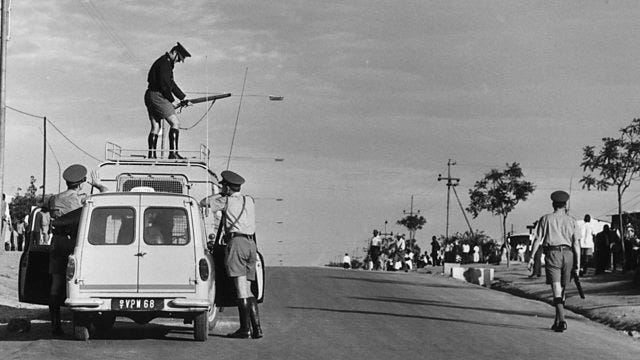
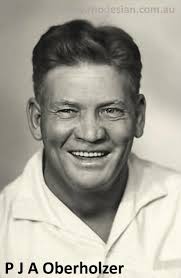
The Rhodesian Bush War, at least officially, began on the 4th of July 1964 when Piet Oberholtzer, a much loved Afrikaans farmer who the local children called Oom (Uncle), was savagely murdered in front of his wife and one of his seven children by a gang of African terrorists called the ‘Crocodile Gang’ (or as the note at the scene read: ‘This is the work of the Clocadile Gang, it said. We will keep on fighting until all white setlars are going and our land is returned! VIVA CHIMURENGA!’1). The murder quite rightly changed everything, it was the first politically motivated murder of a White man by an African since the Second Matabele War in 1896.
This horrifying murder, which saw Mr Oberholtzer bravely use his last breaths to drive his family to safety despite the ten inch hunting knife in his chest, was a long time coming. For years now African Nationalists had led a terror campaign all across Rhodesia, but they mostly went for soft targets, their own people. The idea was intimidation, as Elpeth Huxley put it, ‘‘‘Join us or we will come tonight and burn your house’’ is the usual form.’2 Those who refused to join the Nationalist parties or pay their dues suffered a very cruel fate indeed.
The Whites were targets too, but, at most, this tended to just result in the stoning of cars, the trashing of Whites-only pubs or the burning of White shops. Nobody had been killed, at least not yet.
Winston Field, the Rhodesian Prime Minister since 1962, was perceived as far too soft, not only in his negotiations with Great Britain for independence but also in his handling of African Nationalists, who simply reformed their organisations under different names every time they were proscribed. Ian Smith, perceived as the ‘tough man’3 of the Rhodesian Front, was brought in to handle both of these issues, becoming Prime Minister on the 13th of April 1964.
Five days later the worst attack against whites so far took place right in the middle of Salisbury.
It was the 18th of April in the OK Bazaars Supermarket on Baker Avenue, Salisbury. Shoppers of all Rhodesia’s various races were going about their business. Suddenly, interrupting their shopping, there was a loud, piercing whistling sound. The shoppers, mostly women, did not have much time to think about the source.
Within seconds around twenty African youths, all of whom were mingled in amongst the other shoppers, suddenly turned and, as if absolutely crazed, began attacking any white women they could get their hands on, ‘punching, slapping and beating them in a fury’4. Shoppers of every other race were ignored. Onlookers were ‘scarcely able to believe this could be happening in the centre of Salisbury in the height of the holiday period.’5
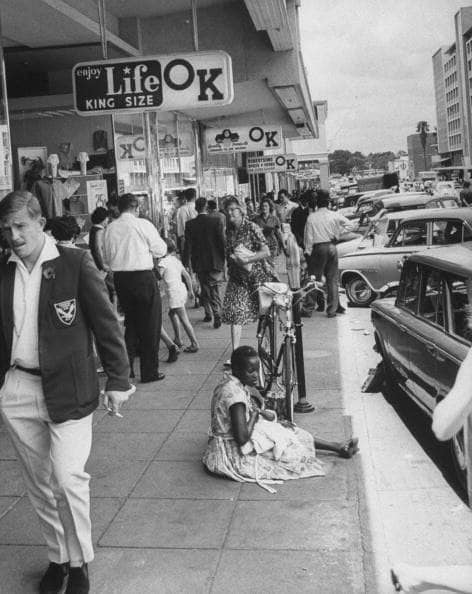
One poor woman was savagely beaten before being ‘knocked down a flight of stairs’6, another was ‘hit with a glass tray’7 whilst a man who tried to stop the attackers getting away was ‘slashed in the arm’8.
Kenneth Young, author of Rhodesia and Independence would recall a few years later how much this attack impacted Rhodesians:
‘It was the O.K. Bazaars incident, though, which proved to be the ‘turning point in white attitudes: this was what happened – and to women, too – when African thugs were allowed to get the upper hand.’9
OK Bazaars was just the start, too, as for ‘another two days, homes, cars and trains were stoned’10 amongst other violent incidents. By the end of Sunday the 19th three hundred arrests had been made.11 The following months saw further violence in which an African was shot by the police and another was sentenced to death for his part in an arson attempt on a white home and two dynamite explosions on a newspaper premises in Salisbury. There were further incidents which saw more white shops set on fire and cars driven by whites stoned. This all culminated in that dreadful attack on Oom Piet Oberholzer on the 4th of July.
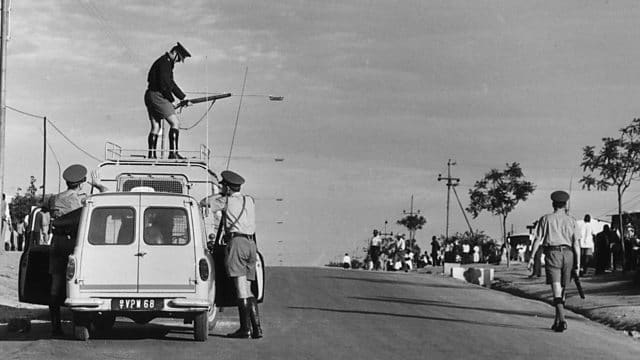
Never before had Rhodesians been so united behind Ian Smith’s Rhodesia Front party, never before had they been so sure that declaring independence would be the correct decision. If this was what Africans were like under White rule, then the treatment of Whites under African rule could hardly even be imagined. Rhodesians did not want to go the way of the Whites in Haiti, the Congo or Northern Rhodesia and, quite naturally, the Whites of Rhodesia retreated further into their racial laager. The Rhodesian’s faith in their Government was swiftly rewarded.
The Rhodesian security forces immediately cracked down hard on black militancy and they were remarkably successful. The border along the Zambezi was tightened and arms shipments were unearthed all over the place. In a bid to get rid of their accumulated ordinance there was a spate of grenade attacks in Bulawayo. In September, meanwhile, there was an abortive ZAPU attack on the Kezi farmstead. The attackers were tracked some distance and then arrested by a heroic black police sergeant.
Peace quickly returned to the Rhodesian countryside and the city streets. Most of the African Nationalist leadership was behind bars and the terrorists had made utter fools of themselves. The Rhodesian Government had shown they were serious. The game was on and the Rhodesian people were as determined as ever to maintain White rule. After all, was a society in which White women couldn’t even peacefully shop alone a society really worth living in? If the Africans weren’t put back in line then emigration to Britain, then still a peaceful White paradise, despite all it’s flaws, would have looked more and more tempting by the day.
Mukiwa, Peter Godwin, p11-12
The Sunday Times, 12.04.59
Rhodesia and Independence, Kenneth Young, p97
The New York Times, 19.04.64
The Sunday Telegraph, 19.04.64
The New York Times, 19.04.64
Ibid
Ibid
Rhodesia and Independence, Kenneth Young, p129
So far and no further!, JRT Wood, p211
Ibid
Zoomer HistorianRead More








 T1
T1