OPEC+ Agrees To Boost Oil Output As US War On Iran Disrupts Shipments
On Sunday, OPEC+ agreed to boost oil output by 206,000 barrels per day for April just as the U.S.-Israeli war on Iran and Tehran’s retaliation disrupted oil flows from key members of the producer group in the Middle East.
It had debated options ranging from 137,000 bpd to 548,000 bpd, according to five sources. The agreed increase, which brings an end to a three-month pause in production hikes, represents less than 0.2% of global supply.
The meeting on Sunday involved only eight members of OPEC+ – Saudi Arabia, Russia, the UAE, Kazakhstan, Kuwait, Iraq, Algeria and Oman. OPEC+ groups the Organization of the Petroleum Exporting Countries and allies like Russia but most production changes in the past years have been done by the eight members. Iran, perhaps understandably, was missing. The eight members raised production quotas by about 2.9 million bpd from April through December 2025, roughly 3% of global demand, before pausing increases for January to March 2026 due to seasonal weakness.
OPEC+ has traditionally raised oil output to cushion disruptions but analysts quoted by Reuters, said the group currently has little spare capacity to add to supply, except for its leader Saudi Arabia and the United Arab Emirates, which will also struggle to export oil until navigation in the Gulf returns to normal.
Riyadh has been increasing oil production and exports in recent weeks by around 500,000 bpd in preparation for US strikes on OPEC+ member Iran, sources also told Reuters.
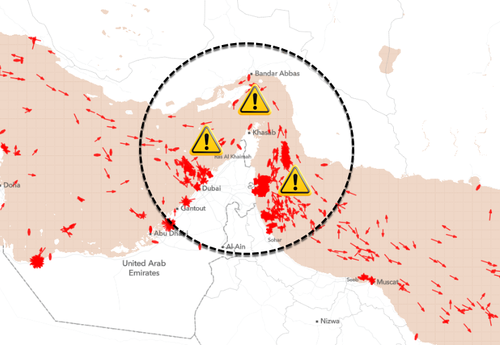
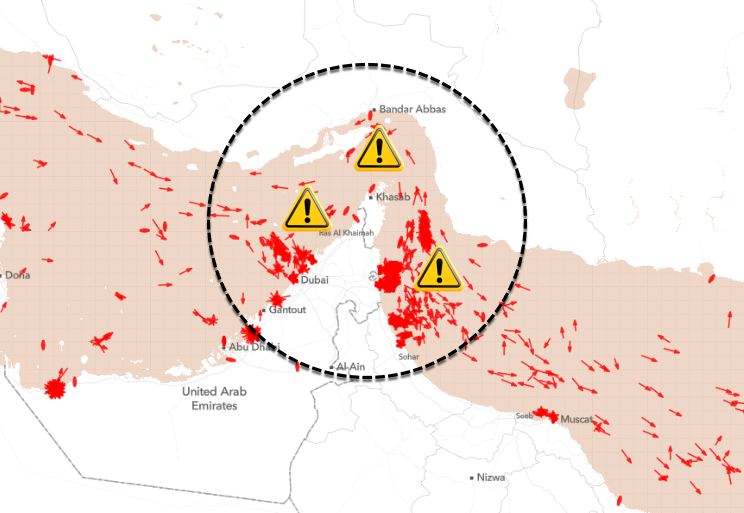
The near-term impact on oil prices remains unclear: oil, gas and other shipments from the Middle East via the Strait of Hormuz have come to a halt since Saturday after shipowners received a warning from Iran saying the area was effectively closed for navigation. There was confusion later in the day, when Iran’s Foreign Minister Abbas Araghchi told Al Jazeera TV his country has no intention to close the Strait of Hormuz and has kept it open so far.
Hundreds of ships dropped anchor and were not moving on Sunday and several ships came under attack, as reported earlier. Hormuz is the world’s most important oil route accounting for over 20% of global oil transit.
Despite fears of a glut that would weigh on prices, global benchmark Brent crude has rallied this year and jumped on Friday to $73 per barrel, the highest level since July, on fears of a wider conflict in the Middle East. In other words, as nat gas trading legend John Arnold (first at Enron then at Centaurus) much of the conflict is already in the prices, although what happens next depends on how long any Hormuz closure lasts. As Arnold also explains, while the market was somewhat hopeful a war could be avoided, Iran’s response thus far suggests a below expectations ability to materially disrupt supply which would suggest any oil price spike is temporary.
re: oil prices
– Oil had already rallied ≈$7 from late January in anticipation of possible attack
– Market was still assigning some probability to no attack (bullish)
– Iran’s response thus far suggests a below expectations ability to materially disrupt supply (bearish)— John Arnold (@johnarnold) March 1, 2026
While oil may be volatile in the near-term, there is less doubt what happens to shipping charters in coming days: they will soar. As the FT reported, insurers told ship owners on Saturday they would cancel policies and raise coverage prices for vessels traveling through the Gulf and Strait of Hormuz after the US and Israel attacked Iran.
War risk insurers on Saturday submitted cancellation notices for policies covering ships moving through the key oil chokepoint, brokers told the FT, with prices set to rise as much as 50% in the coming days. The unusual move to submit these notices before trading resumes on Monday underscores the pace of escalation after Iran launched retaliatory strikes against US bases across the Middle East.
Insurance prices for ships travelling through the Gulf had been about 0.25 per cent of the replacement cost of a vessel. They could now jump by as much as half, Dylan Mortimer, marine hull UK war leader at broker Marsh, told the FT.
For a $100mn vessel, this would mean an increase from $250,000 to $375,000 per voyage.
Of course, the greatest concern among underwriters is whether Iran would close the Strait of Hormuz: Insurers were also pricing in expectations that Iranian proxies may attempt to board and seize vessels, he added.
“If Israel and US are continuing to strike Iran . . . it’s more likely that Iran will start trying to leverage their control via the manipulation of shipping in the region,” Mortimer said.
As a result of the regional war, some ship owners are now fully turning away from the Strait of Hormuz, through which about a fifth of the world’s crude oil flows. On Saturday at least three ships turned away from the strait, rather than pass through it, as shipowners assessed the risk of being attacked in the narrow waterway.
Yet the probability of a long-term Straits shutdown will be mitigated by an unlikely source: some 80% of Iran’s oil exports, about 1.6 million barrels per day, go to China, and Beijing will do everything in its power to preserve this lifeline and remove any Hormuz blockage…
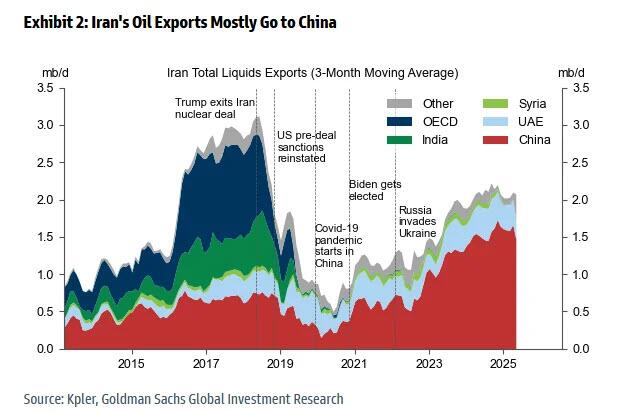
… as will Iran because after a few days of zero revenue, the regime – which is being bombed constantly by the US and Israel – will be in desperate need of cash to keep the military happy.
Going back to OPEC+ output increase, Jorge Leon, a former OPEC official who now works as head of geopolitical analysis at Rystad Energy said it is unlikely to calm markets. Indeed, Brent traded 8%-10% up around $80 per barrel over the counter on Sunday, traders said.
“Prices will respond to developments in the Gulf and the status of shipping flows, not to a relatively small increase in output.”
Middle East leaders have warned Washington that a war on Iran could lead to oil prices jumping to over $100 per barrel, said veteran OPEC analyst Helima Croft from RBC. Analysts from Barclays also said prices could rise to $100.
Croft said the market impact from any OPEC output increase will be limited due to a lack of production capabilities outside Saudi Arabia.
“A tighter market in the first quarter allows the group to continue increasing the quota, however real barrels being added to the market will be a fraction of it,” said Giovanni Staunovo, an oil analyst at UBS. OPEC+’s declining level of spare capacity might have been a factor behind the decision not to opt for a larger boost, he said.
Tyler Durden
Sun, 03/01/2026 – 13:45ZeroHedge NewsRead More








 T1
T1