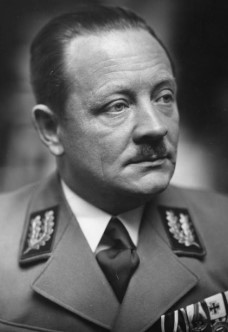
I have debunked two of the most celebrated anti-Slav quotes attributed by ‘Holocaust’ historians to the Gauleiter of East Prussia and Reichs Commissar of the Ukraine Erich Koch and which are constantly wheeled out by historians and journalists alike as part of their ‘evidence’ for the ‘Slavic Holocaust’. (1)
The third extremely famous quote attributed to Erich Koch on the subject goes something like this:
‘If I find a Ukrainian who is worthy to sit with me at table, I must have him shot’
When I began digging into this quote something that I noticed very quickly was that while almost routinely reproduced and cited as real: no date, place or originating source was mentioned. This is decidedly odd in the study of the Third Reich and in modern history in general in that documentation is not generally speaking an issue and specific claims are expected to have specific evidence and if they do not then it is the rule of thumb to disregard such quotes as apocryphal or invented at a later date.
What I found however was that this Koch quote – while often stated – was never linked to a primary source, a time and/or a place which made my eyebrows go up and caused me to wonder: could it really be there is no actual primary source for this quote?
For example, Timonthy Snyder – who is a fairly serious academic authority on Central and Eastern Europe during the early to mid-twentieth century – cited the Koch quote in his 2015 book on the ‘Holocaust’: ‘Black Earth’.
He writes how:
‘Erich Koch chosen by Hitler to rule Ukraine, made the point about the inferiority of Ukrainians with a certain simplicity: “If I find a Ukrainian who is worthy to sit with me at table, I must have him shot.’ (2)
The problem of course is that Snyder provides no reference for the quote and just assumes it is genuine presumably because it is ‘well known’.
When I looked at Karel Berkhoff’s 2004 academic study of Reichskommissariat Ukraine ‘Harvest of Despair’; Berkhoff also quoted a variant of the same words that Koch is said to have uttered.
He writes:
‘He is said to have remarked once, “If I find a Ukrainian who is worthy of sitting at the same table with men, I must have him shot.”’ (3)
Berkhoff’s wording here is telling concerning this quote: ‘he is said to have remarked once’. The reason is because this suggests that like me Berkhoff at least tried to check the quote’s origins and he is unsure if it is genuine, but he quotes it anyway with an inference that it ‘might not be genuine’ but ‘represents Koch’s views’.
The problem that Berkhoff must have run into is locating an original source for the quote in the primary source material; so Berkhoff does the easy (and lazy) thing and simply cites two academic sources for the quote being ‘real’. (4)
The first is Gerald Reitlinger’s January 1959 article ‘Last of the War Criminals’ in ‘Commentary’ which is a long and detailed if polemical article about Koch, but which doesn’t mention this quote once. (5) I even read the article twice to be sure and then checked Reitlinger’s best-selling and much cited 1956 book ‘The SS’ that mentions Koch repeatedly and it isn’t to be found in there either. (6)
The second is Alexander Dallin’s 1981 academic study ‘German Rule in Russia, 1941-1945’ which introduces the Koch quote but again like Snyder doesn’t actually provide a source and leaves it as – essentially – ‘everybody knows Koch said this’. (7)
Thus, we can see that even Berkhoff’s citations lead nowhere and we are left with the impression that this quote has come out of thin air and when checking other works that cover this aspect of German policy – for example Robert Edwin Herzstein’s 1982 ‘When Nazi Dreams Come True’ and Michael Burleigh’s 1988 ‘Germany turns Eastwards’ – as well as widely-cited histories of the Third Reich – for example William Shirer’s 1960 ‘The Rise and Fall of the Third Reich’ – the quote is also not to be found.
Therefore, as best as I can work out this quote has no originating primary source and is either entirely made up – by whom I as yet cannot say – or it is based on a relatively obscure primary source that hasn’t been checked nor is easy to check as such as Koch’s trial in Communist Poland between October 1958 and March 1959 or is a piece of hearsay – as Berkhoff’s wording implies it might be – that has simply been repeated ad nauseum as ‘fact’.
Further it is worth pointing out that the quote ‘If I find a Ukrainian who is worthy to sit with me at table, I must have him shot’ sounds rather like Koch making a joke even if you just say it out loud to yourself and that wasn’t to be taken literally as it has been ever since.
However, without an originating primary source we can’t say for certain, but we can say that unless a primary source for this quote can be provided then it has to disregarded as fake until such a time as that changes.
References
(1) On these please see my detailed article: https://karlradl14.substack.com/p/is-the-erich-koch-we-are-a-master
(2) Timothy Snyder, 2015, ‘Black Earth: The Holocaust as History and Warning’, 1st Edition, The Bodley Head: London, p. 18
(3) Karel Berkhoff, 2004, ‘Harvest of Despair: Life and Death in Ukraine under Nazi Rule’, 1st Edition, Harvard University Press: Cambridge, p. 37
(4) Ibid., p. 322, n. 13
(5) Cf. Gerald Reitlinger, ‘Last of the War Criminals: The Mystery of Erich Koch’, Commentary, January 1959 (Berkhoff cites it as being on p. 32 but it is not). You can check this for yourself here: https://www.commentary.org/articles/gerald-reitlinger/last-of-the-war-criminalsthe-mystery-of-erich-koch/
(6) Cf. Gerald Reitlinger, 1981, [1956], ‘The SS: Alibi of a Nation, 1922-1945’, 1st Edition, Book Club Associates: London
(7) Alexander Dallin,1981, ‘German Rule in Russia, 1941-1945: A Study of Occupation Policies’, 2nd Edition, Westview Press: Boulder, p. 167
Karl’s SubstackRead More






 T1
T1