Lionel Shriver (Credit Image: © B540/ Guillem Lopez/UPPA via ZUMA Press)
Lionel Shriver, A Better Life, HarperCollins, 2026, 304 pp., $19.56 (softcover)
In 2023, the Democrat Mayor Eric Adams of New York proposed that city residents house the newest New Yorkers — some of the millions who had been part of the Biden-era open-borders debacle and who had been dumped in the woke city.
Lionel Shriver, who shot to fame with her 2003 novel, We Need to Talk about Kevin, which was the basis for a successful 2011 Hollywood film about a mass school shooter, took the mayor’s aborted program and gave it an imaginative reworking. But before I read the book, I looked at reviews. “Shriver tackles immigration and goes off the rails” (Atlantic). “Trumpians will love it; others will loathe it” (Spectator Australia). “Sour and hectoring” (New York Times). “Shriver, who’s flirted with hard-right ideology, cozies up to the Great Replacement conspiracy theory . . . . this rehash of The Camp of the Saints is just hackneyed paranoid xenophobia. Her worst book, by a wide margin” (Kirkus Reviews).
Meanwhile, Amazon readers were leaving mostly four and five stars. The reader reviews clinched it for me. The book was triggering all the right people who get it wrong on immigration.
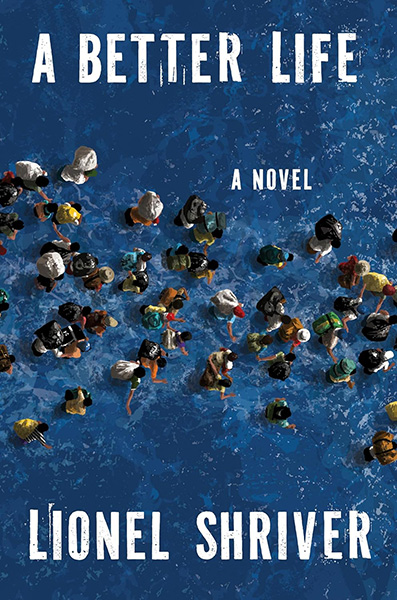
Miss Shriver begins with a fictional “Big Apple, Big Heart” program, and the book is about how it turned out for the Bonaventura family. Sixty-two-year-old Gloria is the progressive family matriarch who marches under all the good banners to the beat of all the right slogans and who lives with her adult son, Nico. He is a political dissident who reads conservative, taboo blogs, in a $2.5 million house Gloria took as settlement after her divorce from her right-wing media-celebrity husband. Gloria is ideologically supported by her two daughters, Vanessa and Palermo, who are on the same political wavelength.
Much to Nico’s dismay, Gloria decides to take in a migrant but she is careful to specify that it should be a woman and not a man “of military age” as the deplorables always add. And so arrives Martine Salgado, a “peppy Latina” from Honduras with no English, no money (well, none of her own – the city government gives her $200 a month in Refugee Cash Assistance) and no skills beyond wielding an iron, and who cooks fatty, Central-American peasant food.
Nico is immediately skeptical. Is Martine a real refugee or just lathering it on from a well-rehearsed, sob-story script about the poor, persecuted migrant fleeing domestic and gang violence (which Mr Biden had declared valid grounds for claiming persecution)? Miss Shriver is not above mocking the “Believe All Women” cult. Gloria gullibly takes Martine at face-value, and as one daughter observes, this is doubly good because it “assures Mom she’s Making the World a Better Place” (Miss Shriver’s sardonic capitalization).
Martine’s arrival soon signals the start of a progression of uninvited others from Honduras, all of them men, expressly not wanted by Gloria. The first is the taciturn Domingo, whom Martine claims is her brother and whom all the Bonaventura women accept because of “family reunification” and all that. Nico suspects Domingo is Martine’s shady husband.
Domingo is followed by half a dozen more “business partners” (Nico suspects the business is wholesale drug dealing). Affable Alonso’s “loquacious bonhomie” is almost endearing, but his comments about how easy it is to take Americans for a ride because of their porous borders and laughable migrant “vetting” are really a case of rubbing his hosts’ noses in the whole asylum-seeker scam.
Then it’s one shakedown after another to extract money from Gloria by the Martine clan. Nico is convinced Martine is a co-conspirator in an extortion racket, but Gloria denounces him as “projecting onto the innocent the nature of his own dark heart.” Gloria’s domestic world is shaken but her political ideology is not — “people of color,” even fake refugees and drug dealers, “are her kryptonite,” observes Nico. Gloria’s suicidal empathy remains intact — except for a brief moment of insight when she tells Martine, “You left Honduras only to bring Honduras here.”
Eventually, however, even the Bonaventura women want to be rid of their new “guests” (at least the men) and, as a last resort, it is up to divorced Dad to organize an armed posse — “a superannuated SWAT team” — to do this. And there, because the book reviewers’ code of ethics precludes spilling all the plot beans, I leave the novel’s denouement unstated other than to note that it is a skillful mix of surprising plot twist and not-that-surprising thematic crescendo.
Miss Shriver has written a topical, political novel — a tricky task but one she comes close to nailing, although at times it reads like a Spectator opinion column rather a novel plumbing the interior workings of the characters. The artist and essayist often bump up against each other.
However, there is psychological depth to the characters. Nico excoriates Martine’s freeloading but he suffers some moral discomfort for living off Mum’s free room and board (he is 26 and still living at home). He is also drawing from a $75,000 inheritance from his grandfather and failing to use his engineering degree (from an el-cheapo school because he had been DEI’d out of better institutions). He tells himself that “family” means kith-and-kin, not some fantasy “Family of Man.”
The Bonaventura women, so noisy about principled compassion, have hypocrisies, too. Accepting the free labor from Martine, the unpaid housekeeper, is hardly in accord with the ideal of not exploiting cheap, brown labor. The family business of one of the sisters also hires illegals for their cut-rate labor, also a “progressive” no-no, at least in theory.
The Bonaventura women also want to defund the police, but when their Honduran occupiers become unendurable and dangerous, they turn to these same repressive agents of the racist state — unsuccessfully, because the New York justice system they wanted defanged is now toothless. Their support for “progressive” causes tends to evaporate when an issue affects them personally.
There is also a mercenary edge to Gloria’s altruism because the cash-strapped divorcee desperately needs the $110 taxpayer per diem that comes with the exile. Neither daughter offers to take in an “asylum-seeker,” embarrassed but relieved to plead lack of space.
Avoiding race
Miss Shriver, like most centre-right critics of (illegal) immigration, mostly dodges the issue of race. She does have Nico say, “Martine and her ilk were trying to cash in on the civilization benefits their forebears hadn’t amassed: their attempted shortcut to prosperity was effectively a kind of cheating, mooching or theft,” adding that this is because their race had never built an advanced civilization.
Miss Shriver comes perilously close to seeing that race may, indeed, explain why some countries such as the US and other white nations are “lucky” successes while some others are “unlucky,” and that it is not a moral obligation for the “lucky” to share their good fortune with “unlucky” brown and black party-crashers.
Nico realizes that “diversity” didn’t build America and that it was only the “race homogeneity” of immigrants “of the same civilizational origins” who did. He notes to himself that non-white immigrants and descendants of black slaves did diddley for the US. Nico’s loud, conservative father sides with his son: “Having even one visually and culturally distinct minority brings you a host of problems, especially if they have a cracking good reason to bear a grudge” (colonialism, slavery, imperialism war). Adding their splash of dun color to the white mix does not create a better life for anyone except the immigrants. Race-denialist Gloria calls this “racist dog-whistling.” Miss Shriver, conservative but cautious, mostly sticks to the “safe” issue of criminals among the illegals.
In Australia in the 1970s, we used to have the beer-like, non-alcoholic Clayton’s, advertised as “the drink you have when you’re not having a drink.” Criminal illegal aliens can be a political Clayton’s — it’s the issue you deal with when you don’t deal with race. But you have to start somewhere.
It’s TDS again
None of Miss Shriver’s characters likes Donald Trump. Nico’s dad calls him “that clown,” and his progressive wife says the “shithole countries” speech was a “racist, Trumpy diatribe.” Even Nico says he won’t even vote. Miss Shriver, as we know from her columns, voted for Mr. Biden over Mr. Trump. Her chronic Trump aversion prevents her from having even a mildly sympathetic character who supports Mr. Trump.
So, A Better Life is not a Great English Novel, but when most contemporary fiction is unreadable progressive propaganda, we are fortunate to have Lionel Shriver. It’s just a pity about the TDS and the reticence on race.
The post Finally, a New Anti-Immigration Novel? appeared first on American Renaissance.
American RenaissanceRead More






 T1
T1