A French group called Les Natifs (The Natives) invited me to give a speech in Paris on June 3, 2026. However, police broke up the meeting, explaining that judging from my record, I was likely to say things that would “violate the penal code and threaten national cohesion as well as the principles enshrined in The Declaration of the Rights of Man and Citizen [of 1789] and in the republican tradition.”
The French version of the talk was published in the magazine Elements on June 8 without, apparently, threatening national cohesion. This is an English version of the speech.
“The American Dilemma Is Now the European Dilemma”
What is the American Dilemma?
The dilemma begins with the fact that we Americans had a multiracial society from the beginning. There were already Indians living where Europeans founded colonies. We then imported another race of people: Africans. And after that, we let in everyone from everywhere. The American multiracial society has been a failure, and it should have been clear to Europeans while they still had white countries that it was a failure.
Part of the problem, however, was that even though European intellectuals realized America had a race problem, they were convinced they could solve it. They believed the problem was not a multiracial society itself. The problem was ignorant, prejudiced Americans — especially Southern Americans — and Europeans were convinced they could teach us how to be better.
How many of you have heard of a Swede named Gunnar Myrdal? He was a leftist economist who won the Nobel Prize. But he also published in 1944 one of the most influential books ever written on American race relations. It was called An American Dilemma. It went through 25 printings and came out in a second edition in 1965 and was even being republished as a two-volume set in 1996.

Gunnar Myrdal
For years An American Dilemma was almost the Bible — the essential guide to American race relations. I have read all 1,483 pages of that great, fat book, and I can summarize its contents very easily. It’s all the fault of white people.
It’s always this way. White people — in this case a Swede — who have little experience with people of other races always think they know better — they are more virtuous — than people who may have lived with other races for hundreds of years.
Gunnar Myrdal called the problem of race relations the American Dilemma, and in 1944, he was right. Now, it is also the European dilemma, the Canadian dilemma, the Australian dilemma. It is, everywhere, the white man’s dilemma.
Look at Gunnar Myrdal’s Sweden today. When he died in 1987, Sweden was 98 percent white. Now, thanks to immigration, Sweden is about 30 percent non-white, and in most years it has the highest rape rate of any country in Europe. Swedes have mostly stopped telling Americans they understand race relations better than we do.
So, first, I would like to tell you a few things about race in America that you probably don’t know. And then, I would like to talk about the broader picture. The European dilemma.
To start with America: I assume most of you have heard about the Jamestown colony of Virginia. This was the first permanent English settlement in the New World, founded in 1607. There were Indians living in Virginia, so when next year marks 420 years since the beginning of America, it will also mean 420 years of American race relations — 420 years during which Americans learned some lessons about race, forgot them, and are slowly beginning to learn them again.
When the English arrived, the Spanish had been settling the New World for more than a century. By 1607, 200,000 Spaniards had emigrated to the colonies. They had found gold and silver and had brought immense wealth back to Spain. At the same time, the Spaniards had, justifiably or not, developed a worldwide reputation for cruelty against the American Indians.
And so, the purpose of the Jamestown colony was to find gold and silver, but the English were determined not to make the Spanish mistake of mistreating Indians. As usual, the ones with no experience with race thought they would do better than the ones who already had 100 years of experience.
It is important to note that the English had no preconceived notions of racial differences or superiority. They saw the Indians as essentially no different from themselves. This was completely different from their view of Moors or black Africans whom they did think of as strange and alien.
The colony was initially all men — about 100 — and they were careful to find a place for their encampment that was unclaimed and uninhabited. They wanted to offend no one. The leader of the colony, Edward Maria Wingfield, decreed that because the English came in peace, they would build no walls and there would be no training in weapons.
However, when the encampment was not even two weeks old, hundreds of Indians attacked and tried to exterminate the English. There were deaths on both sides, and the English would have been massacred if they had not panicked the Indians by firing a cannon that was on one of the ships. This noise terrified the Indians and they ran away. The English quickly built a log fort.
Despite that bad start, all the existing records agree: The English still wanted to be better than the Spanish and to live in harmony with the Indians. However, to their disappointment, it was the tribes who lived closest to them who liked them the least. It was only the ones who lived furthest away that were friendly and willing to trade. This is a fundamental principle of race relations: They are always better at a distance.
The chief of the neighboring Indians was named Powhatan, and his favorite daughter, Pocahontas, converted to Christianity and married an English colonist in 1614, seven years after the colony started. This was the beginning of a period of peace.
By then, the colony had a new leader, George Thorpe, who worked especially hard to please the Indians. If colonists mistreated Indians in any way, it is recorded that George Thorpe “punished them severely,” though there are no specific examples of how. It is also recorded that when dogs that belonged to the English barked at Indians, Thorpe had the dogs killed in the presence of Indians — much to the anger of the owners.
But in 1618, four years after Pocahontas married a colonist, her father, Chief Powhatan, died, and his younger brother, Opechancanough, became chief. Opechancanough did not have a favorite daughter married to an Englishman, and he did not like the English.
And so, in 1622, four years after he became chief, Opechancanough decided to exterminate the colonists. By then there were about 1,200 of them in Jamestown, spread out in several locations. Every morning, Indians would come to the settlements and work with the English on farms and in workshops. On March 22, 1622, the plan was for the Indians to rise up and kill every man, woman, and child.
However, the main settlement at Jamestown was warned by an Indian who had converted to Christianity. The men kept their weapons handy and there was no violence. In other areas there was total surprise, and the Indians killed about 400 colonists — one third of the whole colony. Interestingly, they were especially cruel to George Thorpe, who had killed dogs that annoyed Indians and who was so concerned about their welfare. They tortured him and mutilated his body.
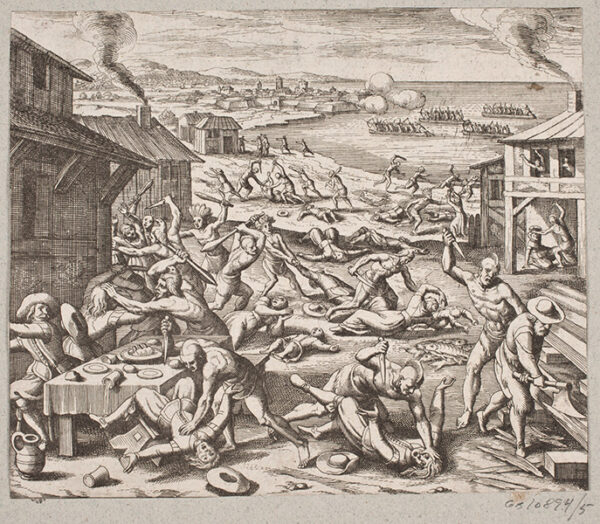
The English briefly made war on the Indians, but the two groups returned to peaceful relations, just as before. Opechancanough remained chief.
Amazingly, in 1644 — 22 years later — Opechancanough launched an identical surprise attack, and this time managed to kill between 400 and 500 colonists in yet another attempt to exterminate the English. This time, the English went on what amounted to their own extermination campaign, and killed many Indians, including Opechancanough.
I call this the inherent tragedy of race relations. The English appear to have had genuinely good intentions. They were unaggressive and trusting and had no sense of racial superiority. The Jamestown colony seems as promising an effort to establish peaceful race relations as could be imagined.
And yet the very presence of white men was an act of aggression, even if they didn’t realize it. The Indians were there first. Someone is always there first. We may say it was wrong for Opechancanough to massacre colonists in sneak attacks, but I do not reproach him for that. It was the only way the Indians could have driven out the white man and remained masters in their own house. Those attacks failed and the Indians were destroyed.
And that is the story of the conquest of America. The intentions of whites — sometimes good, sometimes bad — don’t matter. The fundamental fact is that one people had the land, and another group, more advanced and more powerful, wanted the land. The result was dispossession, and even now, despite a great deal of mixing, Indians are still a distinct people with a distinct identity that shows how difficult assimilation is across racial lines, even after 400 years. Race relations always bring trouble.
It was just plain bad luck for the Indians that Columbus didn’t wait 500 years. If he had shown up in 1992 rather than 1492, the whole hemisphere might have been declared a World Heritage Wildlife Area with maybe a little eco-tourism but no colonies.
Blacks and slavery
Now, I’d like to talk about blacks. If you think there was slavery only in the American South you’re wrong. In 1770, just before the American Declaration of Independence of 1776, there was slavery in every part of the New World: English, French, Spanish, and Portuguese. North and South America. In 1770, 40 percent of white households in what is now New York City owned black slaves, and there were more slaves in the colony of New York, in the North, than in the Southern colony of Georgia.
Let’s look at the very beginning of the independent United States of America. The new country ratified its constitution in 1788. The US Congress met for the very first time the next year, in 1789. This was a brand-new country, and the first Congress had to decide a lot of things. It set up the federal court system, the postal service, the treasury department, and the war department. It passed the Bill of Rights that contains the famous first 10 amendments. The first Congress had to decide where the capital city would be.
And, it had to decide who could be a citizen. Do any of you know who could be a citizen? The first nationality law, passed by the first Congress in 1790, reserved citizenship only for “free white persons of good character.”
This was to be a nation for white people.
At that time, there were about 760,000 blacks, most of them slaves. Even free blacks might be citizens of a state, but they were not citizens of the United States. There were 3.3 million whites.
The North of the United States was not suitable to plantation slavery, and the Northern states gradually freed their slaves. The abolition movement, however, is one of the most misunderstood movements in American history. Most Americans today think the abolitionists wanted to free the slaves and make them equal to whites. Not at all. Abolitionists thought slavery was wrong, but the huge majority wanted to free the slaves and send them outside of the United States. They called this colonization — sending blacks to colonies overseas — and you can think of it as the original remigration plan.
This idea goes back to America’s Founding. Our third president, Thomas Jefferson, owned several hundred slaves, but he thought of slavery as a terrible dilemma — to use that word again. As he famously put it, “We have the wolf by the ears, and we can neither hold him, nor safely let him go.” Imagine holding a snarling wolf by the ears. Jefferson thought slavery was a terrible injustice, but what havoc might they make if you freed the slaves? He thought it would be impossible for whites and free blacks to live together.
In Washington DC, there is a beautiful monument to Thomas Jefferson, with Ionic columns, a pediment, and a dome — a little like the Pantheon in Rome. Inside, there are quotations from the third president carved in marble. One says, “Nothing is more certainly written in the book of fate than that these people, the Negroes, are to be free.” And at the memorial, the quotation stops there. However, Jefferson did not stop there. He wrote: “Nor is it less certain that the two races, equally free, cannot live in the same government.” The building was completed and dedicated in 1943. Even then, Americans were lying to themselves about Jefferson. He wanted to remigrate blacks, “beyond the reach of mixture,” as he put it.
The next president, James Madison, tried to get the federal government to buy up the entire slave population of the United States and transport it overseas, but he could not get Congress to spend the money. After he left office, Madison became the president of the American Colonization Society (ACS), a very influential private organization that raised money to send blacks to Africa. The next American president, James Monroe, worked tirelessly to set up the nation of Liberia as a place to send freed American blacks. The capital of Liberia, Monrovia, is named for Monroe in gratitude for his help. A list of some of the members of the ACS reads like an honor roll of early Americans: Henry Clay, Thomas Jefferson, James Madison, James Monroe, Bushrod Washington, Francis Scott Key, Daniel Webster, John Randolph.
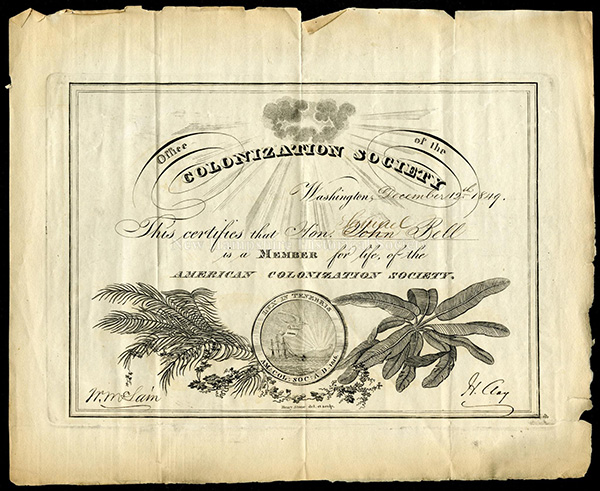
Nine of the first 11 American presidents, by the way, beginning with George Washington, owned slaves.
Abraham Lincoln, the 16th president, is called “the great emancipator,” and most Americans think he wanted to make blacks equal to whites. They are wrong. He, too, thought slavery was a terrible injustice, but he also insisted on colonization.
The United States fought a terrible civil war because of slavery. More Americans died in that war — Americans fighting each other — than in all the other American wars combined: 750,000 deaths. While that terrible war was raging, Lincoln anticipated that it would end with emancipation. But he did not want free blacks living in the United States. He appointed a Commissioner of Emigration to find a place for free blacks to go. He looked in the Caribbean, Central and South America, but the project did not succeed.
Lincoln invited a delegation of black preachers to come to the White House to explain to them that the war was being fought because of them. He told them to go back to their congregations and persuade other blacks that they must all leave America, because white people did not want to live with them.
Blacks had been to the White House before as servants or workers, but this was the first time any had come on official business. And it was for the president of the United States to tell them they weren’t wanted and had to go. This is considered such a shameful fact in American history that it is rarely written about, and probably not one American in 200 knows this.
Many people in the North, where slavery had already been abolished, opposed ending slavery in the South unless it included remigration. They often broke up the meetings of abolitionists unless this was clear: No abolition without remigration.
Abolitionists who did not link emancipation directly to colonization were so unpopular — even in the North — that no one would rent them a hall for a meeting, much like identitarians today. And so, in 1838, 23 years before the Civil War, the Pennsylvania Anti-Slavery Society built its own building in Philadelphia so it could hold meetings. It was called “The Temple of Free Discussion.” It opened, and had been in use for only three days before several thousand people gathered at the hall and burned it down. The fire department came, but only to make sure the flames did not jump to neighboring buildings. The “Temple of Free Discussion” was completely destroyed because the people of Philadelphia loathed the idea of living with free blacks. I would guess only one in 500 Americans has ever heard of the “Temple of Free Discussion.”
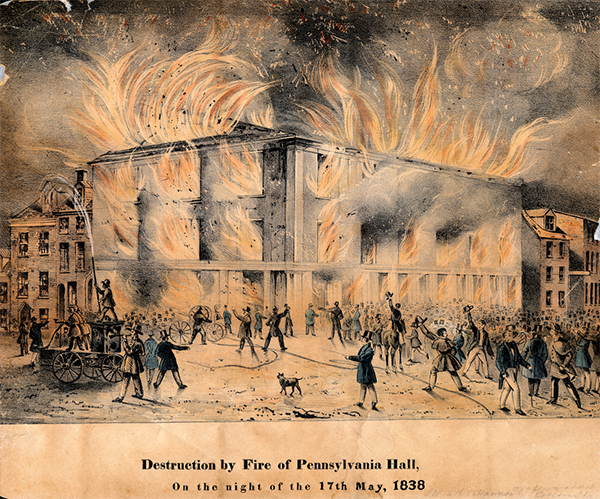
Several states that joined the United States before the Civil War hoped to avoid race problems by remaining all white. The people of the Oregon Territory, for example, voted first, not to permit slavery. Then, they voted in even greater numbers not to permit blacks in the state at all. This prohibition was written into Oregon’s constitution of 1857.
Many prominent Americans said very harsh things about blacks and also Indians.
President James Garfield, elected in 1881, wrote, “[I have] a strong feeling of repugnance when I think of the Negroes being made our political equals and I would be glad if they could be colonized, sent to heaven, or got rid of in any decent way.” Theodore Roosevelt was president from 1901 to 1909. He wrote in 1901 that he had “not been able to think out any solution to the terrible problem offered by the presence of the Negro on this continent.”
About American Indians, he wrote: “I don’t go so far as to think that the only good Indians are dead Indians, but I believe nine out of ten are, and I shouldn’t inquire too closely into the health of the tenth.”
Mark Twain, the famous humorist, called the American Indian “a good, fair, desirable subject for extermination if ever there was one.” Indians did not receive American citizenship until an act of Congress in 1924.
Harry Truman was president from 1945 to 1953. He wrote: “I am strongly of the opinion Negroes ought to be in Africa, yellow men in Asia and white men in Europe and America.”
Dwight Eisenhower, president from 1953 to 1961, said that it might be necessary to grant blacks certain political rights, but this did not mean social equality “or that a Negro could court my daughter.” It is only with John Kennedy that we finally have a president whose ideas about race begin to be acceptable by today’s standards.
As many of you probably know, until 1965, the United States had an immigration policy designed to keep the country white, and at that time it was about 90 percent white. The Hart-Celler Act that ended this policy was passed by Congress only because of promises that only a few non-whites would ever come and the racial mix of the country would not change.
Until about the 1950s, therefore, this is what most white Americans believed:
People of different races differed substantially in intelligence, temperament, and ability, and that was why different races built different kinds of societies. Americans wanted only whites to live in America, because only whites could maintain the civilization that Americans valued. Immigration of non-whites was considered a mortal threat to that civilization. It was common to argue that if non-whites could not be removed from the country, they should be separated socially and politically. Whites were strongly opposed to marriage with non-whites.
What whites are now supposed to think is the complete opposite. I can think of very few cases in human history in which fundamental values have been so completely turned upside down in so short a period. This is like the Islamic Revolution in Iran or the collapse of Communism in the Soviet Union.
Now, whites are supposed to believe that the races are absolutely equal in every way. Race must never be a reason for making any choice. Whites have no legitimate group interests, so they must never organize as whites. It is immoral for whites to want to remain majorities in their homelands.
Racial diversity is inherently wonderful, so whites should welcome people from everywhere into their countries, neighborhoods, institutions, and schools — even if this reduces whites to a minority. We are not yet at the point where whites are actively criticized for marrying other whites, but dating and marrying non-whites is thought to be marvelously progressive. You see this promoted in advertising images all the time.
The idea that all races are equal in every way is practically the 11th Commandment of American society. But, of course, this is obviously not true.
On average, whites are more intelligent than Hispanics and Hispanics are more intelligent than blacks. In the United States, where blacks are 14 percent of the population, they are only 1 percent of the people with an IQ of 130 or greater and just over half a percent of those with IQs of 140 or greater.
So, what happens when they fail to perform at the same level as whites? Because all races are officially equal, the only permitted explanation of black or Hispanic failure is oppression by wicked white people. Astonishingly, almost no white people publicly dispute this. They submit to humiliation and blatant discrimination because they dare not contest the idea that it is their fault if others do not succeed.
You would think self-blame of this magnitude — and all the psychological burdens that come with it — would be inconceivable, but that is the rule in America today.
The subject of race differences is forbidden in Europe just as it is in the US. But in a multiracial society, it is madness to pretend that every group is the same.
And, while we ignore the reality of race, the current population projections in the United States are that whites will become a minority by 2045, just 19 years from now. Already, every white child in the United States under the age of 18 is a minority. By 2060, Hispanics are projected to be the outright majority and whites will be only 30 percent of the population.
The majority is supposed to believe that losing numbers, losing influence, losing control over its own destiny, and perhaps even disappearing is a wonderful thing. Such a thing has never happened before in human history.
America is slowly ceasing to exist. It is an unspeakably grievous thing for me to watch my country delude itself into self-destruction. The lessons in all of this should have been clear to Europeans in the 1960s, but we deceived ourselves and we deceived you.
In my view, the white man hit rock bottom on May 25, 2020. Do any of you know what happened on that day? George Floyd ascended into Heaven. Three hundred cities declared curfews. Thirty states called out the National Guard. But since then, there has been a remarkable recovery not just in the United States but around the world.
So far, I have been speaking to you as an American, and it would be difficult to be more American than I. The first Taylor came to the English colonies in 1635. We have voted in every election, we have fought in every war. At the time of the Civil War, my male ancestors of military age fought for the Confederate States. My country is stuffed with our bones, drenched in our blood.
And yet, my culture is European, my heritage, my language, the faith of my fathers, everything that makes me an American has roots deep in Europe. And just as my heritage is the same as yours, so are my future and my destiny. Our fates are linked and inseparable. And so, with your permission, I would like to claim the honor of calling myself a European.
I believe wherever you find our people — in Canada, Australia, New Zealand, the southern tip of Africa — you find what I call the world brotherhood of Europeans. And everywhere, our people are waking up to the terrible crisis we face.
To us in this room, this is obvious. Our ancestors did not build Europe so that our generation would give it away to strangers. Strangers who are not us, who cannot be us, don’t want to be us, and who often hate us. Europe must be for Europeans. We find it almost impossible to understand any white person who does not understand this instinctively.
I came to Europe for the first time in 1960 when I was nine years old. Everyone was European. Or an American tourist. Now, there are whole neighborhoods of complete strangers. You walk through the great cities your ancestors built and you don’t have to know anything about their religion, their mentality, their crime rates, their poverty rates. You can tell at a glance that they are not European. They can never be European. And, in large enough numbers, they will devour you.
Muslims, in particular, are sworn enemies. For a thousand years, from the invasion of Spain by the Moors in 711 to the siege of Vienna in 1683, Islam was a mortal threat to Europe. But now, we are supposed to let Muslims pour into our countries and think they will look after us in our old age? Who can believe this madness?
Do even our rulers truly believe that Somalis and Congolese belong here? Can even the most committed leftists explain to us what possible benefits they bring?
Fortunately, millions of Europeans now understand that it was a terrible mistake to be like America, to open the continent to immigration. Millions are determined to reclaim their homelands and to build societies in which children learn that it is not just OK to be white. They must learn that there is no greater blessing than to be sons and daughters of Europe, to be the living, breathing heirs to a magnificent heritage, from the moment they are born — to be full participants in this fabulous adventure we call Western Civilization. Others are just spectators. Imitators. This is why remigration is the only solution.
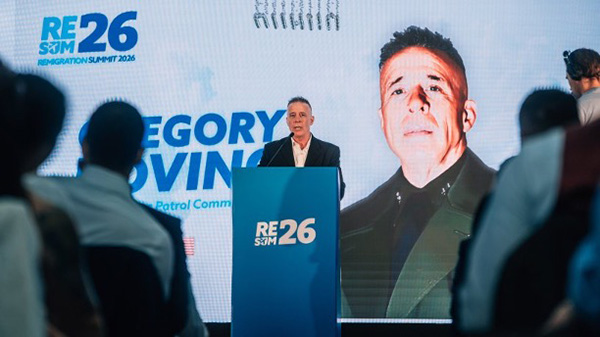
Yes, we are in a fight for our lives, just like our ancestors at Thermopylae, at the Battle of Tours and the Siege of Vienna, like the Afrikaners at the Battle of Blood River. But our fight is different. Our ancestors had a simple goal. Kill the enemy or die trying. I wish it were that simple for us. I believe every man in this room would give his life to ensure the survival of our people. All of us have the blood of heroes in our veins.
But our fight is much harder, because among the opponents arrayed against us are so many of our own brothers and sisters. Fellow Europeans. This is the great tragedy of our struggle and that makes it different from any other struggle in history. We have the appalling task of having to explain to our own people that it is moral for us — for them — to survive. No one else has ever had such a terrible task. Our opponents are therefore not our sworn enemies. Often, they are members of our own households.
I believe that within almost every one of our people there is still a glow, a tiny spark of European identity. That spark has been smothered by years of propaganda and insanity, but our job is to find that spark, blow on it gently, lovingly, and turn it into a raging fire.
I believe this is the greatest struggle of all of human history. On us rides the fate of our people, the fate of the West, the fate of everything our ancestors fought for, the fate of everything we love.
I would give anything to be 40 years younger, to have 40 more years to live in the service of our people. I may not live to see the future of Europe assured and fortified against all threats, but YOU who are young, you WILL.
And in my grave, I will smile when I hear your children laughing.
The post Jared Taylor’s Banned Paris Speech appeared first on American Renaissance.
American RenaissanceRead More








 T1
T1