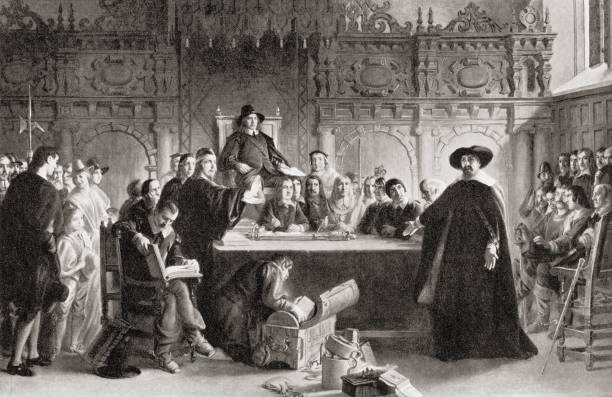
Cromwell nowadays enjoys a somewhat mixed reputation amongst the Anglo right, and is seen as the scum of the earth by much of the European or American right. The monarchy nowadays is treasonous to the point of parody, and Cromwell had King Charles I’s head chopped off, so for that reason, and that reason alone (for there are almost no Puritans or anything of the sort amongst the modern British right) Cromwell has gained some appreciation and become a fixture of British right wing propaganda edits.
More important to most, though, is the matter of the Jews. The more anti-Semitic elements of the right point out that Cromwell was the one who allowed the Jews back in, and therefore he is beneath contempt and to blame for all of our modern troubles. Cromwell’s defenders can almost always be found in the reply section stating that Cromwell did not actually allow the Jews back in, but rather ignored their petition to be readmitted, almost always citing this article from The Guardian1. Neither side ever makes any headway in convincing the other, despite the matter actually being very well documented. So what actually happened?
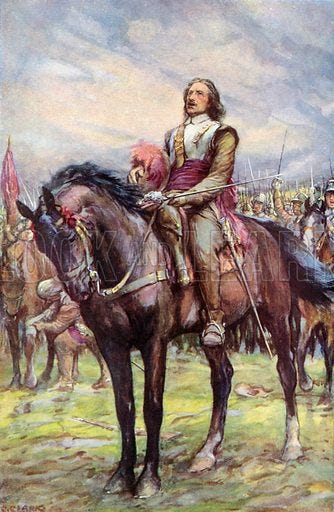
This will be a very concise account, X reply section sized, so its actually readable. I did just cover this matter in far more depth, in video format, in my series for paid subscribers on the Jews in Britain, so if that does interest you, please do check it out.
It is well known that King Edward I expelled the Jews in 1290, but less well known that a trading colony of ‘New Christians’, Jewish converts to Catholicism from Iberia, was established in London in the mid-16th century. A surprising amount of New Christians, despite being essentially forced to convert, were actually sincere, but obviously a large number amongst them were not, and it was proven beyond doubt by the inquisition of Milan that many of these ‘New Christians’ in England were practicing Judaism in secret. The group supposedly proved their innocence to the English authorities, but they dispersed shortly afterwards. Later, during the reign of Queen Elizabeth I, the community thrived once more. In 1609, during the reign of King James, however, the community descended into infighting, and one faction accused the other of living as Jews. The authorities responded by expelling the entire community.
In the 1630s, merchants of Converso2 origin began settling in London once more and for the next few decades they kept relatively quiet, even though ‘it was widely known in Whitehall and the City that some were crypto-Jews.’3 Most Englishmen were willing to tolerate this tiny minority, after all, they were far too busy with everything else going on during those turbulent decades.
The rise of the Puritans was a great opportunity for the Jews. Most were philosemitic to some degree, a small minority surpassed the slavish philosemitism of even the most stereotypical of modern Republican politicians. Jews had recognised this and made several petitions to be reinstated, using the religious angle for the Puritans, and an economic angle for others, but these early attempts came to little.
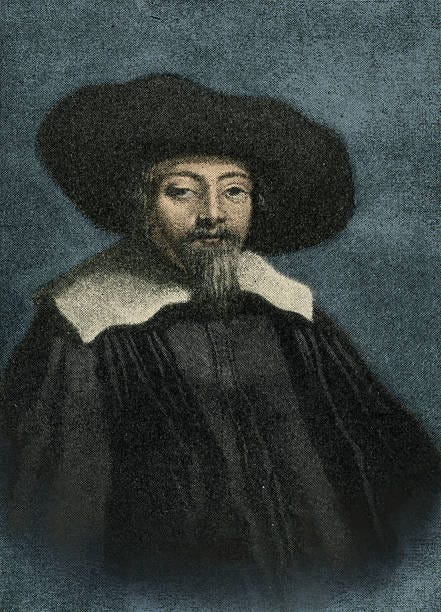
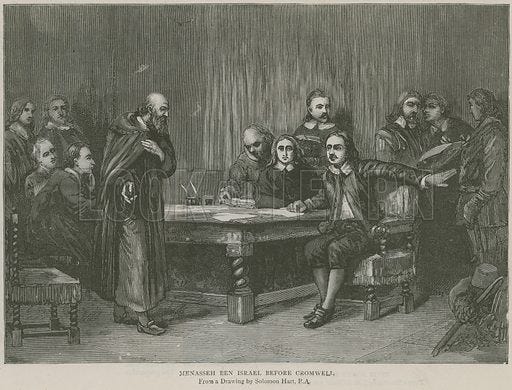
Menasseh ben Israel, a Rabbi in Amsterdam, heard of these attempts and made his own. He had a book laying out his case for reinstatement published in English in 1650, but the Anglo-Dutch war of 1652-54 delayed his efforts. These efforts began anew in late 1654, and it soon became clear that Cromwell himself was sympathetic for both economic and religious reasons, although not fanatically so compared to others.
Cecil Roth put the matter entirely down to economics, writing that from one point of view the readmission question was ‘simply an episode in the Anglo-Dutch and Anglo-Spanish rivalry’, adding that Cromwell’s ‘personal interest in the question of the readmission of the Jews is certain.’4 Endelman did not agree with the claim of the matter being purely an economic one, but agreed that ‘there is no question that Cromwell favoured readmission.’5
Menssah, overjoyed at Cromwell’s sympathy, came to negotiate in person in September 1655, armed with a pamphlet known as The Humble Addresses, which set out the usual economic and religious arguments, and attempted to debunk the common arguments against Jewish readmission, such as usury, the sacrifice of Christian children, and the attempted conversions of Christians.
A majority of the Council of State was sympathetic, but public opinion was overwhelmingly against it. The matter was put before those summoned for the Whitehall Conference, a gathering of influential religious leaders, lawyers and merchants. Puritan radicals were essentially the only ones in favour of readmission here. More orthodox clergymen expressed strong objections, as did the merchants of the City of London. To make a long story short, the conference came out strongly against readmission, so Cromwell simply dissolved it, stating that the Council of State would handle the matter instead.
This time around, Cromwell did not act. His own feelings are beyond doubt, but public opinion was so against the Jews that he found it impossible to readmit them, and so the matter was allowed to drift.
Soon, however, an opportunity arose. War broke out with Spain in October 1655 and therefore, as Spanish subjects, the goods of the conversos could be legally seized. In order to prevent this, the leading members of the colony submitted a petition to Cromwell. They wanted to be seen as Jewish refugees, they said, not Spaniards, and they requested permission to gather privately for Jewish worship. A Jewish burial ground was also requested.
Cromwell took the matter to the Council of State, but did not get his way. The Jews came before the Council of State and inundated them with stories of the harsh treatment of Jews under the inquisition, well-concocted to pull on Anglo-Protestant heartstrings, but it did no good. The Council merely ordered that the ‘Jews’ were to keep their goods, but their status was to remain the same. In a roundabout way, though, the Jews, as Jews, had now been legally accepted as refugees.
Here is where history gets murky, and why some have felt they are able to claim Cromwell did not readmit the Jews. They are right that he did not do so openly, but a few months after their petition, an open Jewish community suddenly came into existence. The Jews got their Synagogue and their burial ground, as requested, and suddenly more Jews, not ‘Conversos’, were moving to England from the Netherlands and elsewhere6.
Put simply, it is clear that Cromwell came to the Jews in private, granted their wishes, and gave them assurances that they would be protected. As Roth put it:
‘Cromwell had determined to follow an oblique policy: to ‘connive’ at the settlement of the Jews without formally authorizing it. It appears, however, that he must have intimated informally to the leading members of the London community that there was no objection to their acting as though their petition of March 24th had been granted.’7
In short, then, it is beyond doubt that Cromwell did readmit the Jews, just not ‘officially’. The edict of expulsion was not then voided, nor was it ever voided (although some would interpret the edict as only applying to the time of its creation), but still, the Jews had been let in, and the opponents of readmission had had the ground cut from under them, for there was nothing ‘official’ to oppose.
It goes without saying that the readmission of the Jews was but a footnote in Oliver Cromwell’s eventful life, and therefore he shouldn’t be judged solely on this matter. It is also worth pointing out that when the matter came up again after the Restoration, Charles II was even more brazen in his defence of the Jews. He took hefty bribes to decide in their favour when some of the most influential men in England demanded that he act in accordance with the Edict of Expulsion (as they saw it) and expel the Jews.
This article has covered the how of Jewish readmission, but not the why, for it was a complex matter. Again, if that interests you, this topic is covered at length in my video on the matter for subscribers.
A textbook example of how these conversations almost always go, from my friend Jclear:
Converted Iberian Jews
Todd M. Endelman, The Jews of Britain: 1656 to 2000, p18
Cecil Roth, History of the Jews of England, p158
Endelman, The Jews of Britain: 1656 to 2000, p24
It should be noted that their numbers were minimal, no more than a few hundred. Jews only began coming en masse in the 18th century.
Roth, History of the Jews of England, p166
Zoomer HistorianRead More








 T1
T1