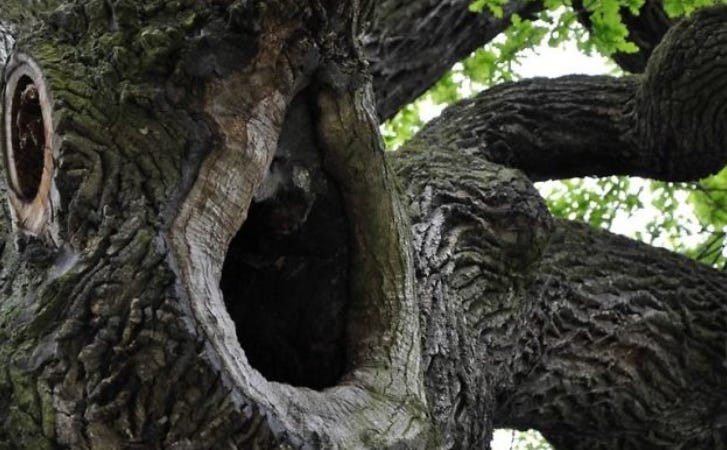
Our next piece of ‘Remarkable Holocaust Nonsense’ is the claim made by jews as well as apparently by so-called ‘historians’ that two jewish brothers surnamed ‘Himi’ or ‘Hymi’ escaped the Frysztak ghetto or the Frysztak labour camp – they were two different things operating side by side but the labour camp was primarily composed of jews deported there from Warsaw – in southern Poland with Mordechai Sones writing for ‘Arutz Sheva’ how:
‘With the outbreak of World War II, two Jewish brothers with the family name “Himi” decided to find a hiding place in the large tree trunk.
Historians who investigated the story claim that the Himi brothers escaped from the nearby “Pristeck” ghetto and found refuge from the Nazis in the large tree trunk, after a Polish citizen who lived nearby showed them the tree and its hiding place.
Since the end of the Second World War, the tree has become a famous tourist attraction and many tourists have come to Vishniova be photographed nearby. An illustration of the tree appeared on bills of 100 Polish zloty.’ (1)
With the ‘Times of Israel’ providing precious little additional information when they write how:
‘A 650-year-old oak in Poland that local legend holds served as a shelter for two Jewish brothers hiding from the Nazis during WWII was recently voted Europe’s most popular tree.
The Oak Józef, located in the south-eastern village of Wiśniowa, has been a symbol of pride in Poland for generations. The 30-meter high oak is a popular destination for visitors, and is often portrayed in paintings and photographs. The natural monument was even depicted on Poland’s 100 zloty bill in the early 20th century.
According to local residents and historians, the massive tree also served as a shelter for two Polish Jewish brothers hiding from the Nazis during WWII.
Locals say the Hymi brothers hid in the oak’s hollow trunk after escaping the Frysztak ghetto or a forced labor camp in the area.
“The hollow in which they hid was huge. People say it had two levels, the lower was used as a hideout and the upper – as a lookout,” said Jakub Pawłowski of the Ulma Family Museum in Markowa. “Both brothers survived the occupation but their fate after the war is unknown.”’ (2)
The problem with this narrative is the obvious one in so far as it is extremely implausible that two jews hid in the trunk of an oak tree for nigh on five years if you believe Sones’ claim that the Himi/Hymi brothers hid in the tree soon after the outbreak of the Second World War in 1939 or at least two years if you use a chronology based on the Frysztak ghetto or the Frysztak labour camp, which were liquidated by the German authorities in 1942/1943.
This means that the basic claim here is that the Himi/Hymi brothers hid in the oak tree for years on end without detection and apparently without water, food or any sanitation. Even if we look at this claim based on the sanitation problem alone the stench emanating from the tree would have been incredible and would have drawn attention from local Poles (some of whom would have told the Germans) as well as the Germans themselves.
The problem of how the Himi/Hymi brothers survived in terms of food and water also presents itself especially as the tree opening, they allegedly squeezed through and lived in was not exactly big nor the tree wide as we can see below: (3)
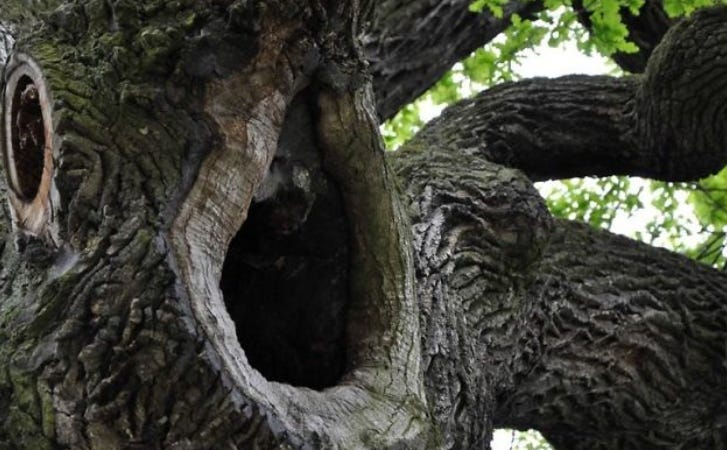
Despite the claim from Jakub Pawlowski that:
‘The hollow in which they hid was huge. People say it had two levels, the lower was used as a hideout and the upper – as a lookout.’ (4)
I simply cannot see how what Pawlowski is claiming could be true since the oak’s trunk isn’t that wide nor is the opening easy to access from inside or outside as far as I can see. So, while I could see someone using it as a hiding place for several days at most (reference how King Charles I of England allegedly hid in an oak tree for several days during the English Civil War); I cannot see how someone – let alone two people without independent food and water supplies – could live in it for years on end as is claimed to have been the case.
The truth, however, is not hard to discern in how unsure the so-called ‘historians’ are about the details of the Himi/Hymi story in that they don’t know if they came from the Frysztak ghetto or the Frysztak labour camp nor do they seem to know any basic details about the Himi/Hymi brothers other than their surname.
The truth is hinted at by the ‘Times of Israel’ when they write as follows:
‘POLIN, the Museum of the History of Polish Jews, said details about the Hymi brothers were sparse, but hoped the competition would shed light on their incredible survival.’ (5)
Translated from academic gobbledygook: there is no evidence other than local hearsay that the Hymi/Himi brothers even existed let alone that they hid in the tree at all let alone for years on end.
In other words: it is all yet another piece of ‘Remarkable Holocaust Nonsense’!
References
(1) https://www.israelnationalnews.com/news/227419
(2) https://www.timesofisrael.com/tree-believed-to-have-hidden-jews-during-holocaust-voted-europes-best/
(3) Idem.
(4) Idem.
(5) Idem.
Karl’s SubstackRead More








 T1
T1