Anzac Day is not about “service”, “mateship”, or “sacrifice,”. It is not about some abstract set of values. It is about the people who served and the people who sacrificed.
Ben Roberts-Smith is not a hero because his service enabled AusAID to teach Afghani women how to read 50 Shades of Grey, nor is Kevin Wheatley a hero because his sacrifice may have had geopolitical implications for South Vietnam.
They are heroes because of their willingness to prioritise their country over their own comfort, and when the Afghan National Army were negotiating a betrayal, or the Vietnamese Civil Defence soldiers had fled, both men placed the lives of the Australians beside them above their own.
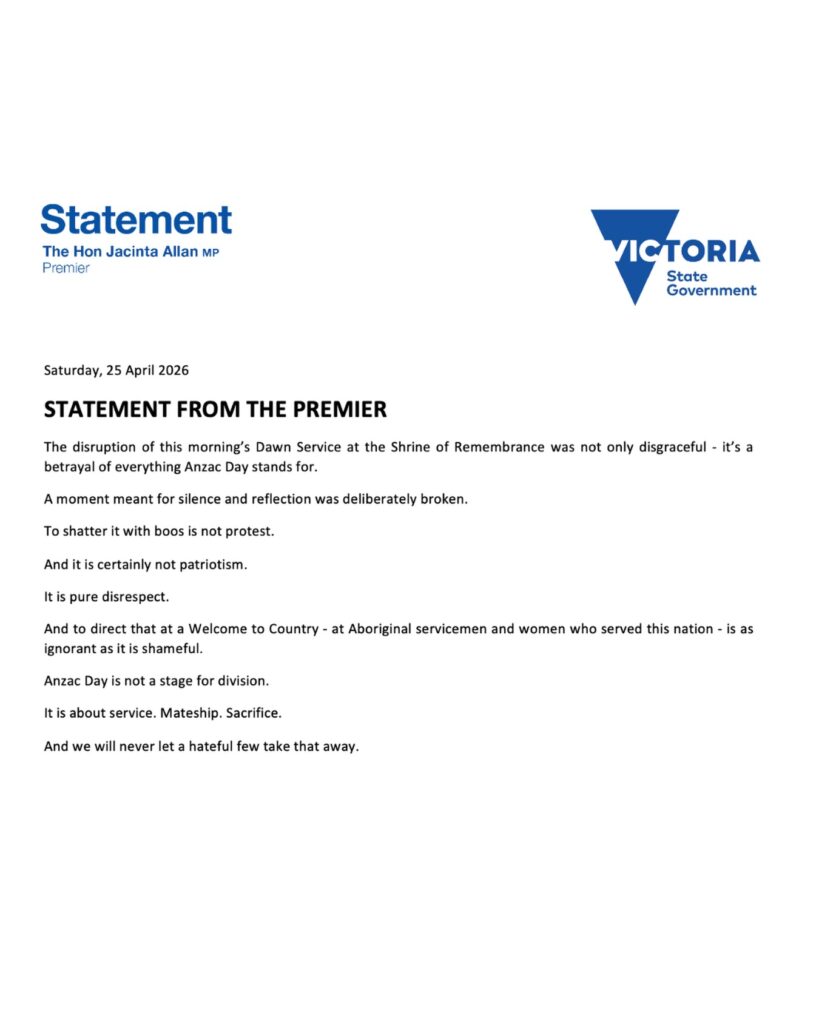
Jacinta Allan is a civilian. Her parents were too, and so are her children, Anzac Day is not about her. She does not get to define Anzac Day, and her attempt to do so is the exact kind of “bastardry” she decries.
Organisations like the RSL also embarrass themselves when they claim that people who heckle “welcome to country” rituals “do not belong” at Anzac Day, while allowing foreigners who never served Australia to march at their events.
RSL president Peter Tinley may wish to consider what foreign military service or waving Turkish flags has to do with Anzac Day, now his day to “reflect on what it is to be Australian” has finished.
The acting Chief of Army Richard Vagg echoed these platitudes when he said he doesn’t want the day to become “nationalistic” and instead wants it to be “a day of national pride.”
If national pride is part of Anzac Day, then the nation must be proud of those who served. If national identity is too, then the identity of those who fought at Gallipoli must play a defining role.
Does a nation show its pride in those who served by lecturing them about who they ought to respect? Should a nation be proud that its war memorials pay someone who never served $600 to do so?
The Australian Defence Force has always been overwhelmingly Anglo-Celtic, but despite claims to the contrary, aboriginal Australians have never been denied recognition for their service either.
To the credit of Ray Minniecon, who was heckled at the Sydney Dawn Service, he served for two years in the Army Reserve. However, if Sydney is the land of the “Eora people,” why was the “welcome to country” delivered by a veteran from Queensland incorrectly wearing his medals?
The majority of Australians do not want “welcome to country” ceremonies on Anzac Day, and if any significant number of aboriginal veterans felt differently, a less embarrassing option than him would have been found.
As a veteran, I would therefore like to pay my respects to Jacob Hersant, and the rest of the present and emerging patriotic Australians, who are standing up to the attempts at subverting the meaning of Anzac Day.
They have more of a right to attend a dawn service than the civilians who seek to co-opt it, and the various organisations that prioritise profits over veterans.
The post A veteran’s reflections on Anzac Day booing first appeared on The Noticer.
The NoticerRead More








 T1
T1