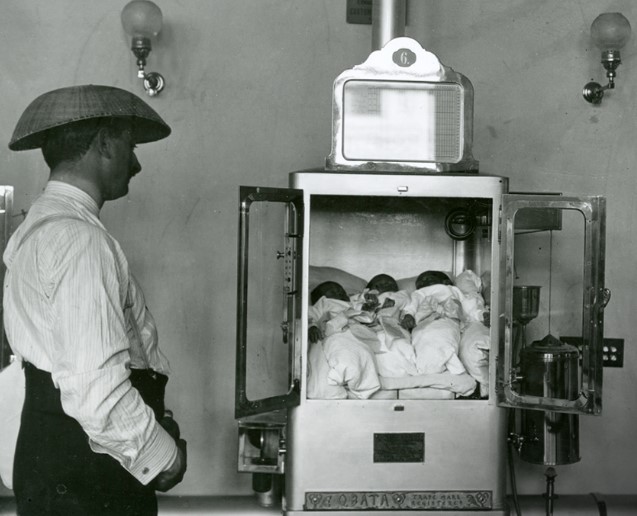
Another one of the ‘jewish invention’ claims made by Marnie Winston-Macauley at ‘Aish’ is that jews were responsible for inventing the incubator. She names the particular jew concerned as one Julius Hess. (1)
Now Julius Hess was a doctor in the United States who is credited with creating an incubator for infants in 1914. The problem with Winston-Macauley’s claim is evident very quickly when you but do a tiny bit of research into Julius Hess’ 1914 incubator.
Since the page on the Julius Hess Papers at the University of Chicago Library is rather specific about what it has to say about Hess’ 1914 incubator.
To wit:
‘Hess was an American pioneer in the care of premature babies. His book on Premature and Congenitally Diseased Infants (1922) was the first of its kind published in the United States. In 1914 he designed a heated bed for infants, influenced by European incubator models, which used an electric-heated water jacket to maintain temperature. He followed this with a transport incubator or “infant ambulance” in 1922, and by 1934 he had expanded upon the design to allow for the provision of oxygen.’ (2)
The key phrase here is:
‘Influenced by European incubator models’.
Put simply Hess never claimed to have invented incubators but rather simply adapted his own design from existing European incubator designs that – as it turns out – had come about over thirty years earlier in France in the wake of the Franco-Prussian War of 1871.
As Columbia University’s Surgery Department explains on their website:
‘It took a war, famine, and poultry to develop the technological breakthrough responsible for saving thousands of premature infants. The Franco-Prussian war in 1870-1871, along with a concomitant famine, had contributed to a significant population decline in France. To increase the growth rate, the French needed to start having more babies, as quickly as possible. But one obstetrician realized that if he could find a way to reduce infant mortality, then the population growth rate problem could be solved far sooner.
That French obstetrician was Dr. Étienne Stéphane Tarnier, who, having observed the benefits of warming chambers for poultry at the Paris Zoo, had similar chambers constructed for premature infants under his care. These warm air incubators, introduced at L’Hôpital Paris Maternité in 1880, were the first of their kind. Dr. Pierre Budin began publishing reports of the successes of these incubators in 1888. His incubators had solved the deadly problem of thermoregulation that many premature babies faced.
Dr. Budin wanted to share his innovation with the world, but few in the stubborn medical establishment would listen. Many doctors viewed the practice as pseudo-scientific and outside the realm of standard care. But Dr. Budin was convinced that the Tarnier incubators would save so many lives that he enlisted the help of an associate, Dr. Martin Couney, in exhibiting the new incubators at the World Exposition in Berlin in 1896.
Apparently blessed with skills in showmanship as well as medicine, Dr. Couney took the assignment perhaps a step farther than what Dr. Budin has originally anticipated; Couney asked the Berlin Charity Hospital to borrow some premature babies for this experiment, and they granted his request, thinking that the children had little chance of survival anyway. When he managed to hire a cadre of nurses to fully demonstrate the capabilities of the incubators, he was ready to take the show on the road.
Nestled between exhibits of the Congo Village and the Tyrolean Yodelers, “Couney’s Kinderbrutanstalt,” or ‘Child Hatchery,’ became a wild success. Remarkably, all six babies in the Tarnier incubators survived. From there, Couney took his entourage to the United States where he went on to share his show at virtually every large exhibition and at the World’s Fair.
He ultimately settled at New York City’s Coney Island amusement park and connected parents eager to save the lives of their premature newborns with circus sideshow visitors willing to pay 25¢ to view the uncannily tiny babies. It was an odd connection indeed, but a brilliant one that kept the warming glow of the incubator lights on for over 40 years, and saved thousands of babies in the process.’ (3)
Put simply the French doctor Etienne Tarnier invented the first incubator in 1880, which was then further refined and popularised by his fellow French doctor Pierre Budin from 1888 then popularized by their fellow countryman – and also a doctor – Martin Couney in both Germany and the United States from 1896 on.
So, in other words Winston-Macauley’s claim that the incubator was invented by the jew Julius Hess in 1914 is not only completely wrong and the fact that Hess – to my knowledge – never claimed to have invented the incubator at all and only his own version of it informs us that Winston-Macauley is actively lying and engaging what Adolf Hitler beautifully explained as the ‘Big Lie’.
References
(1) https://aish.com/91795029/
(2) https://www.lib.uchicago.edu/e/scrc/findingaids/view.php?eadid=ICU.SPCL.CRMS51&q=Hess,%20Julius%20Hays,%201876-1955
(3) https://columbiasurgery.org/news/2015/08/06/history-medicine-incubator-babies-coney-island
Karl’s SubstackRead More






 T1
T1