Elie Wiesel – the author of the famous novel-presented-as-autobiography ‘Night’ that has been massively revised from its violently anti-gentile first edition – (1) probably more than any other is the jew who exemplifies and was/is the symbolic head of the ‘Holocaust’ industry with his only real rival being Simon Wiesenthal. (2)
The true Wiesel – who was late in life to become embroiled in controversy as a serial sex pest – (3) is far less palatable than the popular public relations image of the man; since – for example – in the original Yiddish first edition of ‘Night’ – originally titled ‘Un di velt hot geshvign’ by-the-way – Wiesel and his fellow jewish concentration camp survivors immediately upon ‘liberation’ run off ‘to rape German shikses’ (basically ‘to rape blonde German women who are by virtue of their birth whores’ to sense translate the comment) while the amended French first edition of ‘Night’ dishonestly translates this as ‘to sleep with young girls’. (4)
Jews going around raping German women – as the Soviet soldiery did so famously in Germany but far less famously also to Hungarian women in Hungary – is not exactly the image that jews want to project, but never-the-less that is exactly what Wiesel states that he and his fellow ‘Holocaust survivors’ did.
Coming to the particular ‘Remarkable Holocaust Nonsense’ peddled by Wiesel; this is found in his best-selling 1966 non-fiction book ‘The Jews of Silence’ that went through multiple editions and whose third edition from 1987 I have previously discussed in detail. (5)
In many ways Wiesel’s ‘The Jews of Silence’ was the founding document of the ‘Refusenik’ and ‘Save Soviet Jewry’ movement in the West, which in turn spawned such odious creatures as Natan Sharansky – who became an Israeli Minister with various different briefs from 1996 to 2005 – who were subject to hagiographic treatment in the 1970s to the 1990s. (6)
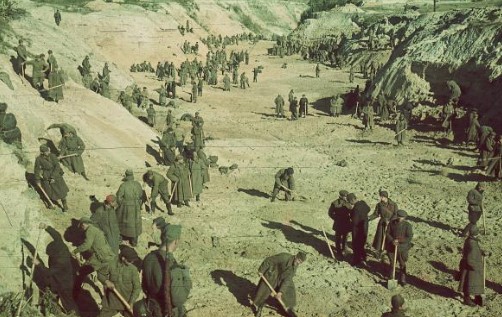
Aside from everything else in Wiesel’s ‘The Jews of Silence’ there is a famous piece of ‘Remarkable Holocaust Nonsense’ buried within it concerning the infamous ‘Holocaust by Bullets’ mass execution at Babi Yar in the Ukraine.
Wiesel writes as follows:
‘How many Jews were killed at Babi Yar? Exact estimates are hard to come by. Some say seventy thousand, others a hundred and fifty thousand. Unlike those in Auschwitz, the Germans and their local collaborators here did not bother with statistics… perhaps because Ukrainians have no head for figures.
Eyewitnesses say that for months after the killings the ground continued to spurt geysers of blood. One was always treading on corpses.’ (7)
Clearly this is utter nonsense and while the German executions at Babi Yar were quite real – albeit massively overstated and misinterpreted – (8) the idea that the Germans and the Ukrainian locals were witnessing ‘geysers of blood’ erupt from the ground at the execution and burial site for ‘months afterwards’ and that they were routinely ‘treading on corpses’ is quite frankly (and obviously) ludicrous and contrary to both logic and common sense.
We can once again see here that not only were stories like Wiesel’s widely believed as true (this claim is still extant in the third edition in 1987 long after revisionist historians like Robert Faurisson had pointed out how ridiculous and stupid it was), but they were treated as ‘evidence’ for the reality of the ‘Holocaust’.
This is what I mean when I talk of there being two ‘Holocausts’: the ‘Holocaust’ of the 1940s to the 1960s/70s – which is the original ‘Holocaust’ – with all the absurd and/or physically impossible stories and the heavily sanitized ‘Holocaust’ narrative of the 1980s to present that edits out a lot of the material claimed as true by the original ‘Holocaust’ in favour of a streamlined more believable narrative focused on the ‘gas chambers’ rather than Isle Koch making kitsch lampshades out of Wiesel’s extended family.
Wiesel’s ‘geysers of blood at Babi Yar’ claim from 1966 is very much from the first ‘Holocaust’ but is a rare survival from it that survived as a truism into the late 1980s and early 1990s – the height of Wiesel’s fame – whereupon it was quietly dropped by the ‘Holocaust’ industry.
It isn’t hard to work out why!
References
(1) See Naomi Seidman, 1996, ‘Elie Wiesel and the Scandal of Jewish Rage’, Jewish Social Studies, Vol. 3, No. 1, pp. 1-19. This is available at the following address: http://www.vho.org/aaargh/fran/tiroirs/tiroirEW/WieselMauriac.html
(2) For a thorough discussion of the myth and reality of Elie Wiesel as his centrality to what has become the ‘Holocaust’ Industry see: Germar Rudolf (Ed.), 2021, ‘Elie Wiesel, Saint of the Holocaust: A Critical Biography’, 3rd Edition, Castle Hill: Uckfield, while on Wiesenthal see Gerd Honsik, 1993, ‘Schelm und Scheusal: Meineid, Macht und Mord auf Wizenthals Wegen’, 1st Edition, Bright Rainbow: Madrid
(3) Please see my article: https://karlradl14.substack.com/p/elie-wiesel-a-sex-criminal
(4) https://killingthebuddha.com/mag/exegesis/revising-night-elie-wiesel-and-the-hazards-of-holocaust-theology/
(5) Please see my article: https://karlradl14.substack.com/p/elies-awesome-adventure
(6) For example, see: Martin Gilbert, 1986, ‘Shcharansky: Hero of Our Time’, 1st Edition, MacMillan: Basingstoke
(7) Elie Wiesel, 1966, ‘The Jews of Silence: A Personal Report on Soviet Jewry’, 1st Edition, Holt, Rinehart & Winston: New York, p. 35
(8) On the myth and reality of the Einsatzgruppen executions at Babi Yar see: Herbert Tiedemann, 1994, ‘Babi Yar: Critical Questions and Comments’ in Germar Rudolf (Ed.), 2003, ‘Dissecting the Holocaust: The Growing Critique of ‘Truth’ and ‘Memory’’, 2nd Edition, Theses & Dissertations Press: Chicago, pp. 501-528 and Carlo Mattogno, 2018, ‘The Einsatzgruppen in the Occupied Eastern Territories: Genesis, Missions and Actions’, 1st Edition, Castle Hill: Uckfield, pp. 485-534
Karl’s SubstackRead More






 T1
T1