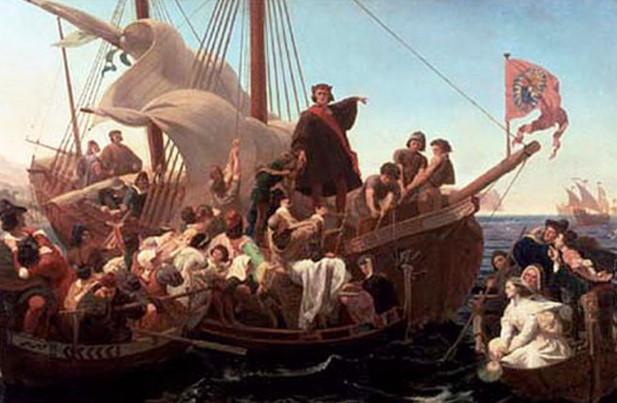
One of the traditional talking points that is often brought up to argue for Christopher Columbus’ jewishness – I have addressed and debunked both the classic historical arguments for this (1) as well as the new DNA-based claims – (2) concerns why Columbus brought jews along with him on his 1492 expeditionary voyage of the Indies.
The problem with this is that it is made in profound ignorance – deliberately or otherwise – of the point of Columbus’ voyage and the context to it. Namely the point of Columbus’ expeditionary voyage across the Atlantic in 1492 was – as often imagined – to ‘find new land’ but rather to find a shorter and less hazardous route to the East Indies (i.e. Indian and Asia in general) rather than the traditional sea route around the stormy Horn of Africa/the Cape or the even older land route along the Silk Road.
This is why we call so-called ‘Native Americans’ ‘Indians’ in the first place because Columbus originally thought they were… well… Indians (specifically from what we now call the Indian state of Kerala) and that he’d landed in the Indies not the Americas.
So how was Columbus supposed to communicate with any Indians/Asians that he might meet if he was successful?
Well, he needed translators and what were the languages that were likely to be spoken based on common European knowledge of the time?
Arabic and Hebrew.
And who were most dual Arabic and Hebrew speakers?
Jews or Marranos.
As Grisar put it in 2018:
‘For all their clout in the American imagination, the Niña, Pinta and Santa Maria don’t appear to factor much into the American Jewish tapestry. But Christopher Columbus, a devout Italian Catholic sailing at the behest of the king and queen of Spain, was certain that, when he arrived in Asia, he’d encounter descendants of the Lost Tribes of Israel. And since he anticipated a rendezvous with Arabic and Hebrew speakers, Columbus brought one along.’ (3)
While Menocal also explains that:
‘Torres [meaning Luis de Torres (born Yosef ben Ha Levy HaIvri) – K.R.] was taken along to speak the language that Columbus expected would be understood where he thought he was going: surely the lingua franca of the Indies would be Arabic, as it was in the rest of the infidel but civilized world.’ (4)
The point is that Columbus thought he was going to India/Asia where they primarily spoke Arabic and there was also a secondary possibility that we know of in that Columbus thought he might encounter the ‘Lost Tribes of Israel’ and so needed a Hebrew speaker as well should he do so in order to communicate with them. (5)
Of the other five jews who left with Columbus we know about we have Alonso de la Calle.
De la Calle’s alleged ‘jewishness’ is based solely on his surname, (6) which means ‘of the street’ in Spanish and is utterly unconvincing as evidence of jewishness as it is a particular jewish surname in the Spanish-speaking world (rather like ‘Newman’ in English and ‘Neumann’ in German; it could be but usually isn’t). The claim is derived on the unevidenced speculation that ‘de la Calle’ is itself a derivation of ‘La Calle de los Judios’ (lit. ‘the street of the jews’) when it could just as easily be a derivation of say ‘La Calle de la Virgen’ (lit. ‘the street of the virgin’) or ‘La Calle de Carniceros’ (lit. ‘the street of the butchers’).
It is just a typical nonsense claim and there is no evidence I am aware of that Alonso de la Calle was actually jewish and just ‘received wisdom’ that he was with the claim itself originating – as far as I am aware – from Meyer Kayserling’s – and remember Kayserling was himself a rabbi and a propagandist for the ‘jews did everything positive’ view of history – famous 1894 book ‘Christopher Columbus and the Participation of the Jews in the Spanish and Portuguese Discoveries’. (7)
The next is Roderigo Sanchez de Segovia, who we know was jewish because he was a relative of the converso treasurer of Aragon Gabriel Sanchez who had been one of the principal agents on behalf of Queen Isabella and King Ferdinand in collecting the money required to sponsor Columbus’ voyage (8) and who was the son of Pedro Sanchez of Saragossa who was in turn the son of Juan Sanchez; whose original name was Isaac Alazar before he converted Roman Catholicism around 1390 to 1400. (9)
Now Sanchez de Segovia was on board not because Columbus wanted him to be but rather because Queen Isabella required that he be on board (10) and this in turn is probably related to his relative Gabriel Sanchez’s political influence to involve his relative in such a potentially important expedition which in all honesty is a common occurrence in such expeditions historically and even up to the present time (for example John Hanning Speke joining [later Sir] Richard Francis Burton’s expedition to find the source of the Nile in Africa in 1854).
The next is Master Bernal one of ship’s doctors on the voyage (11) and again – like Roderigo Sanchez de Segovia – we actually have decent evidence of Bernal’s jewishness because he had been subjected to public punishment by the Inquisition in Valencia in October 1490 for being a Judaiser (12) and it is rather obvious why he would have desired to escape mainland Spain at this time given this, but also why Columbus would have taken Bernal with him: he was a doctor and doctors willing to travel on board ships on speculative expeditions were naturally in short supply.
The next is known only as ‘Marco’ (13) who – like Bernal – was also a kind of ship’s doctor – specifically a surgeon meaning barber-surgeon meaning he both cut hair and when required performed surgery – and is claimed to have been jewish by Keyserling but on absolutely no stated evidence as we are simply told ‘he was of jewish stock’ and that is it. (14)
I can find no reason whatsoever for Keyserling’s claim that Marco was ‘of jewish stock’ as those who claim such invariably cite Keyserling and he cites nothing in support of such a conclusion.
Therefore, we have to conclude unless actual evidence is provided that Marco was not ‘of jewish stock’ – which must per force be our default position – and thus the claim he was must be discarded.
The next and last jew who allegedly sailed with Columbus that we know about is Roderigo de Triana, who was the sailor who first saw land. (15) The problem is that the claim that de Triana was jewish is a myth.
As Keyserling explains:
‘According to others, it was Rodrigo de Triana, a sailor of the Pinta, who first cried “Land.”
The land was Watling’s Island or perhaps Acklin Island; the natives called it Guanahani. We are told that it was given this name by the Spanish Jews on board the Pinta, and Guanahani is even said to be formed from Hebrew words. A professor of Oriental languages in Tacubaya, who comes from Mahon on the island of Minorca and who calls Isaac Abravanel his ancestor, claims to have been led to this etymological discovery by a Spanish ballad, which, he asserts, he received from Spanish Jews in Barbary. According to this ballad, in which there is a sprinkling of Hebrew and Arabic words, as soon as Rodrigo de Triana saw land, he uttered the little Hebrew word “I, I” (“Island, Island”), to one of his Jewish comrades. The latter then asked in the same language “W’an-nah?” (“And where?”). Thereupon Triana responded “Hen-I” (“There is the island”). Thus originated the name “Uanaheni” or “Guanahani.” This childish explanation of the world is not worthy of serious consideration. Rodrigo de Triana was not a Jew, nor did he speak Hebrew, and Guanahani is known to be a word of Indian origin.’ (16)
The point here is simple enough in that despite Triana being widely claimed to be a Marrano – i.e., a jew converted to Roman Catholicism in Spain – (17) there is no evidence that he was; the alternative names given to Triana (Juan Rodriguez Bermejo and Juan Bermejo) indicate little beyond linguistic confusion as they may indeed refer to Triana or another sailor on board the Pinta. We simply don’t know although there is a lively historical controversy around the issue. (18)
The problem of course is that practically no one – even Keyserling – appears to think he was jewish and he isn’t even mentioned by Baer in his ‘History of the Jews in Christian Spain’. (19)
Thus, we have to conclude that despite claims to the contrary Triana wasn’t jewish at all since no actual evidence has been produced for it beyond rumour based on an obscure linguistic claim by a jewish academic from the island of Minorca in the nineteenth century that is based on a misunderstanding of what was reported by Christopher Columbus in his diary. (20)
So, to summarise the above we have the following six alleged jewish members of Columbus’ 1492 expedition to the America:
Luis de Torres
Alonso de la Calle
Roderigo Sanchez de Segovia
Master Bernal
Marco
Roderigo de Triana
Of these only three were in fact jewish:
Luis de Torres
Roderigo Sanchez de Segovia
Master Bernal
Of these Torres was brought along because he could speak both Arabic and Hebrew which Columbus – in line with European thought of the day – believed would likely be spoken in the Indies (India/Asia) where he was trying to find a new Atlantic route to, because Arabic was the lingua franca of the era and that Columbus also expected to potentially find the descendants of the ‘Lost Tribes of Israel’ there (hence the Hebrew requirement).
Sanchez de Segovia was brought along because Columbus was told to bring him by Queen Isabella because of the influence of his relative Gabriel Sanchez – the treasurer of Aragon – not because Columbus particularly wished to do so.
Bernal was brought along because he was a qualified doctor willing to serve as a ship’s doctor on a hazardous expedition in order to escape the Inquisition not because he was jewish although Bernal’s reason for joining Columbus was because he was jewish.
So put another way: the claim that Columbus brought along ‘six jews’ with him is factually incorrect as he actually brought along three jews with him: none of whom were selected because they were jewish. Two were selected for particular skills they had and their willingness to go on the expedition on the first place and the other one (Sanchez de Segovia) was because he wanted to go and Columbus was told by Queen Isabella to take him along.
So thus, we can see that the fact that Columbus brought along jews with him on his expedition is not evidence that he is jewish – or had any particular sympathies with jews – at all in any way, shape or form: the claim is both massively overstated and made without checking other more likely (i.e., practical) possibilities.
References
(1) On this please see my article: https://karlradl14.substack.com/p/was-christopher-columbus-jewish
(2) On this please see my article: https://karlradl14.substack.com/p/the-myth-of-columbus-jewishness-addressing
(3) https://forward.com/culture/433044/christopher-columbus-luis-de-torres-americas-first-jew/ also see https://www.heritage-history.com/index.php?c=read&author=kayserling&book=columbus&story=voyage
(4) Maria Rosa Menocal, 2002, ‘The Ornament of the World: How Muslims, Jews, and Christians Created a Culture of Tolerance in Medieval Spain’, 1st Edition, Little, Brown and Company: New York, p. 251
(5) https://aish.com/christopher-columbus-secret-jew/
(6) https://www.heritage-history.com/index.php?c=read&author=kayserling&book=columbus&story=voyage; Meyer Kayserling, 1894, ‘Christopher Columbus and the Participation of the Jews in the Spanish and Portuguese Discoveries’, 1st Edition, Longmans, Green and Company: New York, p. 90
(7) https://www.jewishencyclopedia.com/articles/1302-alonzo-de-la-calle; also, Kayserling, Op. Cit., p. 90
(8) https://www.jewishvirtuallibrary.org/s-x00e1-nchez-gabriel
(9) Yitzhak Baer, 1966, ‘A History of the Jews in Christian Spain’, Vol. II, 1st Edition, The Jewish Publication Society of America: Philadelphia, p. 93
(10) Kayserling, Op. Cit., p. 90
(11) https://www.jewishvirtuallibrary.org/the-jews-who-sailed-with-columbus
(12) Kayserling, Op. Cit., p. 90
(13) https://www.jewishvirtuallibrary.org/the-jews-who-sailed-with-columbus
(14) Kayserling, Op. Cit., p. 90
(15) https://www.jewishvirtuallibrary.org/the-jews-who-sailed-with-columbus
(16) Kayserling, Op. Cit., pp. 90-91
(17) For example, see: https://www.worldjewishcongress.org/en/about/communities/CU
(18) https://historia-hispanica.rah.es/biografias/44218-rodrigo-de-triana
(19) Cf. Baer, Op. Cit.
(20) You can read this for yourself here: https://ems.kcl.ac.uk/content/etext/e019.html#d0e393
Karl’s SubstackRead More








 T1
T1