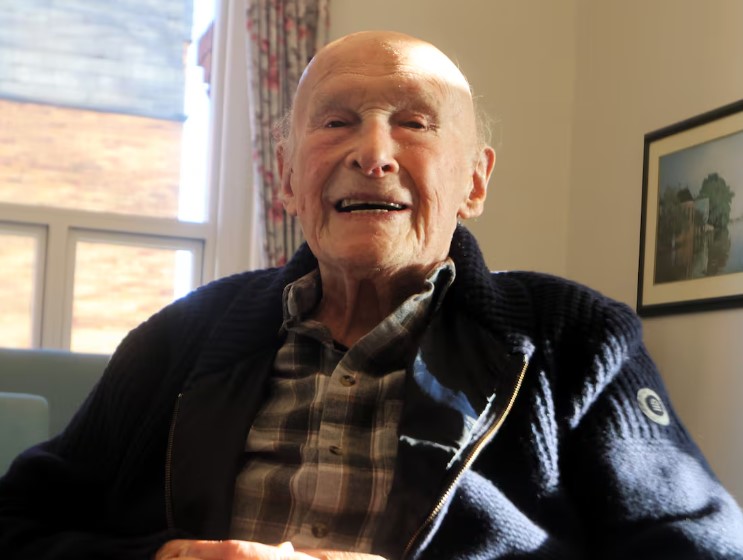
Josef Veselsky – born Josef Weiss – was (and is) probably the best known so-called ‘Holocaust Survivor’ in Ireland and when he died recently, he was subject to the usual hagiographic panegyrics in the mainstream media.
For example, ‘Irish News’ wrote that:
‘Josef Veselsky was a Holocaust survivor, an international table tennis player, a jeweller, and one of Ireland’s oldest men at the time of his death aged 107.
Born Josef Weiss in 1918 into a Jewish family in Trnava in present-day Slovakia, on the same day the Czechoslovakian republic was declared, he changed his name following the Nazi invasion of the country which saw his parents taken away on a cattle truck.
He joined the underground resistance movement and survived the war in the Carpathian mountains. He was later awarded the Order of the Slovak National Uprising.
However, he also learned that his parents, elder brother and sister-in-law were all murdered in the Auschwitz concentration camp.’ (1)
This description of Veselsky’s life is… shall we say… rather economical with the truth as the much longer and similarly hagiographic article in the ‘Irish Times’ illustrates when they explain that:
‘As war broke out in 1939, he was a young official at Bratislava Allgemeine Bank. This post offered some protection when laws penalising Jews were passed by the puppet Nazi Slovak republic, the regime set up after Germany’s invasion of Czechoslovakia.
According to a private family history, Veselsky was one of 25,000 Jews deemed “economically vital” who were granted “certificates of exemption” from wearing the Star of David. “He was deemed ‘irreplaceable’, largely due to his connections at the police headquarters, which meant he could get visas and other permits for bank staff.”
It was in the bank that he met his future wife Katarina Laszlo, who predeceased him. She was the daughter of minor aristocratic Hungarian landowners. Her father, prosperous enough to retire as a railway stationmaster aged 28, was head of the local Calvinist community.
Veselsky was present in the Bratislava Jewish centre when senior Nazi Adolf Eichmann arrived in 1942 for an inspection on the progress of deportations to the camps. Veselsky was in a loud conversation when Eichmann walked in and was abruptly told to “shut up”.’ (2)
So now we can immediately see that what ‘Irish News’ implied – that Veselsky joined ‘the resistance’ and ‘fled to the Carpathian mountains to fight the Germans’ sometime after March 1939 after the annexation of rump Czechoslovakia by the Third Reich (and Poland as it happens) – is simply nonsense and Veselsky was an openly jewish bank clerk in 1939 and was in that position in 1942 when he was told to ‘shut up’ by Adolf Eichmann himself at the Bratislava Jewish centre. This claim is purely anecdotal, but the dating does make sense given that according to Eichmann’s subordinate Dieter Wisliceny; Eichmann was indeed in Bratislava in May 1942. (3) Whether or not he actually told Veselsky to ‘shut up’ and how Veselsky knew the SS officer who told him to ‘shut up’ was Eichmann remains complete conjecture.
However, the point is simple in that Veselsky wasn’t actually victimised by the Germans (or the Slovaks for that matter) because he was jewish since we next read how:
‘In 1943 his name appeared on a list of people deemed “politically unreliable” by the Slovak justice ministry, prompting the bank to send him to Budapest to lay low while covert efforts were made to remedy the situation. “Fixing meant bribing,” Veselsky told Little.
The next year he joined the Slovak national uprising, a two-month offensive against German occupiers. The fight began in August 1944 but was suppressed in October by an enemy better armed and greater in number. He faced near certain death when captured but escaped with nine comrades.
Veselsky’s party retreated to the Carpathian Mountains for the remainder of the war. He recalled hundreds of dead comrades, sleeping in forests, digging tunnels in snow, robbing food to survive and eating fish killed by grenades thrown into lakes. “It wasn’t comfortable but everyone had only one aim by that time: to survive.”’ (4)
Put another way: Veselsky was happily working as a bank clerk in Bratislava under Slovakian rule and freely admits that he wasn’t deported at all as well as that he openly worked as a jew in Bratislava – despite being (correctly) identified as ‘politically unreliable’ (which we can see from the fact that he joined the Slovak National Uprising [led by Tito and his communist partisans; ergo Veselsky was likely a communist himself] against the Germans on 29th August 1944) in 1943 and bribing his way off that list – and then retreated for a brief period into the Carpathian mountains as a ‘partisan’ (the Slovak National Uprising ended in failure on 27th October 1944 and Slovakia was occupied by the Red Army in April 1944 meaning that Veselsky spend at most 5-6 months as a ‘partisan’) until he was ‘liberated’ by – and likely joined – the advancing Soviet forces.
This means that we can see that Veselsky never went near a German (or Slovak) concentration camp, spent nearly the whole war working as a bank clerk in Bratislava and seems to have been a jewish communist supporting Stalin and Tito from at least 1943 onwards but probably earlier.
Other bits of Veselsky’s story make just as little sense since he claimed that:
‘In a remarkable personal testimony recorded for NewsTalk radio by Éamon Little, he recalled how fellow Jews around him in Bratislava carried “shoes for work” when deported to their deaths because they were told they were going to work camps for six months. The last time he saw his parents was when they were “pushed into the cattle truck”, his mother desperately imploring him to change his religion as they were taken away forever. Soon afterwards he officially converted to Calvinism but he regarded himself as an atheist.
His father was Max Weiss, a former carpenter who once owned a hardware store. He was prisoner number 26 in the deportation to Auschwitz of April 13th 1942. His mother Berta was prisoner number 35 in the same deportation. Veselsky was in his 80s when he finally learned the detail of their fate. His parents and Hugo, a medical doctor, were killed on August 15th, 1942. Hugo’s wife Eva (née Rothova) was also killed – they had known each other only for three months and married about four weeks before they were taken away.’ (5)
The problem is that Veselsky admits the jews were told they were ‘going to work camps for six months’ in April 1942 – this is probably accurate since in April 1942 the war in the East looked like it would be over by the end of the year – and then states his parents were deported to Auschwitz and never returned with the implication being that they were ‘gassed’, but this was long before Auschwitz allegedly became a true ‘gassing centre’ – this only really occurred according to the orthodox narrative in late 1943/early 1944 – and most of the deaths at this time are known to have been related to epidemics wreaking havoc on the inmates (as well as the guards) of the camp.
While Hugo and Eva died at Auschwitz (on 15th August 1942) six days after Edith Stein (on 9th August 1942) likely from a similar cause to Stein (infectious disease; probably typhus) and like Stein is simply claimed – on no evidence in either case mind you – to have been ‘gassed’ by Veselsky.
The basis for Veselsky’s claims of ‘gassing’ – aside from the post-war ‘Holocaust’ consensus – is also made clear in the article in the ‘Irish Times’ when we read:
‘At the height of the second World War, Josef Veselsky received a note from his brother Hugo Weiss who had been deported from the former Czechoslovakia to the Nazi extermination camp at Auschwitz in German-occupied Poland.
To counter rumours of mistreatment and worse in German camps, Jewish prisoners were forced to send postcards home conveying a false message of comfort. Surrounded though he was by slaughter and starvation and facing an immediate threat of death, Hugo had no choice but to write that all was well in Auschwitz, saying he and his new wife had a very nice flat with a bathroom.
The word bathroom was underlined. Veselsky came to see that as a reference to the gas chambers that were designed to look like communal showers.
“After the war a Jewish fellow came to visit me,” he recalled decades later. “He said he saw my brother digging his own grave and he was shot then and he fell into the grave.”
Born Josef Weiss and known to all as Joe, he had changed his surname during the war when his mother urged him to adopt “something a bit more Slovak”.’ (6)
Jews did indeed send postcards from concentration camps such as Auschwitz and they were indeed censored, but the ‘bathroom’ reference is classic piece of ‘Holocaust’ confusion since the ‘gas chambers’ of Auschwitz were not built to look like bathrooms at all (they were designed and labelled as morgues) – although this is sometimes claimed about them – but actually refers to the claims about the primary Operation Reinhard camps (Belzec, Sobibor and Treblinka) as well as Majdanek not Auschwitz.
The point being that Veselsky is clearly modifying his ‘Holocaust’ story to fit what he believes is the established ‘Holocaust’ narrative, but he doesn’t realize he is contradicting it by claiming that Auschwitz had ‘gas chambers disguised as shower rooms’ rather than just ‘gas chambers’.
Further the point about reading the ‘bathroom’ reference by his brother as ‘code’ for ‘gas chamber’ is clearly nonsense given this, but the fact that he read this reference as something it is obviously not shows how ludicrous the ‘Holocaust’ narrative is and I’d also question Veselsky’s claim about what the postcard from Auschwitz said as while I can believe that such a claim might have been made for propaganda purposes it is more than reasonable to ask for evidence of such not just Veselsky’s word for it.
The evidence has – to my knowledge – naturally not been produced.
While the claim that Veselsky’s was ‘forced to dig his own grave and then shot’ so that he fell into it is possible, but is based on simply believing hearsay. It is also extremely unlikely if he was indeed at Auschwitz since the execution of inmates had to be approved by the Central Concentration Camp Administration and even minor punishments generated considerable paperwork (7) with the executions as described by Veselsky being carried at the ‘Execution Wall’ in Block 11 of Auschwitz I (8) and did not feature jews being ‘forced to dig their own grave and then being shot into it’, which is likely Veselsky once again importing the claims about German mass executions of jews in the East by the Einsatzgruppen into Auschwitz rather than him describing what actually happened in Auschwitz.
In summary then Veselsky never went near a German (or Slovak) concentration camp, spent nearly the whole war working as a bank clerk in Bratislava and seems to have been a jewish communist supporting Stalin and Tito from at least 1943 onwards but probably earlier, while after the war he made up a story about getting a ‘postcard referencing the Holocaust from his brother in Auschwitz’ and then also claimed that his brother was executed in completely the wrong way (and with no paperwork) in Auschwitz.
Put politely: Veselsky told an awful lot of fibs.
References
(1) https://www.irishnews.com/news/northern-ireland/remembering-josef-veselsky-holocaust-survivor-and-table-tennis-champion-died-in-dublin-aged-107-TY25UDLTLFBGFMVMRPUTQXRHCE/
(2) https://www.irishtimes.com/obituaries/2026/01/17/josef-veselsky-holocaust-survivor-skilled-table-tennis-player-and-irelands-oldest-man/
(3) Proceedings of the Trial of the Major War Criminals Before the International Military Tribunal, Vol. 4, p. 356
(4) https://www.irishtimes.com/obituaries/2026/01/17/josef-veselsky-holocaust-survivor-skilled-table-tennis-player-and-irelands-oldest-man/
(5) Idem.
(6) Idem.
(7) On this see Carlo Mattogno, 2016, ‘Healthcare at Auschwitz: Medical Care and Special Treatment of Registered Inmates’, 1st Edition, Castle Hill: Uckfield, pp. 28-30
(8) https://www.auschwitz.org/en/history/punishments-and-executions/block-11
Karl’s SubstackRead More






 T1
T1