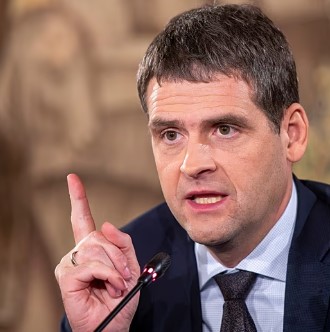
Remigijus Zemaitaitis – the leader of the Lithuanian nationalist ‘Nemunas Dawn’ party – has been a prominent critic and opponent of jewry inside Lithuanians as well as of Israeli crimes against the Palestinians and he had shown to some extent how one can be a racial nationalist for one’s people while also being supportive of the struggles of other peoples against international jewry.
Between 2023 and 2024 Zemaitaitis made a series of comments on social media attacking jews that have subsequently gotten him fined for ‘anti-Semitism’ but he has also strongly denied any wrongdoing.
Back on 9th December 2025 ‘US News & World Report’ reported that:
‘The founder of the populist Nemunas Dawn party, Remigijus Zemaitaitis, was fined 5,000 euros ($5,800) last week for a series of social media posts that a court said falsely blamed Jews for historical crimes and promoted hostility towards them.
In his posts, Zemaitaitis blamed Jews for a “Holocaust of Lithuanians” during World War Two, and quoted an old nursery rhyme with the line “take a stick, children, and kill the Jew”. He has denied his comments broke the law and promised to appeal.’ (1)
But what did Zemaitaitis actually say?
Well, the Lithuanian news website LRT happily provided his actual words rather than a summary of them.
For example, he stated that:
‘Perhaps next time Israel will drop a bomb on a Palestinian hospital with a note: we bombed out of fear that they will attack us. […] I want to give you, dear Israeli Jews, a chance to apologise to Palestine and the EU for your nasty little actions in a foreign country. And let me repeat myself: ‘After such events, no wonder there appear sayings like this: A Jew was climbing the ladder and accidentally fell off; take a stick, kids, and kill that little Jew.’ (2)
He also stated that:
‘One barbarian lives in Russia and now, it turns out, [other] barbarians are Israel. […] If the communist ambassador is so regretful and demanding of an apology, I hope this communist ambassador will publicly apologise to the Palestinian people, Palestinian children for a destroyed school that was built on my and your money, because the money came from the European Union.’ (3)
These (predictably) caused ‘outrage’ among the ‘jewish community of Lithuania’ as well as the Israelis and their myrmidons who immediately began hopping around screeching histrionically about ‘anti-Semitism’ because how dare Zemaitaitis link the ‘jewish community of Lithuania’ with Israel and rightly state that Israel has been – and is – committing war crimes against the Palestinians.
However, what really upset the jews was the following statement from Zemaitaitis:
‘Prime Minister met with Israeli President: our historical ties and friendship between our countries are what we are proud of.’ It’s nasty for Šimonytė to say such nonsense when on June 3, 1944, Lithuania’s Jews alongside the Russians killed the village of Pirčiupiai and its people. […] How much longer will our politicians be kneeling to the Jews who killed our compatriots, contributed to the surveillance, torture of Lithuanians and the destruction of our state. […] There was a holocaust of Jews, but also an even bigger holocaust of Lithuanians in Lithuania!” (4)
LRT promptly ‘qualified the facts’ by claiming that:
‘The Pirčiupiai village massacre to which Žemaitaitis is referring was in fact perpetrated by German SS men as a retaliation for an assault by Soviet partisans. Žemaitaitis later said he made a mistake and meant another event.’ (5)
Now the principal issue cited here is the Pirčiupiai massacre in Lithuania on 3rd June 1944 where Žemaitaitis claimed that ‘jews alongside the Russians’ killed the people of Pirčiupiai in Lithuania. Naturally it is claimed that it was the Germans doing but looking at the evidence a little it becomes clear that Žemaitaitis might have been correct and his critics wrong.
The ‘Universal Lithuanian Encyclopaedia’s’ entry on the village of Pirčiupiai is instructive since they state that:
‘During World War II, in September 1943, the Trakai County Committee of the Communist Party of Lithuania declared the Rūdninkai Forest with the villages (and Pirčiupiai) there a zone of active Soviet sabotage. In order to protect the Vilnius–Varėna and Vilnius–Eišiškės highways, the Nazi German army set up a support point with a crew in Senieji Pirčiupiai (on the other side of the highway). In April 1944, the 16th SS and Police Regiment (commander W. Titelis) was transferred to Lithuania to fight against Soviet saboteurs and partisans of the Home Army; it was deployed in Vilnius, Trakai (and headquarters), Eišiškės and Rūdninkai.
On the morning of June 3, 1944, 2 trucks with SS men near Pirčiupiai drove over mines laid by saboteurs and were fired upon; most of the Germans died, several escaped. The SS men took revenge on the residents of Pirčiupiai. At about 11 a.m., a column of punishers led by W. Titelis (the 9th and 10th companies of the 3rd battalion of the regiment, 17 trucks, 3 tanks and a self-propelled gun) arrived from Eišiškės near Pirčiupiai. The SS men surrounded Naujojies Pirčiupiai, drove people from their huts into the center of the village, and looted household property. The 15 strongest men were selected and herded into a barn, which was pelted with grenades and set on fire. Those who escaped from the fire were shot at. Another group of stronger men was dealt with in this way, and then the women, children and the remaining men were forced into the barns and burned. All the huts in the village were set on fire. 119 people were burned – 61 women and 58 men (including 45 children under 15, 4 babies). Those residents who were not in the village at the time survived, 9 who accidentally escaped and became witnesses to the crime. The burned village was guarded by soldiers from the support point. In order to hide the crime, the remains of the dead were doused with gasoline and burned. Only on 06 11 did the occupation authorities allow the dead to be buried. The 39 Pirčiupiai residents who accidentally survived rebuilt the village: in 1957 there were 12 houses, in 1972 – 30.’ (6)
Now without going into the detail too much – I will do this separately – the actual facts are briefly these:
A) The Lithuanian Communist Party – which was heavily dominated by jews at this time – (7) declared that the Rūdninkai Forest area – which included the village of Pirčiupiai – was an active partisan/sabotage zone in September 1943 resulting in an attack on a detachment of SS troops near Pirčiupiai on the morning of 3rd June 1944 in which most of the SS troops were killed.
B) The Germans responded by sending a large detachment from 16th SS Police Regiment – which had only been transferred to the SS in early 1943 having originally been a German army police unit – under Walter Titel (who died a month and a half later in mid July 1944) who was a World War I veteran; (8) who it is claimed carried out the mass murder – largely by burning them alive – of most of the population of Pirčiupiai.
C) There were no survivors from the village who saw what happened and the ‘survivors’ who are apparently the origin of the ‘German atrocity’ claim were not in the village at the time of the atrocity. They appear to have come back later to find the Germans there and put two and two together.
Now it should obvious that when we break down this claim down to the actual facts, we are left with two possible scenarios.
A) The Germans carried out the atrocity at Pirčiupiai as the direct result of the deadly Soviet partisan attack on SS troops near the village a few hours earlier assuming that villagers had been complicit in the attack.
B) Soviet partisans carried out the atrocity at Pirčiupiai before or after their attack on SS troops near the village that morning assuming the villagers were collaborating with the Lithuanian government and their German allies, while the German reaction force merely found the carnage and was blamed for it by the remaining villagers of Pirčiupiai because they found the Germans there when they came back.
We should note that the second scenario isn’t even considered and I have not been able to find an Einsatzgruppen operation report for the alleged German atrocity at Pirčiupiai as of yet, which is odd because the Germans were pretty keen on documentation although it may have been lost due to Operation Bagration beginning two to three weeks later.
What makes me think that this was a Soviet atrocity that has been simply mythologized as a German atrocity is the fact that we have no real evidence that the Germans had anything to do with it and the 16th SS Police Regiment rolling in force into a small forest village from their base circa 15 kilometres away in the town of Trakai – remember they had three tanks and a self-propelled gun so they aren’t exactly breaking the speed limit (German tanks tended to travel between 5-15 miles an hour off road as even the main roads would have been simple dirt tracks not an autobahn) – but more like 20 kilometres if we assume the Germans would be using main roads a mere two-to-three hours after the deadly Soviet partisan attack of that morning then they might just about get there around the 11 o’clock mark as is ‘Universal Lithuanian Encyclopedia’s’ entry, but the problem remains of how the SS survivors of the attack got word to Trakai about what had happened so quickly.
It isn’t like there were lots of telephones around in rural Lithuania at the time and the SS detachment’s radio set would have likely been in the two trucks at the Soviet partisans destroyed. So, this then blows a rather large hole in the orthodox narrative that the ‘Germans were responsible for the atrocity at Pirčiupiai’ and while it is still possible the Germans could have done it (the Germans were prone to shooting hostages/locals who intelligence indicated had been involved or were suspected of being pro-Stalin) (9) if we the timeline is significantly revised; the alternative perpetrator in the form of the Soviet partisans is obviously a lot stronger than not now because the timeline puts the Germans arriving much later and in force suggesting that the Germans only found the massacre of Pirčiupiai and were documenting it (probably primarily for propaganda purposes as well as for documenting what had happened for future war crimes trials of their own) (10) which the returning villagers mistakenly interpreted as ‘the Germans were responsible’ when in fact the Germans were clearing the village of mines/booby traps/partisans (remember the partisans used mines to ambush the SS unit hours earlier) having set up a military perimeter around it before they began to document what had happened for their files/reports.
This then became the Soviet claim that the Germans had committed the atrocity at Pirčiupiai rather than Soviet partisans and this claim became part of the accepted history of the Second World War in Lithuania rather than the truth that Zemaitaitis was right in that the atrocity at Pirčiupiai was likely conducted by Soviet partisans – who were frequently jewish or Russian in origin rather than Lithuanian – and not by the Germans and was one of many jewish atrocities against the Lithuanian people before, during and after the Second World War.
References
(1) https://www.usnews.com/news/world/articles/2025-12-09/lithuania-ruling-party-to-stay-in-coalition-with-group-whose-leader-found-guilty-of-hatred-against-jews
(2) https://www.lrt.lt/en/news-in-english/19/2410821/zemaitaitis-anti-semitism-controversy-what-exactly-did-he-say
(3) Idem.
(4) Idem.
(5) Idem.
(6) https://www.vle.lt/straipsnis/pirciupiai/
(7) On this see my article: https://karlradl14.substack.com/p/jews-and-communism-in-lithuania-1918
(8) https://www.tracesofwar.com/persons/14033/Titel-Walter.htm
(9) Cf. Philip Blood, 2006, ‘Hitler’s Bandit Hunters: The SS and the Nazi Occupation of Europe’, 1st Edition, Potomac: Sterling
(9) Cf. Alfed-Maurice de Zayas, 1989, ‘The Wehrmacht War Crimes Bureau, 1939–1945’, 1st Edition, University of Nebraska Press: Lincoln, esp. pp. 73-75
Karl’s SubstackRead More








 T1
T1