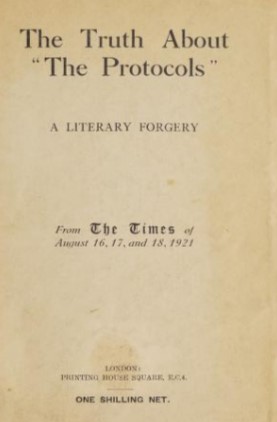
One of the most persistent and oldest claims made by ‘debunkers’ of the Protocols of Zion is that they are ‘plagiarised’ from another source with the general claim being that they are ‘plagiarised’ from Maurice Joly’s 1864 book ‘The Dialogue in Hell Between Machiavelli and Montesquieu’ which itself derives purely from the claim of a British journalist and ‘former’ spy Philip Graves in August 1921. (1)
It is worth noting that unfortunately for Graves he wasn’t the make this charge about the Protocols as the first claim of this sort was made by the jewish writer Herman Bernstein in his 1921 book ‘The History of a Lie’. (2) The problem of course is that Bernstein claimed the Protocols ‘plagiarised’ an entirely different book which was an 1868 novel by the German writer Hermann Goedsche titled ‘Biarritz’ and specifically ‘Biarritz’s’ chapter ‘In The Jewish Cemetery in Prague’ without knowing anything of Graves’ Joly claim in the same year.
John Spargo – an early popular anti-communist writer and an early example of a communist turned anti-communist – was essentially paid by wealthy jews in 1921 to write a popular book promoting Graves’ claims about the Protocols – as well as the myth that jews weren’t significantly involved in the Bolshevik Revolution in any way, shape or form – titled ‘The Jew and American Ideals’ as an attempt to counter the popularity of Henry Ford’s articles in the ‘Dearborn Independent’ which then were collected together to form the even more famous book: ‘The International Jew’. (3)
Part of the reason we know Graves’ claims better than we do Bernstein’s is due to the fact that Graves’ claims were published in ‘The Times’ in Britain – probably the most prestigious newspaper in the world at that point in time – as well as trumpeted around the world by jews desperate to counter the influence and power of the Protocols – notably in addition to Spargo’s book there was prolific jewish community propagandist Lucien Wolf’s 1921 ‘The Myth of the Jewish Menace in World Affairs’ that trod very similar ground to Spargo but from a British perspective – especially in the wake of Bolshevik revolution (and the jewish-led atrocities such as the Hungarian Soviet Republic happening around Europe from 1918 to the early 1920s) but also because Graves’ alleged ‘parallels’ (aka the ‘plagiarism’ of the Protocols) with Joly are ostensibly far more obvious that Bernstein’s alleged ‘parallels’ with Goedsche.
I’ve commented extensively on some of the alleged ‘parallels’ claimed by Graves in 1921 and exposed them as – at best – deliberately dishonest arguments that don’t cite whole sentences and the immediate written context of remarks in the Protocols to claim they are ‘plagiarism’ when in fact they are likely nothing of the kind (as there is only ever so many ways to make a similar point). (4)
However, one question that – to my knowledge – has never been asked even though it should have been obvious one is what translations Graves use to create his ‘parallels’.
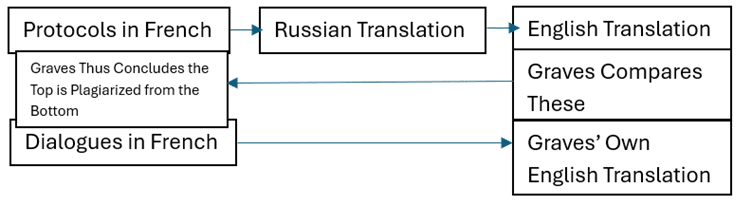
Graves implies he used an original copy of the Joly’s Dialogues in French and compared them to the Protocols, (5) but Graves does not detail which translation of the Protocols he is using and just starts quoting passages from the Protocols. (6) However, what Graves quotes is clearly the 1917 English translation of the Protocols that was attributed – probably deliberately but falsely to the then recently deceased Russia correspondent of the ‘Morning Post’ Victor Marsden – so he is in fact stating that he is comparing Joly’s Dialogues in French to Victor Marsden’s English translation of Sergei Nilius’ version of the Protocols in Russian.
Now to explain how ludicrous this is as a plagiarism claim I have created three diagrams to illustrate what Graves – and the subsequent mass of anti-Protocols literature that makes these claims given they have done no independent verification to my knowledge and have simply reproduced Graves’ parallels either from his original ‘Times’ articles or later popularizations of them like Spargo and/or Wolf’s works – is claiming so people can understand the problem.
The stated logic of Graves’ ‘plagiarism’ claim:
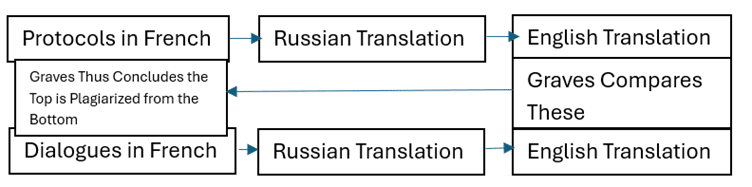
The alternative logic of Graves’ ‘plagiarism’ claim if he actually used a Russian to English translation of Joly which remains a possibility:
The end result if follow the logic of Graves’ ‘plagiarism’ claim and we include all the other ‘plagiarisms’ that were detected by Bernstein around the same time and by others since we get the following logic:
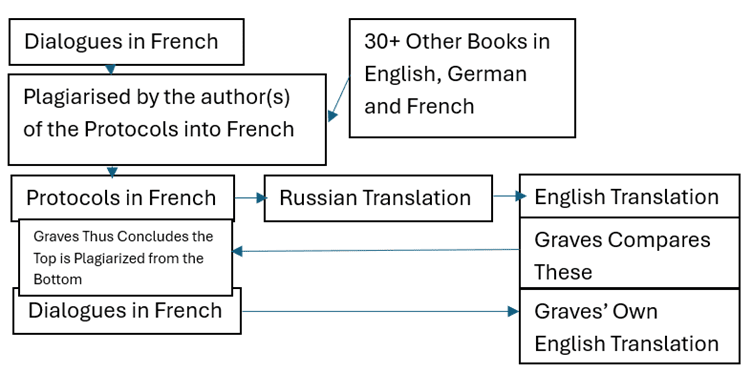
This might still seem a little bit convoluted but the essence of it is that Graves simply made own English translation of small snippets from the original French of Joly’s ‘Dialogues’ – which he was alerted to originally by a ‘Mr. X’ in exchange for money (recent research actually suggests the origin of this connection was later CIA director Allen Dulles) – then claimed the passages in Marsden’s English translation of Nilus’ Russian translation of the French original of the Protocols were ‘plagiarisms’ of Joly’s original French.
Yes: Graves claimed that his personal unchecked translation of a French book when compared to a translation of a translation of another original work in French somehow meant that the original French work that had been subjected to two translations (the Protocols) was ‘plagiarised’ from another original French work (the Dialogues) that was compared to it English.
Graves’ claims make absolutely no sense from either a scholarly or even a logical point of view: you cannot claim that Dostoevsky plagiarised Chekov because you have compared an English translation of Dostoevsky to an English translation of Chekov, because translation necessarily involves rephrasing the entire work to make it comprehensible in another language and translators often make mistakes or have a limited vocabulary they can use – especially as may well have been in true in the case of Marsden English translation where the real translator was likely a Russian whose second language was English (the Marsden translation is notoriously bad in places such as in the famous ‘tunnelling under cities’ quote which is just a bad English translation of the original Russian which means ‘subverting the cities’) – so you often end up with similar turns of phrase such as when JFK referred to a ‘sword of Damocles’ hanging over the head of the people of the world in a speech at the United Nations in 1961 (7) just like Protocols and their allegedly plagiarised source Chabry did when referring to the power of financiers over the French and non-jewish humanity respectively.
This is the essence of the translation problem with the Protocols in that a plagiarism argument has been made on the basis of texts subjected to multiple and/or unverified translations and compared in translation only for them to conclude that one was plagiarised from the other in the original language.
Graves’ claim – which has been frequently repeated ever since – makes absolutely no sense and shows how – in the words of leading modern Protocols scholar Michael Hagemeister – ‘the Protocols are more discussed than read among scholars.’ (8)
It also shows that the translation issue – i.e., what text is being compared to what text – with Graves’ argument about the ‘plagiarism of the Protocols’ from Joly (and subsequent claims of plagiarism from an assortment of other works) all but completely debunks the claim that that Protocols are plagiarised.
References
(1) Cf. Philip Graves, 1921, ‘The Truth about “The Protocols”: A Literary Forgery’, 1st Edition, Printing House: London
(2) Cf. Herman Bernstein, 1921, ‘The History of a Lie: “The Protocols of the Wise Men of Zion”’, 1st Edition, J. S. Ogilive: New York
(3) John Spargo, 1921, ‘The Jew and American Ideals’, 1st Edition, Harper & Brothers: New York, pp. 18-46
(4) Please see my detailed article: https://karlradl14.substack.com/p/the-protocols-of-zion-myth-libel
(5) Graves, Op. Cit., pp. 5-6
(6) Ibid., pp. 8-9
(7) http://www.jfklibrary.org/Research/Ready-Reference/JFK-Speeches/Address-Before-the-General-Assembly-of-the-United-Nations-September-25-1961.aspx
(8) Michael Hagemeister, 2022, ‘The Perennial Conspiracy Theory: Reflections on the History of The Protocols of the Elders of Zion’, 1st Edition, Routledge: New York, p. 19, n. 2
Karl’s SubstackRead More








 T1
T1