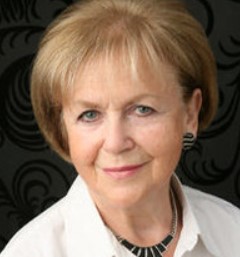
Our next ‘Holocaust Survivor’s’ narrative to examine is that of Mala Tribich (born Mala Helfgott) who was recently ‘honoured’ at a ‘Holocaust Memorial Day’ event in London attended by King Charles III.
Where she demanded the British government effectively throw ‘anti-Semites’ into prison:
‘King Charles said survivors who had died were also present “in spirit” at the reception to mark Holocaust Memorial Day.
Earlier on Tuesday, Mala Tribich became the first Holocaust survivor to address the cabinet – where she urged the government to “do what needs to be done” to tackle antisemitism today.’ (1)
But what is Tribich’s story?
This is helpfully provided by the ‘Holocaust Memorial Trust’ who state that:
‘Mala was born Mala Helfgott in 1930 in Piotrków Trybunalski, Poland. When the Nazis invaded Poland in 1939, Mala’s family fled eastwards. When they returned, Mala’s family had to move into the ghetto which was established in her hometown, the first in Poland. Life in the ghetto was terrible with families living in overcrowded, unhygienic conditions.
The family decided that it would be safer for Mala and her cousin, Idzia Klein, to be taken to the city of Częstochowa to try to pass as Christian children and stay there until the deportations were over. A couple named Maciejewski came to their home to collect payment in advance and it was arranged that Mala would be collected first and Idzia a week later; it would have been too dangerous to take two Jewish children on the train at the same time.
Mala and Idzia were taken to a house on the edge of Częstochowa and pretended to be relatives from Warsaw. Life was at times uncertain for the girls and they often felt vulnerable. Sometimes it was safe to mix with visitors but at other times the girls had to hide in a wardrobe and stay there until they had left. Both Mala and Idzia missed their parents but it was still not safe for them to return. When Idzia told the Maciejewskis that she could go and stay with good friends of her parents, who were hiding their valuables, they took her there. Mala was eventually taken back to Piotrków where her father was waiting for her in the attic of a flour mill with Idzia’s father. On seeing Mala he turned white with shock and said, “Where is my daughter?” Idzia was never seen again.’ (2)
So right off the bat; Piotrkow Trybunalski is a city in Poland that is about 20 miles south of Lodz for those who don’t know, but here we encounter the first issue with Tribich’s story in that it is claimed that her family fled eastwards ‘in fear of the Nazis’ but then – rather bizarrely – ‘went back west again’ when it would have been very easy for Tribich’s family to continue on and ‘be safe’ in Soviet-occupied eastern Poland as many jews indeed made this just this decision and it seems… well… counter-intuitive that the Tribich family would make the same decision then renege on it and wander back to Piotrkow Trybunalski then moved the Tribich and her cousin to the city of Czestochowa after they had entered Piotrkow Trybunalski ghetto that would have occurred on or around 8th October 1939.
Tribich and her cousin being moved south to Czestochowa by their families would not normally make a lot of sense, but because the Piotrkow Trybunalski ghetto was an open ghetto – meaning that the ghetto didn’t have a wall or a fence, so it acted like a traditional medieval ghetto where jews were more or less free to come and go as they pleased – it is quite plausible as is the Tribich and Klein family’s attempt to pass them off as Christians and thus Poles not jews by having them stay with the Maciejewski family in exchange for money.
It then seems that Tribich’s cousin Idzia ran away from/left the Maciejewski’s care and ‘was never seen again’; Tribich implies she was homesick but there are also multiple other possible explanations such as her being the victim of crime, her running away with a boyfriend/lover and/or to join the jewish terrorist underground in Poland. There is absolutely no reason to automatically suppose – as Tribich does – that the Germans had anything to do with her subsequent disappearance and/or that she was ‘killed in the Holocaust’.
Then for a reason we are not given – one wonders why the question isn’t even asked in the narrative – Tribich suddenly returns from Maciejewski’s care in Czestochowa to the ghetto in Piotrkow Trybunalski whereupon she magically re-admitted herself to the now officially closed ghetto which would be near impossible if we followed the ‘Schindler’s List’ type of ‘Holocaust’ narrative, but if we acknowledge that the Piotrkow Trybunalski ghetto remained an open ghetto – with only the addition of a curfew – in reality till at least 1942 then it makes sense of how this could have been achieved without too much comment or scrutiny from the German and Polish authorities.
The reasons for Tribich’s return to Piotrkow Trybunalski we don’t know, but we may reasonably suppose that the cause was the fact that the Maciejewskis demanded more money for the care of Tribich and/or they got cold feet due to the increased German scrutiny around jews being hidden by non-jews.
Alternatively, it may have also been triggered by Idzia’s disappearance and the fact that the Tribich family no longer trusted the Maciejewskis and now believed that Tribich was safer in the ghetto in Piotrkow Trybunalski rather than in the Maciejewski’s house in Czestochowa.
Whatever the cause we can say that we can already see how the ‘Holocaust’ narrative that we were all taught in school is utterly inaccurate as regards the reality of the Third Reich’s jewish policies in Poland and they were far more practical as well as pragmatic in nature than is ever suggested in the ‘Holocaust’ narrative and not remotely homicidal to boot.
Tribich’s narrative continues when we read how:
‘Shortly after Mala’s return to the ghetto, there were further round ups during which her mother and eight-year-old sister were taken. All these people were murdered in the local forest. Soon afterwards Mala had to undertake the responsibility of caring for her five-year-old cousin Ann Helfgott, whose mother was deported to a concentration camp. When the ghetto was liquidated, Mala became a slave labourer until November 1944, when the remaining Jews were deported. Mala was separated from her father and brother and together with Ann was sent to the Ravensbrück concentration camp.
After about 10 weeks they were transported in cattle trucks to Bergen-Belsen where conditions were appalling and Mala contracted typhus. At the time of the liberation by the British army, Mala was very ill.’ (3)
Now regarding this claim that there ‘were round ups and all the people were murdered in a local forest’ (which included Mala’s mother and younger sister apparently); it turns out that we have the testimony of Tribich’s brother Ben Helfgott which is where this story appears to come from rather than from Tribich herself.
The ‘anti-Holocaust Denial’ website ‘Aktion Reinhard Camps’ does a good job of narrating the claim:
‘On 19 November 1942, 100 mainly elderly Jews were taken from the synagogue to the Rakow forest, near Piotrkow and shot. Six days later, assured by the Germans that they were needed for work and would be safe, all “illegals” were ordered to present themselves for registration. Those who did so were also taken to the synagogue, which was surrounded by Ukrainian guards who proceeded to shoot into the building. The imprisoned Jews, including many children, had no food, no water and no light. In an act of great sacrifice, Yeshayahu and Tova Weinstock gave themselves up at the synagogue in order to change places with their children, thus saving the children’s lives at the expense of their own. Some captives possessing a skilled trade were returned to the ghetto as “legals”. On 19 December, 42 men were taken from the synagogue to the Rakow forest, where they were ordered to dig five burial pits. Most of the men were then shot. A few escaped to the forest. That night, 520 Jews were marched to the burial pits in groups of 50 and shot there. Among them were Ben Helfgott’s mother, Sara, aged 37 and his sister Luisa, aged 8. Artek Poznanski wrote:
‘In freezing conditions terrorised by bayonets and rifle butts, they were forced to undress, were machine-gunned, and then buried in the trenches. In the confusion of the massacre, six or seven individuals, some wounded, managed to escape. Sometime later I met one of them in the Bugaj timberworks, a pale, blue-eyed boy 14 or 15 years old. He told me how, only slightly wounded, he managed to manoeuvre himself on top of a pile of bleeding corpses. Covered with heaps of leaves and chunks of frozen earth, and barely able to breathe, he remained virtually motionless until nightfall. Then under cover of darkness, he crawled out and dragged himself back to the ghetto…I noticed him mainly because of one unusual feature; his hair was completely white.”’ (4)
You’ll notice that all these claims are anecdotal in nature and are non-validated so it is hard to take these claims at face value given the claims are being made – primarily about the Ukrainian guards rather than the Germans – without supporting evidence and we are just left with a list of instances of alleged atrocities and/or claims that boil down to ‘the Germans took a bunch of people away and they were never seen again’ not that they were actually killed and/or ‘I heard that…’
One also wonders why the Ukrainian guards would summon all the ‘illegals’ – including a large number of children apparently – shove them in a synagogue then randomly shoot at them in said synagogue then allow all the children out at the intercession of a random jewish couple named Yeshayahu and Tova Weinstock – presumably the source of the story – and then decide to separate all the ‘illegals’ who had a useful trade and make them ‘legal’ anyway then we aren’t told what happens to the rest of the ‘illegals’ who are still stuffed in the synagogue but we are left to assume they were killed yet we have no reason to assume this was the case.
Instead, it would be more reasonable to suggest that something like the following occurred:
– The Ukrainians summon all the ‘illegals’ in the Piotrkow Trybunalski ghetto for registration.
– The Ukrainians use the synagogue as a holding/administrative area to begin to process of registering the ‘illegals’ to make them ‘legals’.
– Due to the large number of ‘illegals’ – especially children – in (or just outside) the synagogue the Ukrainians shoot in the air and/or at the synagogue walls to stop the crowd getting restless and/or to engage in some kind of primitive crowd control.
– Yeshayahu and Tova Weinstock approach the Ukrainian guards and successfully negotiate for the children of the ‘illegals’ to be let out of the synagogue to ease the overcrowding situation.
– The Germans then process the ‘illegals’ into ‘legals’ while then marking all individuals with useful trades – the famous ‘Blauschein’ (‘Blue card’) of ‘Schindler’s List’ fame – so those with useful trades are subject to deportation to the work camps last and/or are routed according to their skill sets.
– During the war or post war the story of how this was a ‘massacre’ comes about with Yeshayahu and Tova Weinstock transformed into the ‘heroes of the hour’ and the Ukrainians into vicious irrational anti-Semites which then becomes ‘accepted truth’ because it feeds into the ‘Holocaust’ myth.
The point of going through this particular example from the Piotrkow Trybunalski ghetto is to illustrate how most – if not nearly all – the so-called ‘atrocities’ committed by the Germans and/or their allies are anecdotal claims based on what are essentially Chinese whispers and when you dig into the story a bit. It becomes immediately apparent there is both a lot of information that should be present that is missing – hence why we can suggest it is based on rumour not remembrance – but also the events can be explained in far more pedestrian less sensational ways by adding in known German policies as context to indicate what the German authorities might have actually been doing.
This then in turn makes sense of Tribich’s paradoxical claim that the Germans shipped her aunt to a concentration camp but left said aunt’s five-year-old daughter Ann Helfgott – German policy was to keep mothers with children and deport them both to the same concentration camp (most famously Auschwitz’s ‘Familienlager’ [‘Family Camp’] as well as the Theresienstadt Ghetto) – when if the ‘Holocaust’ were an actual policy then Ann Helfgott would have been deported and immediately gassed per the claimed ‘useless eaters’ logic. In that the only administrative reason Tribich’s aunt would have deported without her five-year-old daughter Ann would be if the Germans couldn’t find Ann and/or thought she had died resulting in her being left behind which in turn could well have been her mother’s decision based on the atrocity rumours that we know were percolating through the ghettos at this time. (5)
We can see this in how Tribich and Ann were subsequently sent to the ‘Women’s Camp’ of Ravensbruck where Tribich was engaged as a forced labourer – by implication in what Tribich doesn’t mention we know Ann was not subject to any such treatment as we may reasonably assume had this been the case – and then were further kept together when they move on from Ravensbruck to Bergen Belsen where they were then ‘liberated’ and where Tribich was badly sick with typhus at the time (indicating why Bergen Belsen was the notorious horror show that it was when it was ‘liberated’ aka rampant typhus combined the breakdown of the German ability to fight it in the last weeks and months of the war).
Thus when we look at Tribich’s account we can see how what should be a relatively pedestrian first-hand account of being hidden with a Christian family based on rumours, her return to the ghetto, the various events in the ghetto and her subsequent transfer to Ravensbruck and then Bergen Belsen has been transformed by belief in atrocity propaganda and gossip into a ‘Holocaust Survivor’ story complete with miracles and monstrosity.
It just goes to show how absolutely ridiculous ‘Holocaust’ historiography generally is in that it applies no critical lens whatsoever to ‘Holocaust Survivor’ testimony and what is worse is that it only takes minutes to work out what is actually going on: it isn’t even hard!
References
(1) https://www.bbc.com/news/articles/ce3epjw2x20o
(2) https://www.het.org.uk/survivors-mala-tribich
(3) Idem.
(4) http://www.deathcamps.org/occupation/piotrkow%20ghetto.html
(5) For example, see: Samuel Kassow, 2007, ‘Who Will Write Our History?: Emanuel Ringelblum, the Warsaw Ghetto, and the Oyneg Shabes Archive’, 1st Edition, Indiana University Press: Bloomington, p. 192
Karl’s SubstackRead More








 T1
T1