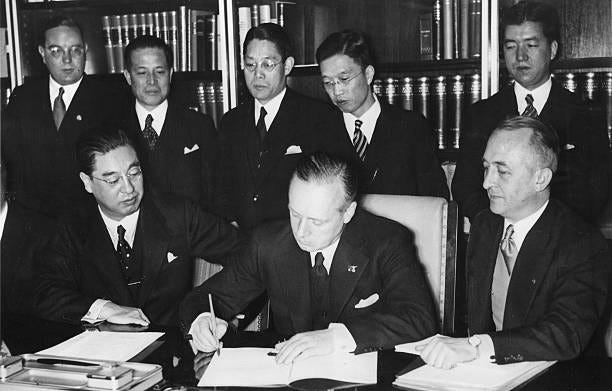
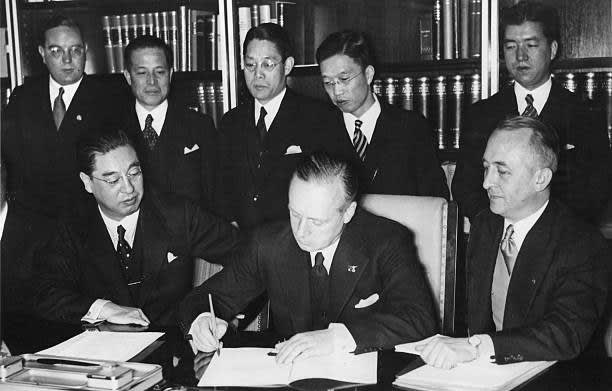
It is commonly claimed that Adolf Hitler personally declared the Japanese people to be honorary Aryans, with this myth persisting for almost a century. Despite this popular misunderstanding, there is no direct primary source quotation that is properly attributable to Hitler in which he referred to the Japanese people as honorary Aryans in any published dictates, reliably transmitted private records, or properly documented speeches. With discussion regarding the Japanese and this claim increasing in use, questions regarding where this determination was made by Hitler have become more important to investigate in order to understand the truth of the matter.
The majority of contemporary rumor points towards a 1934 letter from Countess Hanna Hatzfeldt-Aoki (archival number BArch R 64IV/31).1 The nature of this letter is hearsay, in that it was claimed by a Japanese individual that they heard that the Reich government had issued a formal determination, where the Japanese and their descendants would be treated as honorary Aryans. Of course, this hearsay does not further the claim that Hitler had directly claimed the Japanese to be honorary Aryans, and instead simply demonstrates the rumors that were circulating within the Japanese community at the time. This letter does not attempt to assert these rumors to be based on the utterances of Hitler, effectively ruling this out as a relevant source in this investigation.
Another primary quotation that is looked to in scholarship originates in a German politician’s speech in Tokyo, where he was reported to tell audiences that the term Aryan was not particularly scientifically complete and mostly means non-Jew.2 There are many explanations for this instance, from the German politician seeking to soften the NSDAP’s position on race in front of a foreign audience, to a misattribution of words, but it nonetheless does not represent an instance of Adolf Hitler speaking on the matter.
One primary source from 1945, which was recorded as Bormann dictations, features a passage that is frequently quoted concerning the Chinese and Japanese, where he asserts that he never had found them to be racially inferior, and further praises their racial pride and ancient civilizations. While this dictation is commonly regarded as historically sound, it does not include any mention of the Chinese or Japanese being honorary Aryans. It is only in loose inferences where this is inserted by interpretation, rather than received as Hitler’s word.3
If it has been recognized that the NSDAP did not officially recognize honorary Aryan as a status nor attribute it to the Japanese, and Hitler himself cannot be found saying such, why is it so prevalent to hear it be claimed? First, we should look towards Wikipedia, which is many people’s first stop to learn information like this.
Wikipedia claims that “Hitler declared the Japanese people as Honorary Aryans, which granted them equal rights,” and cites five sources in support of its assertion.4
Source one: Farrell, Joseph P. (2004). Reich of the Black Sun: Nazi Secret Weapons & the Cold War Allied Legend (illustrated ed.). Adventures Unlimited Press. p. 117. ISBN 9781931882392. Retrieved 30 July 2018.
Review of the book shows it to be thoroughly unscholarly in nature, with the majority of the book dealing with things such as UFO-“Nazi” connections and other highly speculative claims. The Wikipedia article references page 117, which asserts that due to an old Japanese tale that the Japanese originate from blonde haired blue eyed aliens, Hitler proclaimed the Japanese to be honorary Aryans. The author of this book offers no citation to show what speech or statement he is attributing to Adolf Hitler, completely failing to support the assertions made on Wikipedia.
Source two: Adams, James Truslow (1933). History of the United States: Cumulative (loose-leaf) history of the United States. C. Scribner’s sons. pp. 260, 436. Retrieved 30 July 2018.
The second source that Wikipedia points to in support of their narrative is James Adams’ History of the United States, which was published in 1933. This book was difficult to find, and the independent copies available did not speak on the matter at all, let alone specifically reference honorary Aryans. When the reference on Wikipedia’s page is opened, two snippets from Google Books reveal what is attributed to this 1933 volume. In the available snippet, the author claims that the “Pure Aryan race in his looting of Jews and other peoples has declared the Japanese to be honorary Aryans!” No sources were offered within these previews, and this wording was not found in the available copies of the 1933 publication. Again, this source appears as unsatisfactory to be used in a scholarly or even casual manner.
Source three: Delgado, Richard; Stefancic, Jean (1997). Critical White Studies: Looking Behind the Mirror. Temple University Press. p. 53. ISBN 9781439901519. Retrieved 30 July 2018.
The third source should need little explanation after the title is introduced: Critical White Studies: Looking Behind the Mirror. This book describes itself as a comprehensive exploration into the concept of whiteness and its implications on society, clearly holding an anti-European political position and thus inherently limiting its scholarly potential. This source claims that Adolf Hitler was forced to declare the Japanese to be honorary Aryans due to political compromise, again only offering their personal opinion and failing to cite the acts or words of Hitler directly. This source does not even reference another secondary source in their claim, ruling out yet another source Wikipedia has provided.
Source four: Narula, Uma; Pearce, W. Barnett (2012). Cultures, Politics, and Research Programs: An International Assessment of Practical Problems in Field Research. Routledge. p. 105. ISBN 9781136462689. Retrieved 30 July 2018.
On page 105, this fourth source from Wikipedia mentions in passing that “Nazi Germany gave Japanese a special category, ‘Honorary Aryan.’” This claim was made amidst discussions on greater race relations, not in scholarship regarding World War II in particular. Additionally, no primary or secondary sources were cited here to support the author’s assertion, making this another inappropriate source referenced on the Wikipedia page.
Source five: Snyder (1976). Encyclopedia of the Third Reich, p. 170.
This fifth and last source that Wikipedia lists is an encyclopedia of the Third Reich printed in 1976. In it, honorary Aryans is given its own description where it is directly claimed that it was a “title accorded to the Japanese people by Hitler.” It goes on to say that the purpose of the creation of honorary Aryan status was to justify the German-Japanese agreement on communism that was signed on November 25, 1936. Further, it says that they were considered by Hitler to be similar enough to German Nordics to deserve such a designation, yet again citing no sources to support the claim. This is a flawed logical step, as the NSDAP worked with various other governments, and no such claim has been made about them. Without any sort of citation of primary sources, this encyclopedia offers little in the way of accurate scholarship and again does not prove that honorary Aryan was an official designation for the Japanese created by Hitler.
Looking further into the information available online turns up many unscholarly websites that follow the same pattern as Wikipedia on the subject. A frequently cited website in this regard is “Sources Select Resources.” The relevant section claims that “However, in the case of the Japanese people, to whom Adolf Hitler bestowed the title following the Anti-Comintern Pact on Communism (signed in 1936), it seemed that they were granted the status not simply for economic, military, or political reasons, but more so because of their apparent racial integrity.”5
While this quote is accurate, as in it matches what was published attributed to Bormann, in no way does it assert the development of a new status called honorary Aryan. This is the full quote:
“In saying this, I promise you I am quite free of all racial hatred: It is, in any case, undesirable that one race should mix with other races. Except for a few gratuitous successes, which I am prepared to admit, systematic cross-breeding has never produced good results. Its desire to remain racially pure is a proof of the vitality and good health of a race. Pride in one’s own race – and that does not imply contempt for other races – is also a normal and healthy sentiment. I have never regarded the Chinese or the Japanese as being inferior to ourselves. They belong to ancient civilizations, and I admit freely that their past history is superior to our own. They have the right to be proud of their past, just as we have the right to be proud of the civilization to which we belong. Indeed, I believe the more steadfast the Chinese and the Japanese remain in their pride of race, the easier I shall find it to get on with them.”6
If we break this down piece by piece, we get the following:
-
Hitler proclaimed that he was free from racial hatred.
-
That he viewed the mixing of different groups to be an overwhelmingly negative thing.
-
Pride in one’s people is healthy and does not require contempt for other races.
-
That Hitler did not view the Chinese or Japanese as inferior to the Europeans.
At no point is it asserted in this dictated statement that a new status of honorary Aryans is to be created or recognized. Furthermore, this statement is attributed to 13 February 1945, whereas the previous website source claims that it was following the 1936 pact, neglecting to mention that the quote is nine years later and does not designate the status it asserts. While 1945 obviously followed the year 1936, the claim that these statements were made in connection with this pact almost a decade earlier appears misleading.
This position is reinforced and clarified by Adolf Hitler’s earlier publication, Mein Kampf, which was published almost two decades before the Bormann dictations were recorded. In the Stalag edition of Mein Kampf, Hitler asserted that the Japanese were reliant on European inventiveness and culture, and without it would find themselves and their inspiration drying up. Here he correctly asserts that the development of the Japanese is reliant on the Aryan, not that the Japanese themselves are Aryans or honorary Aryans.
“If, from to-day onwards, the Aryan influence on Japan were to cease, and if we suppose that Europe and America were to collapse, then the present progress of Japan in science and technique might still last for a short duration; but within a few decades the inspiration would dry up, and native Japanese character would triumph, while the present civilisation would become fossilised and fall back into the sleep from which it was aroused about seventy years ago, by the impact of Aryan culture. W e may, therefore, draw the conclusion that, just as the present Japanese development has been due to Aryan influence, so in the immemorial past an outside influence and an outside culture brought into existence the Japanese culture of that day.”7
This secondary source website “Sources Select Resources” utilizes a reference to this passage to support Hitler’s high opinion of the Japanese; in fact, it very well may show the opposite. Clearly, this secondary source has failed to prove the point it had set out to assert.8
Another commonly cited website that speaks on this is an Indian site that apparently deals with yoga books, and in the article published titled “Hitler and his God,” it is directly asserted that Hitler considered the Japanese and declared them to be “honorary Aryans.” This site even used quotation marks around the phrase and cited Ernst Hanftstaengl’s work Hitler: The Missing Years as the source for the claim. Page 121 of the book, the page which was cited, only says the following in regards to the Japanese:
“But Hitler only had his little moustache and he was taken seriously and he took himself seriously and the whole thing became an obsession with him. That was bad enough but what really worried me was the way in which Hess had succeeded in pumping his head full of the Haushofer thesis of getting the Russians to be knocked out a second time by the Japanese, who were Germany’s only possible ally in the world and so on.”9
Clearly, no such quotation of honorary Aryan was attributed to Hitler on this page, as well as anywhere else in the book. Additionally, this book is not an impartial, scholarly analysis, but rather a personal interpretation originating in post-war literature that focuses more on the condemnation of Hitler than a recalling of his beliefs through direct quotes.
In 2023, a researcher published a paper through the University of London titled Music and Internationalism in Nazi Germany: Provenance and Post-War Consequences which directly asserts that “Despite the obvious ethnic distances between Central Europeans and East Asians, the Japanese were even referred to by Hitler as ‘honorary Aryans’, and there was a wide range of German-Japanese musical interactions during the Reich.”10
In this research, Pace cites Ricky W. Law, Transnational Nazism: Ideology and Culture in German-Japanese Relations, 1919–1936, as supporting the quoted “honorary Aryan” arrangement. Law claims in this publication that “A few of the Japanese Germans even cited the Führer lauding the Japanese as ‘honorary Aryans’ to support their petitions, but the phrase was merely a quip and carried no legal weight.” This passage speaks about how marriage applications between Germans and Japanese were denied and that the limits of “transnational Nazism” were strict, with no true weight being afforded to any groups outside of legally recognized Aryans. Considering that the initial source was published through a UK government website and a university publisher, it is very disappointing to see the same misattribution from secondary source to secondary source in a manner that is entirely unbecoming of a scholar.
Some modern scholarship points towards the development of this rumor being based in the NSDAP’s “reluctance to define its position” on German-Japanese Mischlinge, leading to its further development. Regardless of the speculated cause, these scholars ultimately found no primary evidence to suggest that it was anything but a rumor.
“Early Nazi racial legislation provoked speculation regarding its potential impact on Japanese German Mischlinge (individuals of mixed race), and the regime’s reluctance to define its position helped to spread the rumour that they had been recognised as ‘honorary Aryans’. Although this was never more than a rumour, the ambiguous racialisation of the Japanese historically seemingly legitimised demands by Japanese Germans that the regime should recognise their rights as members of the Nazi Volksgemeinschaft (national community).”11
Finally, some point toward the various pacts made between Germany and Japan as containing evidence of a new “honorary Aryan” status, but no such language or intention exists. The Anti-Comintern Pact of 25 November 1936 clearly asserts that the states would “co-operate for defense against communistic disintegration,” with no deeper assertions being made regarding a mixing of cultures, peoples, or an alteration of status for the Japanese.
The claims of Hitler asserting the Japanese to be honorary Aryans do not appear to be supported in any primary sources that can be directly attributed to Hitler himself. Additionally, the majority of websites that assert such information lead the reader back to unsupported claims from other secondary sources, some of which are entirely misquoted or not fit for scholarly purposes. A review of primary sources, quotations, and dictations from Hitler additionally does not reveal any passages that could be reasonably interpreted as such without a gross conflation being made.
The national socialist position that stands in opposition to ethnocentrism and racial mixing can be seen directly supported by Hitler in these relevant passages, as well as leading racial figures such as Walter Groß, where it is established that the races are different and that assertions of superiority are not necessary to the philosophical or ideological fulfillment of National Socialism. The persistence of the claims covered by this article demonstrates the result of repetition and the solidification of unsupported assertions within secondary literature and popular understanding.
Endnotes
-
Sarah Panzer, “Honorary Aryans? Japanese German Mischlinge and the Negotiation of Identity in Nazi Germany,” Contemporary European History 33 (2024).
-
Harumi Shidehara Furuya, “Nazi Racism Toward the Japanese: Ideology vs. Realpolitik,” Monumenta Nipponica 37, no. 1 (1982): 1-18.
-
Adolf Hitler, “Auszüge aus Hitlers letzten Diktaten über menschliche ‘Rassen’ und internationale Politik (Februar–April 1945),” in Hitlers politisches Testament: Die Bormann-Diktate Februar–April 1945, ed. Martin Bormann (Munich: Deutscher Taschenbuch Verlag, 1981).
-
“Honorary Aryan,” Wikipedia, accessed March 28, 2026, https://en.wikipedia.org/wiki/Honorary_Aryan.
-
“Honorary Aryan,” Sources Select Resources, accessed March 30, 2026, https://www.sources.com/SSR/Docs/SSRW-Honourary_Aryan.htm.
-
Adolf Hitler, Political Testament: Hitler–Bormann Documents (February–April 1945).
-
Adolf Hitler, Mein Kampf (Stalag edition), 324.
-
“Honorary Aryan,” Sources Select Resources, accessed March 30, 2026, https://www.sources.com/SSR/Docs/SSRW-Honourary_Aryan.htm.
-
Ernst Hanfstaengl, Hitler: The Missing Years (New York: Arcade Publishing, 1994), 121.
-
Ian Pace, “Music and Internationalism in Nazi Germany: Provenance and Post-War Consequences,” Journal of the Royal Musical Association 147, no. 2 (2023): 594-616.
-
Sarah Panzer, “Honorary Aryans? Japanese German Mischlinge and the Negotiation of Identity in Nazi Germany,” Contemporary European History 33 (2024).
Jake LeoneRead More








 T1
T1