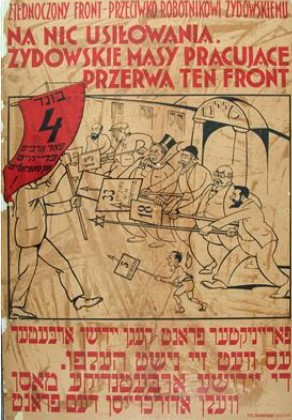
The relationship between jews and communism in Poland is probably the most debated of all the links between jews and communism outside of what was then the former Russian Empire and the nascent Soviet Union. This is almost entirely because the so-called ‘Holocaust’ is a hotly-debate subject between the jews and the Poles which basically amounts to a victimhood Olympics by both side with the jews insisting the Germans primarily targeted jews and the Poles insisting that the German also heavily targeted Poles.
I won’t get into the ins and outs of the argument, but essentially the focus of the debate has shifted away from the ‘Holocaust’ itself over time and towards what we might call ‘Polish culpability for the Holocaust’ and also for ‘Polish atrocities against the jews after the Second World War’ with the focus being on Poles who aligned themselves with the Third Reich (such as the Polnische Polizei im Generalgouvernement aka ‘The Blue Police’) and/or agreed with the German views and/or policies to resolve the jewish question as well as the widespread anti-Semitism of the Polish population before, during and after the Second World which led most famously to the Kielce pogrom on 4th July 1946.
Naturally the debate has then further focused on the reasons why the Poles hated the jews so much in the first place, which could then lead them to repeatedly rise against and massacre the jews less than two years after the jews were allegedly being gassed and made into lampshades and soap by the Germans in the ‘Holocaust’.
That reason above all others is the jewish relationship (and involvement) with communism and thus their culpability and apologetics for Stalin’s numerous genocides and massacres as well as those of Lenin, Trotsky and others.
In Poland this concept is so famous that it even has its own term to describe it: Zydokomuna.
So desperate are jews and leftist to dismiss this thesis of close jewish collaboration with the Soviet Union and its web of communist parties that they usually resort to ridiculous counter-factual statements that dismiss it entirely as a ‘deluded myth’.
For example, Andre Gerrits – a Belgian scholar of Russian History – claimed rather absurdly in 1995 that:
‘Judeo-Communism is a ‘xenophobic assertion’… indeed a myth, a delusion, which has never existed.’ (1)
This however is complete nonsense both quantitively and qualitatively as Jaff Schatz explains in his 1991 study of the role of jews in communism in Poland.
He writes how:
‘Throughout the whole interwar period, Jews constituted a very important segment of the Communist movement. According to Polish sources and to Western estimates, the proportion of Jews in the KPP was never lower than 22 percent. In the larger cities, the percentage of Jews in the KPP often exceeded 50 percent and in smaller cities, frequently over 60 percent. Given this background, a respondent’s statement that “in small cities like our, almost all Communists were Jews,” does not appear to be a gross exaggeration.
The proportion of Jewish members in the KPP reached its peak in 1930 at 35 percent. During the remainder of the 1930s, the proportion is said not to have exceeded 24 percent. However, there are data suggesting that it might have increased further in the larger cities: Jewish membership in the Communist organization in Warsaw increased dramatically from 44 percent in 1930 to over 65 percent in 1937.
All in all, most estimates put the proportion of Jews in the KPP at an average from 22 to 26 percent throughout the 1930s. In the semiautonomous KPZU and KPZB, the percentage of Jewish members was at least similar to that in the KPP.
In the Communist youth organizations, the proportion of Jewish members was even higher than in the party itself. In 1930, Jews constituted 51 percent of the KZMP [Komnunistyczne Zjednoczenie Mlodych Polakow or Communist Union of Polish Youth], while ethnic Poles were only 19 percent (the remaining number was composed of Ukrainians and Byelorussians). And in 1933, Jews made up 31 as compared to ethnic Poles who made up 33 percent. If we assume that Polish-Jewish Communists constituted between one-third and one-fourth of the total membership of the whole movement (KPP, KPZB, KPZU; and their youth organizations) in the 1930s, this would approximate between 5,000 to 8,400 Jewish Communists, without counting those in prison. If we include those imprisoned, the total number of Jews in the Communist movement in Poland during that period would probably rise to between 6,200 to 10,000 individuals.’ (2)
Naturally pro-jewish writers like Jan Gross have tried to attack Schatz’s research because he used official Polish communist party sources for his data, which Gross pejoratively labels as ‘unrealistic’ but doesn’t explain why Schatz’s figures – taken from official Polish communist sources remember – are ‘unrealistic’ beyond the fact that they show the stereotype of Zydokomuna to have a lot of truth to it. (3)
This is why Gross spends little time discussing the interwar Polish Communist party and immediately tries to talk about the mythical but more arguable idea of post-war ‘Stalinist anti-Semitism’ instead, because Gross knows he doesn’t actually have an argument against Schatz’s figures but because he is desperate to try to attack the ‘myth of Zydokomuna’ in order to support his thesis of widespread irrational anti-Semitism in Poland before, during and after the Second World War: (4) he has to find some way to dismiss Schatz’s figures because they completely destroy his contention that Zydokomuna is just an ‘anti-Semitic myth’ with no basis in fact.
The fact is however that Schatz’s figures have been repeatedly endorsed and supported by other academic specialists on the Polish communist party and the general historical era in Poland such as Henryk Cimek and Tadeusz Piotrowski.
The latter for example is quite specific in explaining just how powerful and important jews were in the Polish communist party writing how:
‘According to Andrzej Zwolinski, in Polish court proceedings against communists between 1927 and 1936, 10 percent of those accused were Polish Christians and 90 percent were Jews. According to Henryk Cimek, out of the fifteen leaders in the central administration of the Polish Communist Party (Komunistcyzna Partia Polska, or KPP) in 1936, eight were Jews and seven were Poles. Jews were 53 percent of the members of the “active center” (aktyw centralny), 75 percent of the KPP publication apparatus, 90 percent of the International Organization for Help to the Revolutionaries, and 100 percent of the “technical apparatus” of the Home Secretariat. Before the dissolution of the KPP in 1938, Jews accounted for 25 percent of its membership. In the urban centres of central Poland, that membership rose to 50 percent.’ (5)
The key point here is that Piotrowski is pointing out that other strands of documentary evidence – such as the court records of trials against communists between 1927 and 1936 – also point to the same conclusion and that when we look at who the members were of individual apparats and organizations within – or aligned to – the Polish communist party: they are overwhelming dominated by jews.
Another strand of evidence indicating this overwhelming jewish domination of the Polish communist party between 1918 and 1938 that Piotrowski points to in order to further illustrate the point is that when Stalin revived the Polish Communist party in 1942; its nucleus was communist jews from Warsaw. (6)
This is hardly surprising given Schatz’s comment that:
‘Communists of Jewish origin occupied most of the seats on the Central Committee of the KPRP and KPP.’ (7)
But it has received further substantive confirmation from Cimek who explains that:
‘Jews played a dominant role in the Polish communist movement in the interwar period. Their views and activities sometimes provoked controversies. The communists of Jewish nationality were accused inter alia of breeding separatist and dogmatic tendencies. In terms of percentages, the share of the Jews in the communist movement as compared to their share in Poland’s population was the highest of all nationalities. The crucial role of the Jews was especially visible in the leadership of Komunistyczna Partia Polski (KPP) [Polish Communist Party] and Komunistyczny Związek Młodzieży Polski (KZMP) [Communist Union of the Polish Youth] (until February 1930 – Związek Młodzieży Komunistycznej w Polsce (ZMKP) [Union of the Communist Youth in Poland]), as well as, albeit to a lesser extent, in Komunistyczna Partia Zachodniej Białorusi (KPZB) [Communist Party of the Western Belarus] and Komunistyczna Partia Zachodniej Ukrainy (KPZU) [Communist Party of the Western Ukraine], being autonomous organizations related to KPP.’ (8)
In addition to this Knebel records that 526 out of the 4,669 employees of the post-war communist Polish internal security service (the UB) between 1945 and 1956 were jewish (as well as that this is likely an significant underestimate to the tune of between 10 to 15 percent) which is 11 percent of the total (9) when in 1945 jews were 0.4 percent (circa 100,000 jews out of an estimated Polish population of 24 million in 1945) of the population of Poland.
Knebel also documents that this wasn’t some weird aberration either when she writes how:
‘Paczkowski (2008) referred to a report of October 20, 1945 by Nikolay Selivanovsky, the chief Soviet adviser at the Ministry of Public Security. According to this report, Jews made up 18.7% of the ministry’s workforce, and held half of the managerial positions. I am using this report’s results for do a comparative analysis with the results of the IPN tables. The IPN Tables include all the MBP sections: Central Ministry departments (later converted to the Committee), the local Provinces, and Prisons and Camps in Poland. When taking into account the Ministry of BP as a whole system, my calculation shows, in the MBP management cadre in 1945, Jews constituted only 12% (142 Jews in the MBP out of all 1194 MBP employees). However when calculating only the numbers of participants in the Central Ministry departments, we see that there was a participation of 42.86% Jews. Out of the 42 employees in the Central Ministry, 18 were Jews. (16 plus additional two that were identified as Possibly Jews). Soviet participation was at 26.19%.’ (10)
The point being that if the Polish Communist party was re-created by Stalin in 1942 out of – presumably senior – communist refugees from the original KPP that had been dissolved on Stalin’s orders in 1938 and the party’s leadership and cadre was overwhelmingly jewish and then that same party goes on to recruit jews hugely out of disproportion to their representation in the population into both its government and security apparatuses in the first years of the Polish communist state. Then it is reasonable to conclude both that this later jewishness of the early Polish communist state was linked to the earlier jewish dominance of the Polish communist party as well as that the jewishness of the earlier party was at least partly why the early Polish communist state was also dominated – again to a frankly ludicrous degree – by jews in positions of power.
Cimek does a good job of summarizing this jewishness in relation to the complicated and inter-linking nature of the various entities aligned to the Polish communist party between 1918 and 1938, which I quote at length so the reader may understand just how crazy the numbers involved really are as well as understand the different groups involved since the network of different groups that were aligned with (or were under) the Polish communist party is one way that traditionally
To wit:
‘Jews played a dominant role in the Polish communist movement in the interwar period. Their views and activities sometimes provoked controversies. The communists of Jewish nationality were accused inter alia of breeding separatist and dogmatic tendencies. In terms of percentages, the share of the Jews in the communist movement as compared to their share in Poland’s population was the highest of all nationalities. The crucial role of the Jews was especially visible in the leadership of Komunistyczna Partia Polski (KPP) [Polish Communist Party] and Komunistyczny Związek Młodzieży Polski (KZMP) [Communist Union of the Polish Youth] (until February 1930 – Związek Młodzieży Komunistycznej w Polsce (ZMKP) [Union of the Communist Youth in Poland]), as well as, albeit to a lesser extent, in Komunistyczna Partia Zachodniej Białorusi (KPZB) [Communist Party of the Western Belarus] and Komunistyczna Partia Zachodniej Ukrainy (KPZU) [Communist Party of the Western Ukraine], being autonomous organizations related to KPP.
[…]
There were also Jewish workers’ parties in Królestwo Polskie, which were under the influence of Zionists (Jewish nationalists) who expressed aspirations of those Jews. They manifested Jewish nationality, aiming at uniting the Jewish diaspora and establishing their own state in Palestine. By contrast, Bund postulated that the Jewish question was to be resolved by introducing a socialist political regime in Poland that would grant the Jews national-cultural autonomy. In turn, Żydowska Socjalno-Demokratyczna Partia Robotnicza Robotnicy Syjonu (Jidysze Socjalistisze Arbeter Partaj Poale Syjon), which was created in Królestwo Polskie in 1905, wanted to combine the socialist slogans with the Zionist ones.
Similar postulates were put forward by Żydowska Socjalistyczna Partia Robotnicza Zjednoczeni (Jidysze Socjalistisze Arbeter Partaj Ferajnigte), which was called into existence in November 1918 by the so-called Zionists-socialists.
Within the listed Jewish workers’ parties ideological polarization and splits occured as a result of which the leftist groupings either joined KPRP or created Jewish communist organizations. This phenomenon was more massive than in the milieu of Polish socialist parties. The Poale Syjon split in July 1920, giving birth to Poale Syjon-Lewica and Poale Syjon-Prawica. The former opted for Jewish emigration to Palestine, being on the other hand dedicated to socialism and internationalism. This grouping criticized separatism, believing in merits of cooperation between the Jewish socialists and all socialist parties in Poland.
A Poale Syjon-Lewicy delegation took part in the proceedings of the III Congress of the Communist International (22 June – 12 July 1921). The party was ready to join KPRP, but wanted to preserve autonomy as far as Jewish issues in which the decisive say was to belong to the international organization Poale Syjon.
[…]
Since October 1921 a communist fraction existed within the Poale Syjon-Lewicy – Żydowski Związek Komunistyczny Poale Syjon [Jewish Communist Union of the Paole Syjon] that joined KPRP following its exclusion of the Paole Party in November 1921. It was headed by Saul Amsterdam-Henrykowski (1898–1937), Gerszon Dua-Bogen (1892–1948) and Alfred Lampe (1900–1943). They held key positions in the party. G. DuaBogen was inter alia a secretary to Centralne Biuro Żydowskie KC KPP (1922–1927), and since the I Congress of KPZB (25 June – 25 July 1928) – a member of its KC [Central Committee]. The two other activists occupied even higher ranks in the party hierarchy being long-term members of KC KPP and of Biuro Polityczne KC KPP 5 P P4F [KC KPP Political Bureau].
[…]
In August 1921 KPRP was also joined by a group that branched off from Ferajnigte, which was the weakest of all of the mentioned Jewish parties. Among the Ferajnigte members who joined KPRP there were, inter alia, Izrael Gajst vel Geist (1888–1939) and Izaak Gordin- -Lenowicz (1899–1937). The former, a member of KC Ferajnigte, joined KPRP mid-year in 1919, being a member of Centralne Biuro Żydowskie KC KPRP (1919–1920) and a deputy member of KC KPP (1930–1933). The latter, Gordin, belonged to CBŻ (1923–1927).
[…]
The Bund issue in Poland was also discussed by the Communist International’s Executive Committee on 19 March 1921. Its representatives – Grigorij Zinowjew (G. Radomylski) and Karol Radek (K. Sobelsohn) – were of the opinion that the immediate merger of Bund with KPRP was not to be pressed for in spite of the CI’s principle that stipulated that only one communist party could exist in a country. The KPRP delegates thought otherwise: Henryk Walecki (Maksymilian Horwitz) and others were against the inclusion of Bund in the IC. The aforementioned activists of the IC and KPRP were all of Jewish origin. Walecki maintained that Bund had not got rid of its nationalism. That was perceived as a threat to KPRP in a situation when at the beginning of 1920 this party counted circa 5500 members, including many Jews, while Bund had almost 10 thousand membership.
[…]
However, taking into account the fact that Kombund counted probably around 2 thousand members, while a few months after its accession, that is in August 1923, KPRP had a little more than 5500 members, it could be hypothesized that there were possibly more than 50% of the Jews in KPRP. Additionally, it is to be remembered that the Jews had belonged to KPRP even before it was joined by Kombund. There were some district organizations that were almost exclusively Jewish or at least with significant shares of the Jews, such as Komitet Okręgowy KPRP Lublin in which the Jews constituted 76,3% members in 1923, while in 1925 – as many as 82,4%. In turn, the KO KPRP Siedlce counted 60% of the Jews in 1923, whereas in June 1924 their share rose to more than 81%.
This increase in the share of the Jews was even more conspicuous in ZMK which counted around 4 thousand members as of December 1922. After it had been united with Cukunft a few months later, the latter’s circa 3 thousand members most probably increased that percentage to at least 60%.
[…]
The Jews belonged also, albeit in smaller numbers, to autonomous KPRP organizations that came into existence at the end of 1923 – that is KPZU and KPZB. Those parties were dominated by peasants, but for instance in 1924 KPZU counted 13,3% of the Jewish members, while in Związek Młodzieży Komunistycznej Zachodniej Ukrainy their share was 25% as of 1926. In November 1924 they constituted 18–20% of KPZB.’ (11)
This is all explained in summarised tabular form by Cimek as follows: (12)
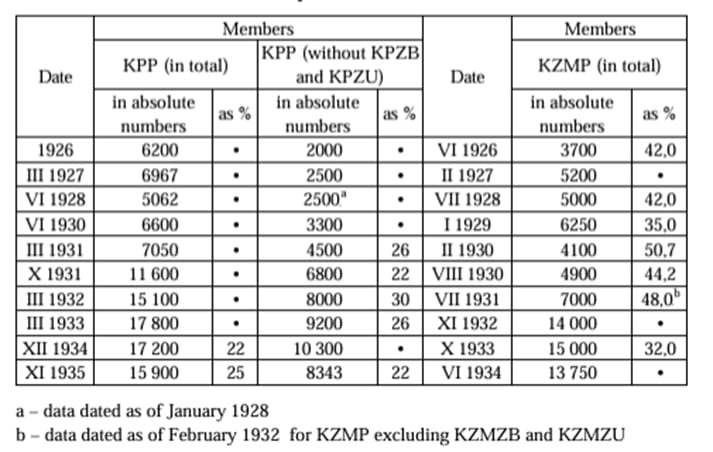
Cimek’s summary table shows us the fact that from the available data we have on the ethnic breakdown of the Polish communist party (from 1931) and its youth wing (from 1926) they are both dominated by jews during the whole period under discussion. The youth wing in particular started off with 42 percent of its members being jews in 1926 and by 1933 this had fallen but only to a still humongous 32 percent jewish having been 48 percent jewish two years earlier in 1931.
But how disproportionate was this membership relative to the jewish population as a percentage of the population of Poland?
Jews were 7.8 percent of the population of Poland in 1921 and 8.6 percent in 1931. (13) This increase in the jewish population of Poland as a percentage of the total population was not owing to jewish having a lot more children but rather was caused by two factors: shifting national borders and a movement inside Polish jewry inspired by the Zionist movement not to label themselves as Polish but rather jewish. (14)
It is worth noting that a similar situation prevailed in Latvia albeit in reverse where the jewish population officially decreased in 1935 as the Latvian government had arbitrarily reclassified them as ‘Russians’. (15)
So, if we take the jewish representation within the Polish communist party (22 percent) and its youth wing (44.2 percent) in 1931 against the Polish census figure for how many jews there were in Poland in that year (8.6 percent). Then we get that jews were overrepresented to the tune of 2.6 times their demographic representation in the Polish communist party in 1931 and 5.1 times their demographic representation in the party’s youth wing in the same year.
Those are figures which quite frankly cannot be explained by ‘accident’, ‘coincidence’ nor ‘literacy rates’ especially as the Polish socialist party – the Polish communist party’s main rival on the political left in interwar Poland – appears to have had something of the same problem despite being desperate to have actual Polish workers join its ranks. (16)
Similarly, the Polish communist party and its youth organizations (the latter organizations if totalled up were 60 percent jewish in terms of their ethnic demographics) (17) recognized the problem and desperately tried to engage in the forced Polonization of their organizations as Cimek explains:
‘The KPRP leadership saw disadvantages that followed from having such numerous Jews among its rank and file. They put forward, inter alia, an idea of Polonization of KPRP as well as tighter linkages between CBŻ’s activities and those by the main party.’ (18)
The effect of this forced Polonization drive was that in the party’s youth wing the membership was 51 percent jewish and 19 percent Polish in February 1930 and then 32 percent jewish and 33 percent Polish in October 1933. (19)
To understand the practical reality behind these numbers if we look at the total membership figures of the party’s youth organization we can see that it doubles between 1931 and 1932 (from 7,000 to 14,000 members) which means – in essence – that if 51 percent of the party’s youth organization’s membership was jewish in February 1930 then out of 4,100 members at that time 2,091 were jewish and only 779 were Polish. (20)
Then by October 1933 because the party’s youth organization had grown from 4,100 members to 15,000 members in the previous three years: the number of jews in the organization (32 percent) more than doubles to 4,800 which is then only covered up by the fact that the number of Polish members (33 percent) roughly multiplied by five to 4,950.
In addition to this; we should note that this is almost certainly an underestimate as numerous members of the party’s youth organization would have migrated – by virtue of coming-of-age – to the Polish communist party proper and no longer be members of the party’s youth organization, which we can in turn see likely represented in the four percent increase in jewish members of the Polish communist party in 1932. (21)
Thus, we can see that while the forced Polonization of the Polish communist party superficially seemed to reduce the significant jewish overrepresentation among the organizations of the communist movement in Poland; it actually represents the opposite. Namely a doubling of the number of jews in the communist movement in Poland which was covered up with the fig leaf of a large relative increase in the number of actual Poles in the movement.
The problem was not only that jews in Poland were primarily an urban population, (22) but also openly despised and/or looked down on actual Poles especially those in rural areas as Cimek explains:
‘The process of the peasants’ joining the communist parties was inter alia hindered by the negative attitude adopted by some of the Jews – who dominated small town party organizations – regarding agitation activities to be carried out in peasant milieus. Most often they excused themselves with the peasants’ anti-Semitism, even though in reality such a phenomenon was not always present. Moreover, the Jews from some local organizations regarded peasants as a “burdensome element” whose understanding is difficult to achieve.’ (23)
Now this obviously supports MacDonald’s theory of ethnocentrism being at the heart of jewish identity as well as what Duke refers to as ‘jewish supremacism’, but what is interesting here is this provides a cogent explanation of three things all at once.
Namely it explains in part why communist agitation failed in Poland (jews viewed communism as ipso facto jewish and therefore recruiting Poles was less important than recruiting other jews), where the stereotype of Zydokomuna comes from (actual experience with the representatives and knowledge of the Polish communist party) as well as why jews (as members of the post-war Polish secret police and government) primarily targeted Poles for repression in the early communist state in Poland (this ethnic under targeting is also in evidence in the 133 Days of Bela Kun in Hungary (24) and during the Soviet occupation of Latvia from 1940-1941). (25)
In short: jews viewed communism in as a jewish intellectual movement and the Soviet Union as a jewish state and they acted accordingly which in turn drove Poles to become increasingly anti-Semitic over time.
A good example of how this hugely disproportionate jewish domination of the Polish communist party and its ancillary organizations was is provided by the example of the Soviet organization MOPR (International Red Aid) in Poland with Cimek commenting how:
‘The biggest share of the Jews was, however, found in Międzynarodowa Organizacja Pomocy Rewolucjonistom (MOPR) [International Organization of Assistance for the Revolutionaries], which had in its big city constituencies around 6 thousand members in Poland as of 1932. 92% of them were Jewish, whereas in rural constituencies this share was 88%.’ (26)
While Schatz states that:
‘In addition, Jews were in an overwhelming majority in the Polish MOPR (Miedzynarodowa Organizacja Pomocy Rewolucjonistom, International Organization for Help to the Revolutionaries), which collected money for and channelled assistance to imprisoned Communists. In 1932, out of 6,000 members in the MOPR, about 90 percent were Jews.’ (27)
The overwhelming and near complete jewishness of the MOPR organization in Poland was also mirrored around the same time in Lithuania where 60 percent of MOPR members were jewish in 1938. (28)
However, in its almost complete jewishness the MOPR organization Poland was certainly not alone nor unusual. Since as Cimek explains:
‘According to Sekretariat Krajowy KC KPP, at the beginning of 1936, the share of the Jews in the executive ranks of the whole party and that of KZMP was too big – 54%. Moreover, the share of the Jews in MOPR reached 90%, in the party technical apparatus about 75%, and in the technical apparatus of the Sekretariat and the leadership of KO KPP Warszawa – 100%. Faced with the overwhelming dominance of the executive by petty bourgeoisie and industrialists who were mainly of Jewish descent, Sekretariat Krajowy decided to introduce more industrial workers in the executive structures. It also tried to increase the number of farm workers and peasants among the activists.’ (29)
Put another way: the Polish communist party was being led by a bunch of largely jewish capitalists or children of such in much the same way that the Hungarian Soviet Republic was largely led by jews from a not dissimilar background. (30)
This is what senior Polish communist activist Wincas Mickiewicz was referring to when in July 1930 he stated that:
‘Those comrades were right who were talking about sui generis two parties: a Jewish one and a Polish one.’ (31)
The ‘two parties’ that Mickiewicz was talking about was both a reference to the fact that jews were massively overrepresented while Poles were massively underrepresented in the ranks of the Polish communist party, but also how there was a significant differential between the two in terms of their power.
This is an area that is rarely acknowledged – let alone discussed – by self-styled ‘debunkers of the myth of Judeo-Bolshevism’ in that they ignore the relative power of individuals as well as how much the given party and/or state bureaucracy – the operational and decision-making heart of any organisation/regime thus the true holders of power – were jewish. In favour of focusing on the silly idea that if you have twenty inconsequential ministers but a jewish interior minister, defence minister and foreign minister that therefore the twenty inconsequential ministers mean that the much larger relative power of a jewish interior minister, defence minister and foreign minister is somehow completely nullified and the ‘myth of jewish power’ debunked because there are ‘more non-jewish ministers’.
Schatz is unusual in the literature in that he factors this relative power differential into his analysis of jewish power and representation inside the Polish communist party when he states that:
‘The qualitative significance of Jewish Communists was even larger than their sheer numbers would indicate. Despite the fact that the party authorities conspicuously strove to promote classically trained proletarian and ethnically Polish members to the cadres of leaders and functionaries. Jewish Communists formed 54 percent of the field leadership of the KPP in 1935. Moreover, Jews constituted a total of 75 percent of the party’s technika, the apparatus for production and distribution of propaganda materials.’ (32)
Cimek echoes Schatz’s analysis when he writes that:
‘The percentage of the Jews was usually higher within KPP’s and KZMP’s leaderships than among their rank and file. During all of the six KPP congress, in total 172 KC members and their deputies were elected, some of whom had been elected more than once (Świetlikowa 1958: 96 and ff.; 1959: 31). In January 1936 the national composition of the central party authorities looked as follows: out of the 19 KC KPP’s members, 11 were Polish, 6 Jewish (31,6%), 1 was Belarusian and 1 Ukrainian; among the 15 members and deputy members of KC KPZB Belarusians were the most numerous – 7, and apart from them 6 were Jewish (40%), 1 Polish and 1 Latvian; out of the 7 KC KPZU’s members 3 were Ukrainian and 3 were Jewish (each 42,9%) plus 1 Polish. Even more Jews were to be found within the ranks of the district KPP activists in 1935 – out of 52 individuals 28 were Jewish (53,8%) and 23 Polish.’ (33)
What both Cimek and Schatz are saying is that Mickiewicz’s ‘jewish party’ was largely the leaders, officials and activists of the Polish communist party, while the ‘Polish party’ was largely confined to the ordinary rank and file membership. Thus, we can reasonably and quite accurately speak of how the Polish communist party was largely run by jews.
We can further see this in how during the 1930s while the percentage of jews as members of the party compared to Poles was decreasing – although as we have in real numbers it actually doubled – the relative power of the ‘jewish party’ inside the Polish communist party was substantially increasing.
As Cimek relates:
‘Towards the end of 1936 the national composition of KPP leadership was changed even more to the disadvantage of the Poles. According to a written report by KPP leaders on the Party’s activities after its IV Plenum (February 1936) in December 1936 the KPP’s authorities counted 15 persons (excluding KPZB and KPZU), including 8 Jews (53,3%) and 7 Poles. Moreover, among the 15 district committees’ secretaries, out of their total number which was 18, 8 were of Jewish descent (53,3%), while 7 of Polish descent. A year earlier, in February 1936, there were 30 members and deputy members of KC KPP, including 15 Poles, 12 Jews (40%), 2 Ukrainians and 1 Belarusian. Added KC KPZB and KC KPZU (excluding deputy members of KC), there were 52 persons, out of whom: 21 Jews (40,4%), 17 Poles (32,7%), 8 Belarusians (15,4%), 5 Ukrainians (9,6%) and one Lithuanian (1,9%). In the central executive, publishing apparatus and technical apparatus of Sekretariat Krajowy, the percentage of the Jews was even higher, respectively 53%, 75% and 100%.’ (34)
This is also shown in the origins of the official delegates to the party congresses with the same pattern holding and also showing that while the forced Polonization of the Polish communist party was effectively hiding the severely outsized and disproportion jewish membership and role in it; the amount of Polish representatives being sent to the party congresses massively decreased throughout the 1920s to the 1930s, while the amount of jewish delegates massively increased in the same period.
As Cimek remarks:
‘The share of the national minorities was growing also among the delegates to KPP congresses, resulting in decreasing participation of delegates of Polish origin who constituted 85,5% in 1923 to drop to 59,8% in 1932.
[…]
The biggest increase in the share of the delegates to KPP congresses applied to the Jews: from 7 persons in 1923 to 23 persons in 1932. In reality there were many more of the Jews if one were to add on top of this a group of Poles of Jewish descent, since, as exemplified by II KPRP Congress, apart from 7 Jews, there were 14 Poles of Jewish descent there.’ (35)
Cimek once again has summarised this reality nicely in tabular form as follows: (36)
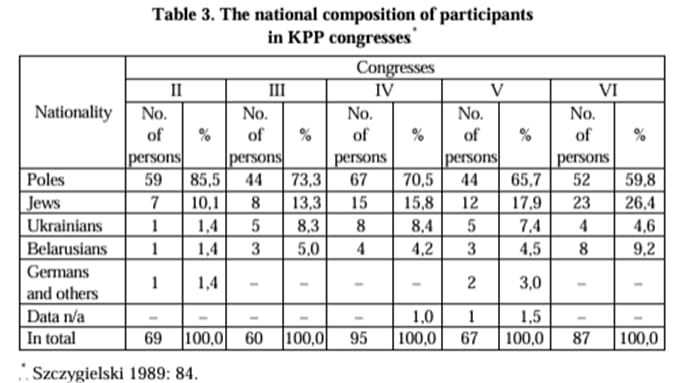
Thus, we can see that between the formation of the Polish communist party in 1918 and its dissolution in 1938 on the orders of Stalin; the party was profoundly jewish in every possible sense and that despite policies attempting to mask this. Jewish power and influence in the party only increased over time with Stalin’s ascension to power and further that the atrocities and genocides against Germans and Poles undertaken by the early Polish communist state (37) were primarily undertaken on orders of – and carried out by – jews.
Thus, we can reasonably refer to the jews in Poland as ‘Stalin’s Willing Executioners’.
References
(1) Andre Gerrits, 1995, ‘Antisemitism and anti‐communism: The Myth of ‘Judeo‐Communism’ in Eastern Europe’, East European Jewish Affairs, Vol. 25, No. 1, pp. 50-51
(2) Jaff Schatz, 1991, ‘The Generation: The Rise and Fall of the Jewish Communists in Poland’, 1st Edition, University of California Press: Berkeley, pp. 96-97
(3) Jan Gross, 2006, ‘Fear: Anti-Semitism in Poland after Auschwitz’, 1st Edition, Random House: New York, pp. 194-197
(4) Ibid., pp. 197-203
(5) Tadeusz Piotrowski, 1998, ‘Poland’s Holocaust: Ethnic Strife, Collaboration with Occupying Forces and Genocide in the Second Republic, 1918-1947’, 1st Edition, McFarland: Jefferson, p. 36
(6) Ibid., p. 37
(7) Schatz, Op. Cit., p. 97
(8) Henryk Cimek, 2012, ‘Jews in the Polish Communist Movement (1918–1937)’, Polityka i Spoleczenstwo, No. 9, p. 42
(9) Batya Knebel, 2016, ‘Revisiting the Jewish Role in Polish Security Service, the UB: Between Soviet Communist Rule and a Hard Place’, Published Masters Theses: Duke University, p. 58
(10) Ibid., p. 60
(11) Cimek, Op. Cit., pp. 42-50
(12) Ibid., p. 51
(13) Ibid., p. 43
(14) Ibid., pp. 42-44
(15) Aadne Aasland, 1994, ‘Russians in Latvia: Ethnic Identity and Ethnopolitical Change’, Published PhD Theses: University of Glasgow, p. 55
(16) Implied by Bernard Wasserstein, 2012, ‘On the Eve: The Jews of Europe Before the Second World War’, 1st Edition, Profile: London, pp. 54-55
(17) Cimek, Op. Cit., p. 51
(18) Ibid., p. 50
(19) Ibid., p. 52
(20) Figures taken from Ibid., p. 51
(21) Idem.
(22) Ibid., p. 44; Howard Sachar, 2002, ‘Dreamland: Europeans and Jews in the Aftermath of the Great War’, 1st Edition, Vintage: New York, p. 65
(23) Cimek. Op. Cit., p. 52
(24) On this please see my article: https://karlradl14.substack.com/p/jewish-versus-non-jewish-victims
(25) On this please see my article: https://karlradl14.substack.com/p/jews-and-communism-in-latvia-1918
(26) Cimek, Op. Cit., p. 53
(27) Schatz, Op. Cit., p. 97
(28) Liudas Truska, n.d., ‘Preconditions of the Holocaust: The Upsurge of Anti-Semitism in Lithuania in the years of the Soviet Occupation (1940-1941)’, p. 9 (Available here: http://www.komisija.lt/Files/www.komisija.lt/File/Tyrimu_baze/Naciu%20okupacija/Holokausto%20prielaidos/Eng/Truska/Research%20by%20L.Truska%20(english).pdf)
(29) Cimek, Op. Cit., pp. 53-54
(30) On this please see my article: https://karlradl14.substack.com/p/the-jewish-role-in-the-hungarian
(31) Cimek, Op. Cit., p. 52
(32) Schatz, Op. Cit., p. 97
(33) Cimek, Op. Cit., p. 53
(34) Ibid., p. 54
(35) Idem.
(36) Ibid., p. 55
(37) On this cf. J. Otto Pohl, 2022, ‘The Years of Great Silence: The Deportation, Special Settlement, and Mobilization into the Labor Army of Ethnic Germans in the USSR, 1941–1955’, 1st Edition, ibidem Verlag: Stuttgart and Alfred-Maurice de Zayas, 2006, ‘A Terrible Revenge: The Ethnic Cleansing of the East European Germans’, 2nd Edition, Griffin: New York
Karl’s SubstackRead More





 T1
T1