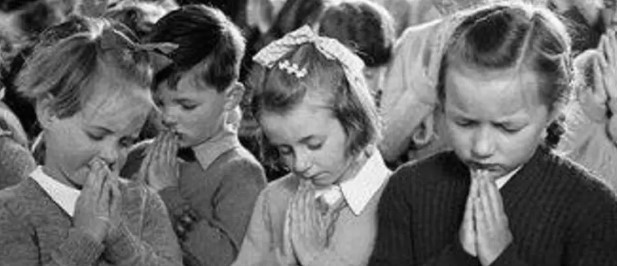
Recently I stumbled across some primary source material from the late Kampfzeit era of the NSDAP where-in after (long-time NSDAP member and friend of Adolf Hitler) Wilhelm Frick had – since he had become the Minister of Education in the central German state of Thuringia in 1929 – had pushed some radical anti-jewish pro-Christian reforms in the schools of said German state: namely the re-introduction of mandatory morning prayers (1) that were overtly and consciously racial as well as anti-Semitic.
The ‘Jewish Telegraphic Agency’ (JTA) reported on 9th May 1930 that:
‘Prayers directed against “aliens to our race, the Jews who demoralize the German people,” have been introduced into the school prayers of Thuringia by Minister of Cults Frick. The prayer calls on the “Lord to protect us from people of a foreign element.”
When the Socialist members of the Thuringian Landtag raised the question Minister of Cults Frick replied, “I sincerely declare that the prayers are directed against aliens to our race, the Jews who demoralize the German people.” The Socialists then declared that the anti-Semitic prayers were contrary to the Reich’s constitution and that the Reich government must therefore prohibit them.’ (2)
JTA mistakenly referred to Frick as the ‘Minister of Cults’ – such factual reporting mistakes were not uncommon at the time – when he was fact the ‘Minister of Education’. This was subsequently corrected by JTA in their article on the speedy intervention of the Reich government in Berlin – specifically by Joseph Wirth who was the Minister of the Interior of Heinrich Bruning’s ‘Catholic Centre Party’ (aka ‘Zentrum’) in 1930 not by Albrecht Wirth (a prominent academic historian; who was a long-time friend of Dietrich Eckart’s as well as Adolf Hitler’s who joined the NSDAP in 1920) who JTA have mistakenly confused with the then Minister of the Interior Joseph Wirth – who was almost certainly prompted by jewish pressure – possibly in return for money – (3) as to intervene in this way using whatever social/political/economic pressure they could muster was very much their modus operandi at the time. (4)
Thus, JTA reported on 15th May 1930:
‘A protest on behalf of the Reich government against the anti-Semitic prayers recently introduced into the schools of Thuringia as infringing the German constitution and violating the religious freedom of German citizens has been forwarded to the Thuringian ministry of state by Dr. Albrecht Wirth, German minister of interior.
Dr. Wirth wrote to the Thuringian ministry of state in connection with the recent demand of the National Socialists in Thuringia that unless members of their party were appointed police directors they would create a government crisis. It was also the National Socialist minister of education, Dr. Frick, who introduced the anti-Semitic prayers.’ (5)
We can see the NSDAP was – quite deliberately I might add – playing the jews at their own game of brinkmanship and while the jews were primarily using whatever social/political/economic pressure they could muster; the NSDAP had little else but increasing popular mass support (primarily among the farmers, tradesmen and workers of Germany), (6) democratic legitimacy and no fear of jewish tricks. Thus, they played the jews at a high stakes game of chicken with little financial backing – other than lots of small donations from Germans who could ill-afford to donate anything – (7) and they did so in part because of their faith in both political and religious terms.
You see at the heart of Frick’s motivation re-introduction of mandatory morning prayers (8) that were overtly and consciously racial as well as anti-Semitic was the fact that he was a devout Protestant Christian (9) and an outspoken admirer of Martin Luther (10) who directly associated National Socialism with Luther’s brand of Protestant Christianity. (11)
Despite being a devout Lutheran; Frick – who was Hitler’s official liaison to the Protestant Churches – (12) had no problem with other Christian denominations such as Catholicism unless – in his view – they sought to attack to Protestantism and thus try and split the German (and Aryan/European) people in general along the lines of religious confession (aka ‘Political Christianity’/’Political Churches’ in the language of National Socialism) (13) and even used his role as the Third Reich’s Minister of the Interior during the 1930s to force Constantin von Neurath – the Third Reich’s Minister of Foreign Affairs during most of the 1930s – to formally lodge a complaint with the Vatican over several anti-Protestant articles published in the semi-official Vatican newspaper ‘L’Osservatore Romano’. (14)
However, even Frick and the NSDAP had to bow to legal and political reality in order to achieve their ultimate goal: the Third Reich. So, while Frick and the NSDAP in Thuringia struck a defiant tone to the end. They also realised that they made a valid point about where they stood and what they wanted to do to both the voters of Thuringia and also to Germany in general with Alfred Rosenberg’s ‘Volkischer Beobachter’ praising Frick’s introduction of such prayers in December 1930. (15)
Hence JTA reported in article on 15th July 1930 that:
‘The National Socialists of Thuringia meeting in convention here decided that they would abide by the decision of the German Supreme Court which on Friday declared unconstitutional and prohibited the anti-Semitic school prayers recently introduced into the schools of Thuringia by Dr. Wilhelm Frick. This decision came as a surprise in view of a statement issued yesterday by Dr. Frick in which he indicated that he had no intention of eliminating those sections of the prayers which the Supreme Court had found offensive.
While saying that Dr. Frick’s interviews in the press were not offensive to the Jews, the Thuringian premier, Dr. Baum, speaking on behalf of his entire cabinet, officially declared that Thuringia would bow to the decision of the Court.’ (16)
And there the matter rested until 30th January 1933 when soon after the racial and anti-Semitic prayers were re-introduced by the NSDAP in Thuringia.
References
(1) Richard Steigmann-Gall, 2003, ‘The Holy Reich: Nazi Conceptions of Christianity, 1919-1945’, 1st Edition, Cambridge University Press: New York, p. 80; Steigmann-Gall mistakenly suggests Frick’s prayer reforms were in Bavaria, but they were actually in Thuringia.
(2) https://www.jta.org/archive/introduce-anti-semitic-prayers-in-schools-of-thuringia
(3) For an example of jewish bankers (Georg Salomonsohn and Oskar Wassermann specifically) doing this just two years later in 1932 please see: Henry Ashby Turner Jr., 1985, ‘German Big Business and the Rise of Hitler’, 1st Edition, Oxford University Press: New York, p. 296
(4) On this see for example: Peter Pulzer, 1988, ‘The Rise of Political Anti-Semitism in Germany & Austria’, 2nd Edition, Peter Halban: London, esp. pp. 285-321 as well as Harriet Pass Freidenreich, 1991, ‘Jewish Politics in Vienna, 1918-1938’, 1st Edition, Indiana University Press: Bloomington, esp. pp. 181-203 that this wasn’t limited to both the time or the place see for example David Mocatta, 1973, ‘The Jews of Spain and Portugal and the Inquisition’, 1st Edition, Cooper Square: New York, pp. 36; 52; 60 for medieval and early modern Spain and for eighteenth and nineteenth century Britain see Neville Laski, 1952, ‘The Laws and Charities of the Spanish and Portuguese Jews Congregation of London’, 1st Edition, The Cresset Press: London, pp. 14-15
(5) https://www.jta.org/archive/reich-protests-anti-semitic-prayers-in-thuringian-schools
(6) William Brustein, 1996, ‘The Logic of Evil: The Social Origins of the Nazi Party, 1925-1933’, 1st Edition, Yale University Press: New Haven, p. 8
(7) Henry Ashby Turner Jr., 1996, ‘Hitler’s Thirty Days to Power: January 1933’, 1st Edition, Bloomsbury: London, pp. 58-59
(8) Steigmann-Gall, Op. Cit., pp. 121-122
(9) Ibid., pp. 134-135
(10) Idem.
(11) Ibid., p. 154
(12) Ibid., pp. 158; 161
(13) On this concept and its origin within National Socialism cf. Todd Weir, 2018, ‘Hitler’s Worldview and the Interwar Kulturkampf’, Journal of Contemporary History, Vol. 53, No. 3, pp. 597-621
(14) Steigmann-Gall, Op. Cit., p. 138
(15) Ibid., p. 80
(16) https://www.jta.org/archive/thuringian-government-will-accept-ruling-of-high-court-banning-anti-semitic-prayers
Karl’s SubstackRead More








 T1
T1