The National Party of Ireland just celebrated 10 years of patriotism with a first-rate international conference in Galway, Ireland. It was perfectly organized, well attended, and utterly unbothered by demonstrators or detractors. The National Party is the only serious Irish party that is determined to reclaim the Emerald Isle for its rightful owners, the Irish people. With its theme of remigration, the conference was yet another example of the growing momentum our movement now enjoys throughout the West.
We were welcomed by Gerry Kinneavy, a veteran who has been with the party since the beginning. He reminded us of the need always to increase membership, but emphasized that ethnic nationalism is poised for a breakthrough. “Open borders have wreaked death and destruction,” he said, and more Irish people are seeing it firsthand. It is vital, he said, to establish close ties with allied parties throughout Europe. Everywhere, he said, “We must watch our ‘leaders’ like hawks,” but if we keep up the pressure, “there is light at the end of the tunnel.”
I was the opening speaker and expressed my incomprehension that Ireland, of all nations, should have opened itself up to mass immigration. “You fought the English for 800 years, and now that you are masters in your own house, your rulers are giving your beautiful nation away to Africans and Muslims?” On the continent and in America, we are constantly reminded of slavery, empire, and suffering aboriginals, but by no intellectual sleight of hand can Ireland be thought of as owing anything to anyone. In our struggle against a perverse morality that denies homelands only to whites, we must remember the example set by other revolutionaries. I noted that on July 4 exactly 250 years ago, 56 men committed themselves to a purpose to which they mutually pledged their lives, their fortunes, and their sacred honor. Those men changed history, I said, and we will do no less.
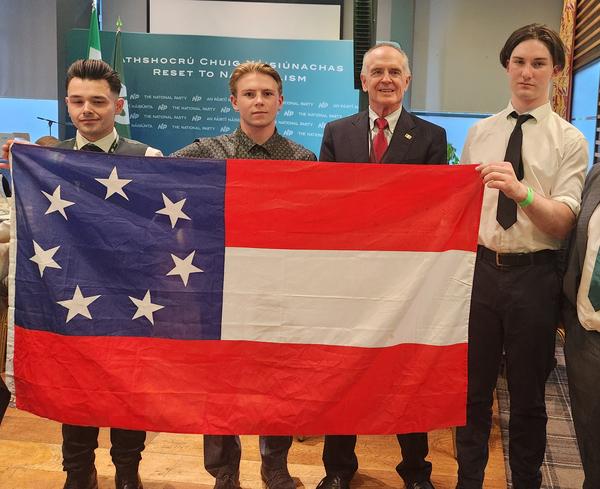
Irish comrades welcomed me with the First National Flag of the Confederacy.
The next speaker was Tom Claeys of the Flemish NSV or Nationalist Student Union. This is the organization that organized the marvelous remigration march I was lucky enough to attend in Leuven, Belgium, in March. His student organization — now 50 years old — trains young men and women for future roles in the nationalist movement, with a motto familiar to Americans: semper fidelis. Immigration has become such a serious problem that even the Left has been forced to take notice, but its only solution is more money, more programs.
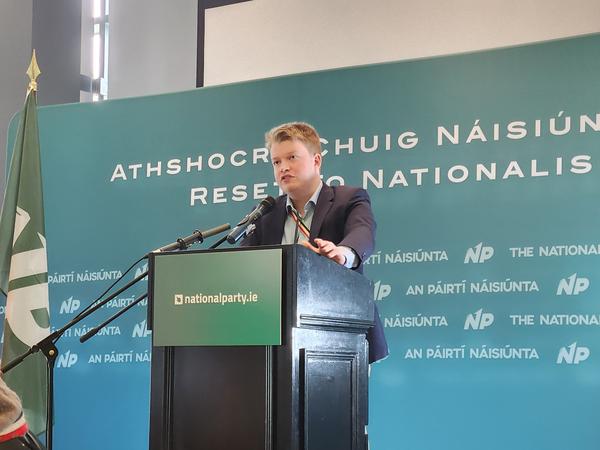
Tom Claeyes
Mr. Claeys gave examples of the persecution of Flemish patriots — the case of Dries Van Langenhove is a striking example — and derided crazed leftists who justify anti-white aggression as “a democratic form of violence.” Even in the face of open bigotry it can still be hard to rouse ordinary people from their apathy. Mr. Claeys noted that most secessionist movements — in Scotland, Quebec, Catalonia — tend to be leftist/globalist but the movement for an independent Flanders is not. Flanders must forever be the exclusive home of the Flemish people. Even if the larger movement for remigration should fail, Flanders will be the final redoubt for his people. However, our goal should always be: “Europe for Europeans — yesterday, tomorrow and for millennia.”
Adrian Kochan represented an equally venerable institution, All Polish Youth. It is a Catholic patriotic organization open to Poles, ages 15 to 30. Like the NSV, it trains patriots for the “long march through the institutions,” with a three-fold emphasis: intellectual, spiritual, and physical. Mr. Kochan noted that “all-Polish” means that the organization is open to Poles of all classes and backgrounds. He noted that although critics complain that nationalists are inward-looking, the opposite is true. Patriots throughout Europe support each other, and Poles have always thought fondly of Ireland as a fellow Catholic nation on the other side of Europe. He wished for Ireland a complete escape from the Anglosphere to the point that “I hope to see Ireland without any English signs in the streets; only Irish.”

Adrian Kochan
Mr. Kochan reminded us that Poland’s independence day is a massive celebration, not just of Polish nationalism but pan-European patriotism, with enthusiastic contingents from all across the continent. “Collective action creates an energy and bonds that strengthen us,” he said. “I call it patriotic unity, collective effervescence.” There is only one solution: “Save the nation save civilization, remigration!”
Irish writer and activist Keith Woods noted that Irish politics has a shockingly narrow political spectrum. All institutions share the same assumptions. This gives an appearance of solidity, but when the entire ruling class betrays the nation, resentment builds below the surface. The prevailing theory is that diversity fails in other countries because of the racism of Europeans. Ireland will do better because the Irish are pure: They have never exploited or colonized non-whites. And yet, the elites are worried. Dennis O’Brien, the richest man in Ireland, proudly proclaims that combating racism is his greatest priority.
Foolish expectations will, of course, be disappointed, and racial gaps in achievement and temperament will be impossible to deny. Ethnic nationalism is therefore inevitable. Ireland’s rulers have clearly forgotten that in the 1980s, theorists were saying that Yugoslavia was a perfect example of overcoming narrow identity and was a model for the world. History proved them wrong, and in the meantime, Ireland tries to paper over the problem by the blind pursuit of population and GNP growth.
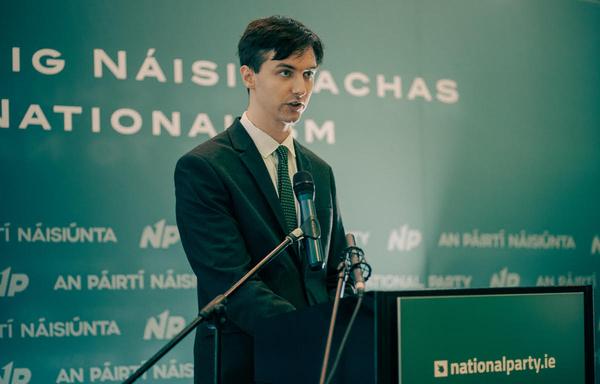
Keith Woods
The sensible thing would be to give nationalism a voice, as most European nations have, but by suppressing every hint of it, Ireland is only making the coming confrontation worse. Ironically, the Irish should know better than anyone the perils of diversity. For centuries, it has seen English/Irish and Protestant/Catholic conflict. Unlike peoples do not live in peace.
Attilio Sodi Russotto is the ranking member in charge of foreign affairs for the Italian identitarian group Casaggi. He recalled the many Italians who shed their blood for Italy; they died for spiritual reasons, not material gain. He argued that it is a mistake to think that our opponents hold what is merely an opposing viewpoint. “They want to destroy us,” he said. “It is as if they are taking revenge on Nature itself.” What we are seeing is not a political difference but something deeper, a clash of archetypes.
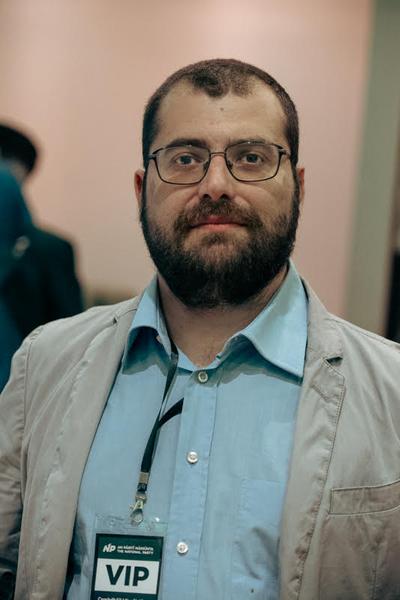
Attilio Sodi Russotto
However, a community of faith endures longer than any government. “When a comrade dies,” he said, “we say he has gone ahead. It is not the end.” Like Italians who fight for their nation, the Irish fight for what they know to be true. “They can see it and touch it. It is real as rivers or mountains.” But consciousness is nothing without action. “A strong resistance is building around a single word,” he said, “Remigration. Let us press forward until our dying breaths.”
Greg Johnson of Counter-Currents noted that Ireland has many advantages in its fight to reclaim the nation. It never had an empire, so cannot be colonized by former subjects. He warned that it is in any case a mistake to try to defend past imperialism; admit that unwanted rule by foreigners was wrong in the past, and it is wrong today. The Irish struggle against England has always been anti-imperialist, and Ireland can defend itself from colonization by evoking its colonized past.
Ireland can never be called a nation of immigrants; it was a nation of people who emigrated. Our opponents perversely try to turn that into a justification for invasion: The Irish found refuge overseas, so they should now offer refuge to others. Thus does the Left seek to dispossess all whites, whether colonizers or colonized. The Irish who live in Ireland today are the ones who stayed. They stayed because this is their land, for them alone.

Greg Johnson
Other advantages are that the Irish have seen firsthand that diversity is not a strength, and that the Irish have a clear ethnic identity. No one has ever pretended that Ireland is a “proposition nation,” like the United States. It also has a recent, living history of patriotic struggle, and has no recent tradition of monarchical, hereditary rule rather selection of leaders by merit. Ireland is fortunate to be an English-speaking country and can therefore communicate easily with identitarians across Europe. Finally, Ireland has an extensive diaspora. Now is the time to explain to Irish-Americans the extent of the migration crisis and seek their help in the patriotic struggle.
John McLoughlin, one of the leaders of the National Party, gave an inspiring speech about the nature and purpose of our struggle. Conferences of this kind are a wonderful way to restore commitment and confidence, and we must all go back to our associates with this renewed and infectious commitment. No matter how far we fall, European man always comes back to accomplish great things. Although the press calls remigration “ethnic cleansing,” it is the reverse of ethnic cleansing and is the only peaceful solution. Those of us who understand are fighting for our nations, and have nothing less than the fate of humanity in our hands. We are determined that our generation will not be the last of our kind, and our only choice is fervent commitment. “Time and again,” said Mr. McLoughlin, “Western Civilization has gone to the dogs, but it was the dog who died, and our people who came back.”
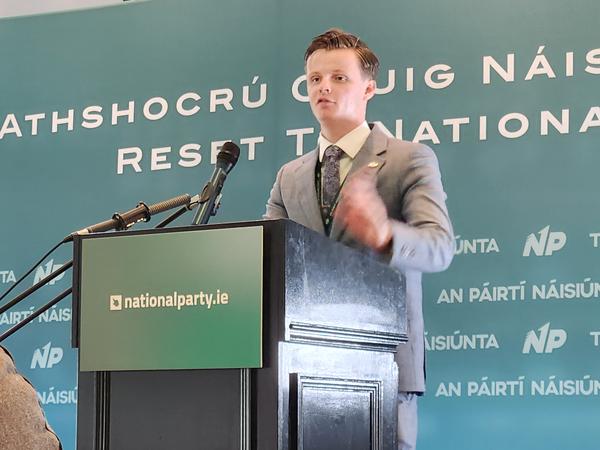
John McLoughlin
Yan MacOireachtaigh, also of the National Party, was one of several speakers who greeted the audience in Gaelic. He pointed out that we have another R-word besides remigration, and that is responsibility. If we are to be leaders, we must first be responsible to ourselves and leaders of ourselves. Even those who are unseasoned will grow into their roles. Our generation will not be the one that breaks that ancient Gaelic chain that goes back thousands of years. Each one of us is part of the great collectivity that is our nation and race. Mr. MacOireachtaigh vowed that on the 10th anniversary of the founding of the National Party, we must build a party that will last 100 years.
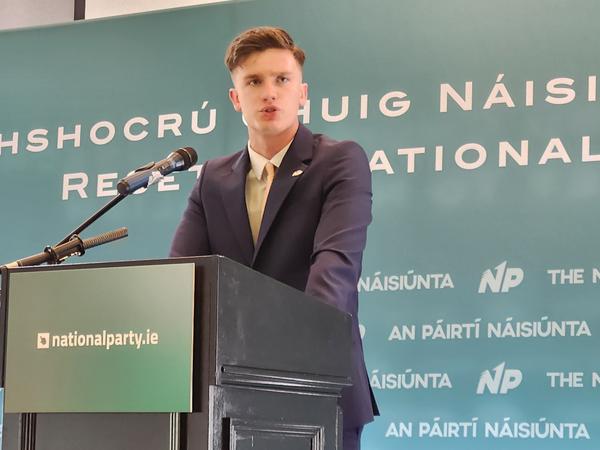
Yan MacOireachtaigh
The final speaker was Martin Sellner of Austria, widely respected as the man who has done the most to make “remigration” a household word. There is no need to talk about the reason for remigration, he said. We are here because we have the same goal, and every other objective is, for now, a side issue. Actual billions want to come and live with us, on a continent where there is no retreat and no white flight. Millions came illegally; they can leave legally.
How do you normalize an idea, he asked. You do it just as you normalize a new fashion, by repetition. We must make remigration central to any discussion of immigration and promote it as the only thinkable solution.

Martin Sellner
As part of a very effective visual presentation, Mr. Sellner played videos of migrant columns heading to the West — but in reverse, with everyone marching backwards. He also showed slides of many effective actions that he and others have undertaken to call media attention to remigration. Activism, he said, is a science that has high risks but also high rewards. A few brave activists can make a spectacular demonstration and do more to make the public aware of us than any number of essays or articles.
Mr. Sellner also warned that there is no way we can fight the system physically; it is much too strong, and will use every futile act of violence as an excuse for ever-harsher repression.
On July 15, Mr. Sellner and others will present 500,000 signatures to the authorities in Brussels — the united voice of half a million Europeans who demand that remigration be debated by the EU. He invited the audience to join him there for a huge demonstration. We are reaching a tipping point, he said. Everywhere, there are people like you, he said. The Irish people are the sons and daughters of saints and heroes. You must — you will — take your country back.
The post Ireland for the Irish! appeared first on American Renaissance.
American RenaissanceRead More








 T1
T1