I’m not a movie guy, a mix of being a workaholic and being busy with the kids, I suppose, but I just never watch movies. Whenever I do find myself with a little spare time I just pick up a book, after all, most movie critics just seem to be endlessly complaining about how bad things are these days, which they aren’t wrong about. Why put myself through so much slop in search of a rare gem?
A couple of weeks ago, though, Mark Collett reached out to me and asked me if I wanted to join his monthly movie review stream as he was going to be going over the new Nuremberg film, a topic I had covered extensively in the past and so naturally I’d make the ideal guest. I immediately assumed the movie would be Schindler’s List tier gutter trash and dreaded having to put myself through it but I said yes anyway because I couldn’t bring myself to say no to Mark who is always good to me. (Although I then proceeded to figure out like an hour before the stream that it was not in fact a watch along but actually just a review and I hadn’t seen the film yet, so we had to postpone until the next week, sorry Mark!)
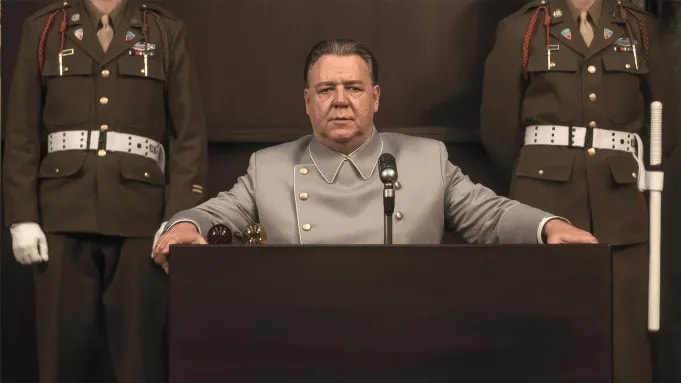
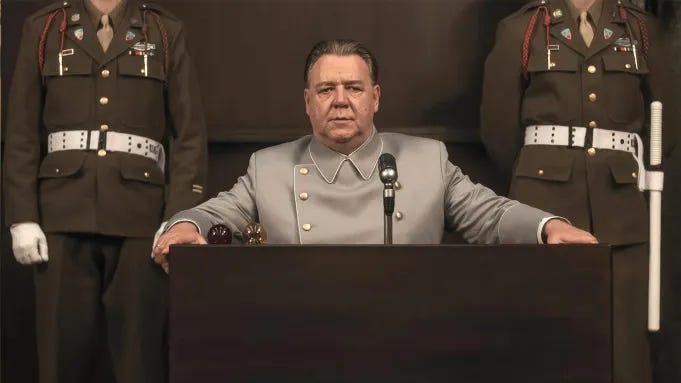
Russell Crowe as Hermann Göring
The movie opened with an American soldier pissing on a bit of swastika-emblazoned debris from a downed Luftwaffe aircraft, quite rightly I immediately feared the worst. The next moment Hermann Goring, to the surprise of the Americans, arrived on scene and a tense stand-off ensues in which the GIs, fingers on their triggers, seem ready to blow Göring’s head off at a moments notice. Knowing that in reality this was a pre-arranged meeting in which the Texan General Robert Stack and Hermann Göring got on fabulously (to the point of the unit getting in trouble), I had a feeling I was in for a grueling two hours.
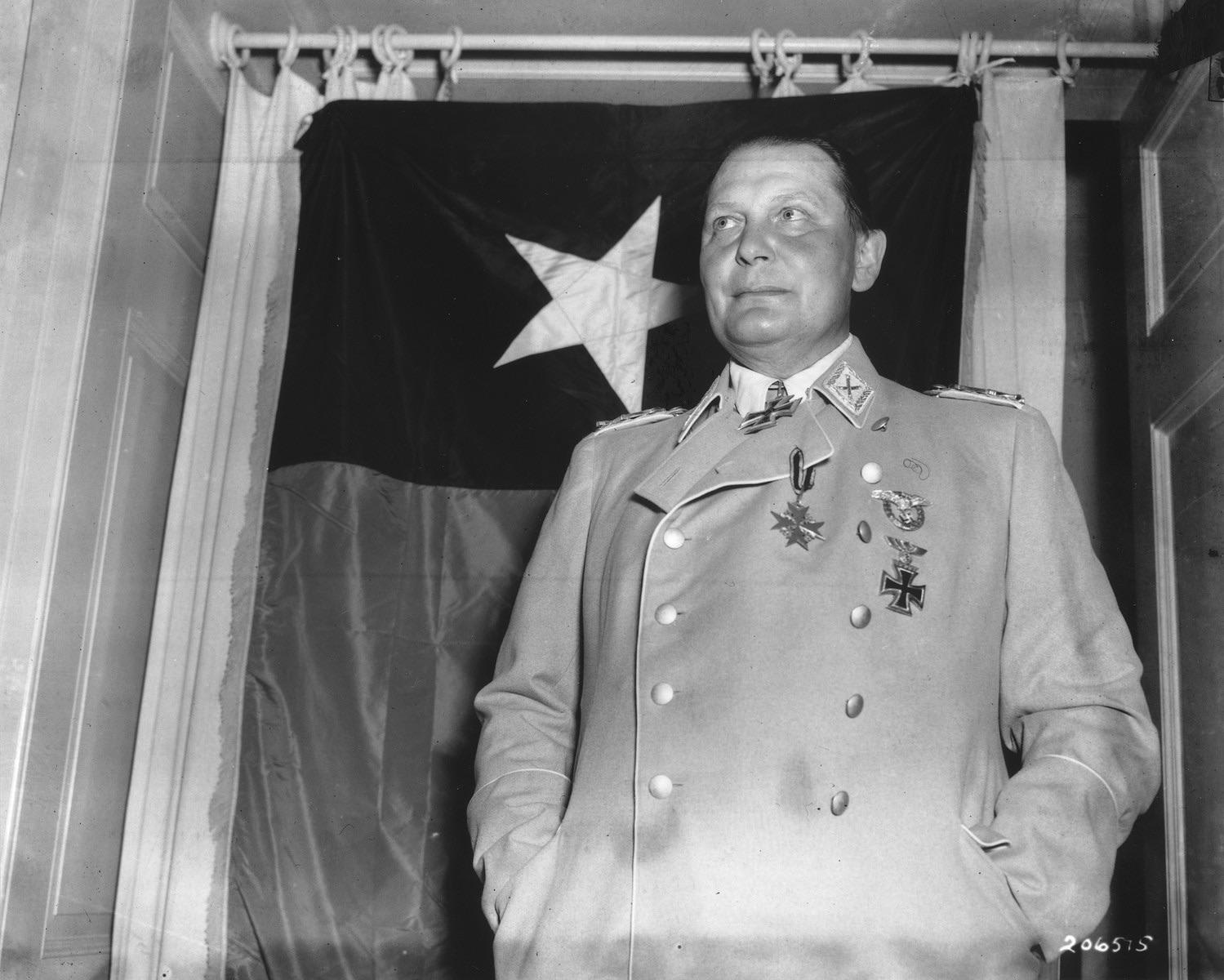
Much to my surprise I was quickly dispelled of this illusion. We are soon introduced to Colonel Burton Andrus, the Prison Commandant at Mondorf (where the Germans were held until the stage was set for them in Nuremberg) and then at Nuremberg, who, true to life, was a real bastard that was hard on his prisoners and made it his life’s mission to make their stay with him hell. Göring then enters the stage and it was immediately obvious that Russell Crowe had put his heart and soul into getting the Reichsmarschall right, whether it be his size, his mannerisms, his personality or the convincing German. Nobody has ever done Göring better and any scenes with Crowe’s Göring in was an absolute joy to watch.
The main idea of the film is essentially that ‘anyone can become a Nazi’, a message that is a little too forced at times as Rami Malek’s character, the psychiatrist Douglas Kelley, never stops banging on about how his patients are normal people led down a dark path.
The choice of Kelley was a strange one for me. Not once during my Göring or Nuremberg videos (over 7 hours combined) is he mentioned, he clearly wasn’t overly close with Göring and he ends up being used as a convenient way to push the film’s message. I quickly noticed that he was multiple characters rolled into one. There is a scene in which Kelley goes to visit the Emmy and Edda Göring, in real life this was Pastor Gerecke, whose services Göring never missed and the Reichsmarschall even went to the extent of haranguing his fellow prisoners into attending them (only Rosenberg held out).
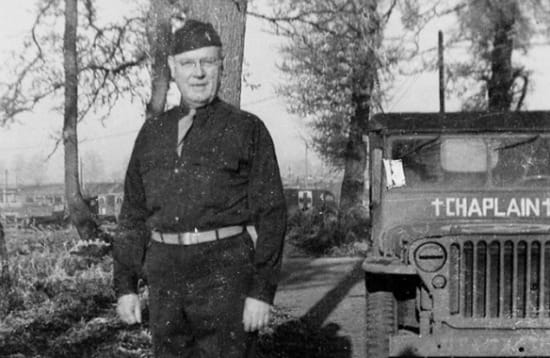
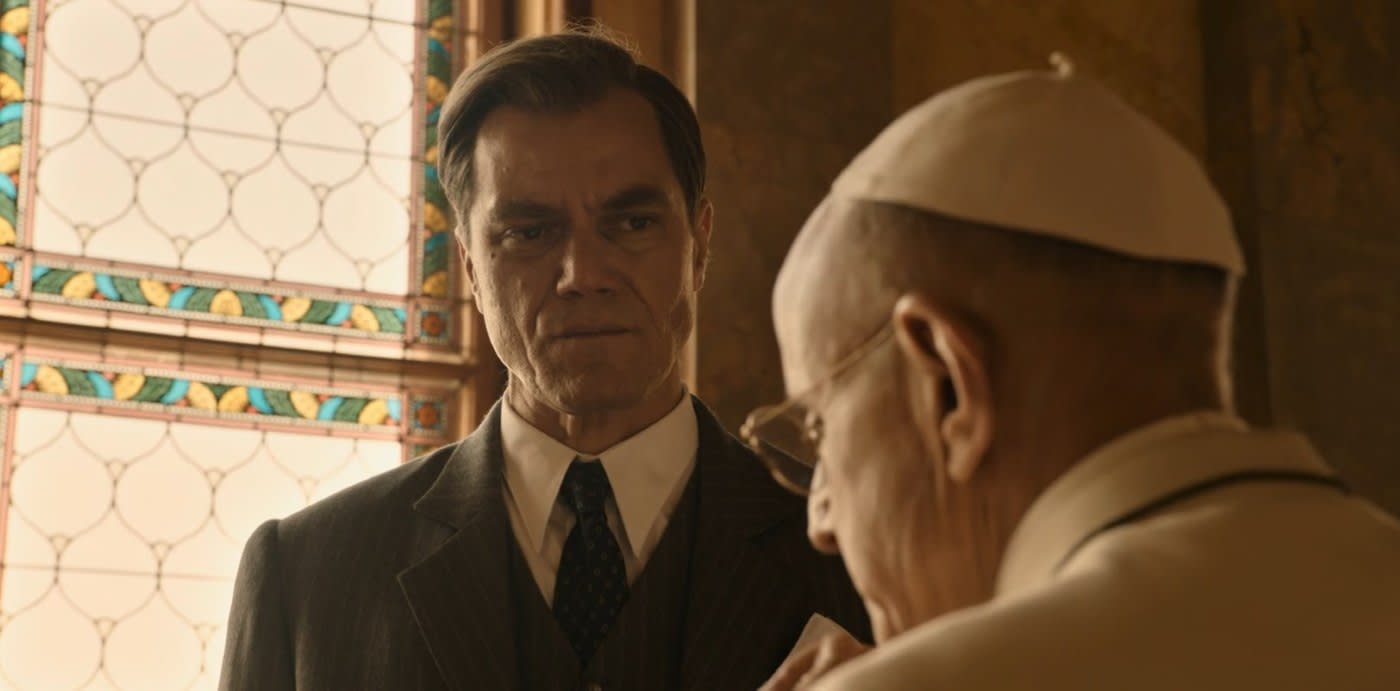
In another scene Judge Jackson (who is leading the trials, played by Michael Shannon) meets with Douglas Kelley and asks him to feed back information from Göring about his plans to defend himself in court. This was done more extensively by Dr Gilbert, Goring’s Jewish Doctor who he got on rather well with.
Kelley, who is barely mentioned in anything I’ve read about the trials, seems to have been these three chaps morphed into one for the sake of convenience.
There were some other scenes that were noticeably different to the reality, the one that stuck out the most for me being when Judge Jackson meets the Pope and, in the film’s words, blackmails him. In reality His Holiness was simply asked to provide any evidence of German crimes, something he agreed to do, in Jackson’s words: ‘he was especially concerned that the whole German people should not be charged with criminality. He thought that was unwise and unfair, for he knew that many people had incurred considerable risk in opposing the Nazi regime.’1 The film instead shows this bizarre scene in which the Pope is made to appear evil and only agrees to giving his blessing to the trials under blackmail about his own involvement with the Nazis which caused so much suffering for Jews. Except for this, though, there weren’t too many other scenes which I found to be egregiously twisted, although Streicher’s execution was a little unfairly done, which I’ll go into later.
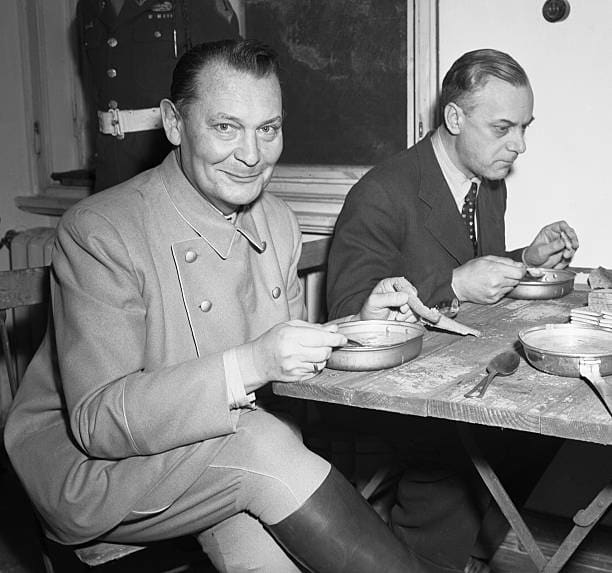
As Mark said on our stream, this really was ‘the Hermann Göring show’, but, as I pointed out, this was also the case in reality. Göring truly did dominate the proceedings and the entire fiasco became all about him and almost him alone. Still, I was a little disappointed at the lack of appearances from the other defendants, those that even made the cut were chosen very selectively for ‘eccentric’ types. We only really get to meet Rudolf Hess (gone mad), Robert Ley (losing his mind, commits suicide dramatically) and Julius Streicher (‘low IQ anti-Semite’ caricature). Regardless, those three were still done pretty accurately.
I’m nitpicking though. The movie was extremely enjoyable and I was having a great time, even finding myself laughing at times, especially when Göring was finally able to speak in the courtroom, mostly because I was surprised at how well it was portrayed and shocked at the things they actually decided to include. This all-important scene was pretty close to reality although missed key elements such as General Milch speaking first in defence of Göring. He ran rings around the courtroom to such a degree that he was sent to a Dachau punishment bunker! (A rare occasion of the Allies sending a Mischling to a Concentration Camp)
At around two-thirds of the way in, though, one of the characters is revealed to be Jewish and the movie takes an extremely weird dark turn. We’re hit with the story of how this fellow’s family only had one ticket to get out of Germany and sent him to the US where he was able to join the army. His parents didn’t make it. This then descends into the typical sort of Jewish revenge fantasy stuff we’re used to from Hollywood movies about WW2 but it wasn’t unbearable, it just felt a little forced, it could have been done more smoothly. I don’t think anyone would argue with a Jewish character feeling resentment in 1945/46 Germany.
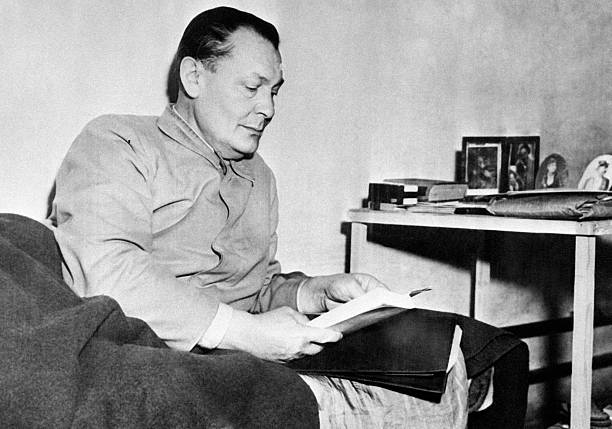
The final scene I felt was lacking somewhat. Göring magically has a cyanide capsule in his cell and beats the hangman’s noose (his doctor had brought it from the storage room where a paid-off American guard had stashed it). A big deal is made of Göring boastfully escaping justice, but annoyingly (probably only to me of anyone that watched it) they didn’t include any of his defiant letters he left in his cell!
One was folded, with writing on both sides:
‘To the Allied Control Council
I would have let you shoot me without further ado! But it is not possible to hang the German Reichsmarschall! I cannot permit this, for Germany’s sake. Besides, I have no moral obligation to submit to the justice of my enemies. I have therefore chosen the manner of death of the great Hannibal. Hermann Goring.
It was clear to me from the outset that a death sentence would be pronounced against me, as I have always regarded the trial as a purely political act by the victors, but I wanted to see this trial through for my people’s sake and I did at least expect that I should not be denied a soldier’s death. Before God, my country, and my conscience I feel myself free of the blame that an enemy tribunal has attached to me.’2
Another letter poked fun at Colonel Andrus over beating the noose which must have stung considering Göring’s suicide ‘ruined Colonel Andrus’ week, month, year – and indeed the rest of his life.’3 The postscript explained that Dr Gilbert had been the one to tell him that the method of execution would not be a firing squad, another old score settled. None of this was included, but I suppose the guy could only be given so much credit, he completely dominated the proceedings from start to finish and got the exact dramatic ending he was hoping for!
The death of Streicher too was just silly. The rest of the executions weren’t shown, just his, and it was extremely over-dramatised, complete with a weird shot of him pissing himself after being hung. Just crass and weird.
The film, meanwhile, ends with a very on the nose message. Douglas Kelley, the ending explains, was not listened to. No one believed him that anyone at any time could become a Nazi and do the things these men did. He went on to kill himself in the exact same manner as Hermann after a depressing life of failure.
The message is obvious, Trump is here now and your fellow-Americans who support him could become just like the Nazis! It’s pretty shoehorned in at certain points but it’s not too annoying. It’s just expected in modern day films now really.
Overall though, far better than I expected! A fun watch, mostly accurate, extremely well-casted (especially the Reichsmarschall!) and doesn’t force feed you too much slop. One could only dream of all World War 2 films being handled in such a balanced manner!
Honestly I’d give it a solid 8/10 if we’re comparing it with what else is on the market, I’d really recommend it and, really, it could or should have been a series. There was so much that was left out that could have been included. The trials did go on for a year, after all.
Nuremberg: The Last Battle, David Irving, p105
Nuremberg: The Last Battle, David Irving, p304
Nuremberg: The Last Battle, David Irving, p307
Zoomer HistorianRead More








 T1
T1