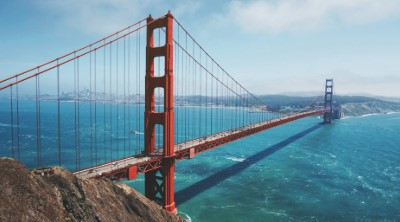
One of the most persistent ‘jewish invention’ myths in the American context is the claim that jews designed the famous Golden Gate Brigade that spans San Francisco bay between the old Fort Baker on the north side and Fort Rock Point on the south side that was built between 1933 and 1937, which has become one of the great man-made landmarks of North America along with Statue of Liberty and the White House.
It is often styled by jews as being the design and creation of its chief engineer, who was a jew named Joseph Strauss. (1) Jews aren’t alone in echoing this false claim since PBS have also been known to do so. (2)
The official ‘Golden Gate Bridge’ website however documents that this narrative is complete and utter nonsense when they explain how:
‘In 1921, Joseph B. Strauss hired Charles A. Ellis to head up his staff and soon advanced him to Vice President, Strauss Engineering Corporation, in charge of bridge design and construction supervision. In 1925, Strauss had Ellis arrange for Prof. George F. Swain of Harvard University and Leon Moisseiff who designed New York’s Manhattan Bridge to serve on a Board of Consultants for the project.
Both men reviewed Strauss’s original plans for a symmetrical cantilever-suspension hybrid bridge and found them to be practical from an engineering standpoint and capable of being built. In November 1925, Moisseiff expressed concern about the hybrid design and submitted to Strauss his Report on Comparative Design of a Stiffened Suspension Bridge over the Golden Gate Strait at San Francisco, CA, which describes a design contrasting from the cantilever-suspension hybrid bridge design—a suspension span design.
The suspension span concept did not immediately become the leading design for the bridge as Strauss continued to campaign for a bridge using his original symmetrical cantilever-suspension hybrid design as late as 1929.
On August 15, 1929, the Board appointed prominent engineers Moisseiff, O.H. Ammann, and University of California, Engineering School, Berkeley, CA, Professor Charles Derleth, Jr., to serve as the Advisory Board of Engineers, alongside Chief Engineer Strauss. Strauss also appointed Ellis to work with the Advisory Board of Engineers, serving as its Secretary.
The timing of the change from the original Strauss proposal to a suspension bridge design is not precisely known, but it was accomplished sometime between the release of Moisseiff’s November 1925 report and the first meeting of the Advisory Board of Engineers on August 27, 1929. Further, The Golden Gate Bridge, Report of the Chief Engineer, September 1937, by Strauss, provides no details on the transition from his originally proposed symmetrical cantilever-suspension hybrid bridge to the Moisseiff-inspired suspension span design that was eventually built, and simply states, “… In the interval which had elapsed any advantages possessed by the cantilever-suspension type bridge had practically disappeared and on recommendation of the Chief Engineer, the cantilever-suspension type was abandoned in favor of the simple suspension type.”
On March 1, 1930, with final design underway and after overseeing test borings at the construction site, Ellis returned to Chicago to work on refining the design and estimates, while continuing to consult with Advisory Board of Engineers members Moisseiff and Ammann.
Ellis was responsible for directing the thousands of calculations required, for the computation of stresses, the preparation of stress sheets, as well as the development of the specifications, contracts and proposal forms. He worked tirelessly until December 5, 1931, when Strauss insisted he take a vacation. Three days before his vacation was over, Ellis received a letter from Strauss instructing him to turn all his work over to his assistant Clarahan, and to take an indefinite unpaid vacation.
For reasons still not clear today, Strauss fired Ellis. Ellis had lost his place in the history receiving no credit for his critical role in the design of the landmark Bridge. He went on to join the engineering faculty at Purdue University in 1934, from where he retired as Professor Emeritus of the Division of Structural Engineering in 1947. He passed away on August 29, 1949.’ (3)
So, in summary: Strauss hired a non-jewish engineer named Charles Ellis to do all the actual engineering work and then promptly fired Ellis for no discernible reason in December 1931. Then as the official ‘Golden Gate Bridge’ website goes on to explain Strauss – aided by his widow – promptly stole Ellis’ work and presented it as Strauss’ work instead:
‘Strauss alienated many people in his quest to build the structure — his first suspension bridge. Obsessed with claiming credit as the span’s creator, he minimized the acknowledgement given to Charles Ellis and Leon Moissieff, the two visionaries who actually worked out the significant engineering challenges of building the bridge. Strauss’ detractors blocked a statue of the chief engineer proposed for the bridge plaza; his widow would eventually fund its creation in 1941, inscribing it, “Joseph B. Strauss, 1870-1938, ‘The Man Who Built the Bridge.’”’ (4)
Indeed, we further learn that Strauss actually abandoned the Bridge’s construction part way through since we read that:
‘During the bridge’s construction, Strauss started to feel unwell, both mentally and physically. He disappeared for more than six months — causing rumors to spread that he had suffered a nervous breakdown. During this time, Strauss divorced his longtime wife and married a young singer, many years his junior.’ (5)
Even the architecture and the Golden Gate bridge’s famous colour is not the work of Strauss, but rather this was the work of the non-jewish chief architect of the project: Irving Morrow. (6)
The only place where jews did truly contribute to the design and construction of the Golden Gate bridge is in the form of the aforementioned jewish engineer Leon Moisseiff who acted as a part-time advisor to Ellis around the wind impact on the bridge (7) and while Moisseiff certainly contributed; it is difficult to give him primary credit for the Golden Gate bridge – which rightly belongs solely with Ellis – (8) but his contribution was such that gives him the right to secondary credit for assisting Ellis with key parts of the design that allowed the Golden Gate bridge to be a success and still stand to this day.
Thus, we can see that like many other superficially plausible ‘jewish invention’ myths; the claim itself doesn’t actually stand up to even the simplest critical scrutiny.
References
(1) For example: https://aish.com/91795029/%60
(2) https://web.archive.org/web/20071117114217/https://www.pbs.org/wgbh/amex/goldengate/peopleevents/p_strauss.html
(3) https://web.archive.org/web/20171210054905/https://goldengatebridge.org/research/Design.php
(4) Idem.
(5) Idem.
(6) https://www.pbs.org/wgbh/americanexperience/features/goldengate-morrow/
(7) https://web.archive.org/web/20071117104634/https://www.pbs.org/wgbh/amex/goldengate/peopleevents/p_moisseiff.html
(8) https://www.pbs.org/wgbh/americanexperience/features/goldengate-ellis/
Karl’s SubstackRead More








 T1
T1