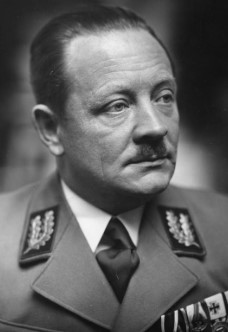
One of the most famous quotes from the Third Reich era – and one that is almost always trotted out when dealing with the Third Reich’s Eastern Policy – is a quote attributed to the Gauleiter of East Prussia and Reichs Commissar of the Ukraine Erich Koch.
This quote is usually rendered as follows:
‘We are a master race, we must remember that the lowliest German worker is racially and biologically a thousand times more valuable than the population here.’
It is rarely presented in its fuller form, which is:
‘1. We are the master race and must govern hard but just . . . .
“2. I will draw the very last out of this country. I did not come to spread bliss. I have come to help the Führer. The population must work, work, and work again . . . for some people are getting excited that the population may not get enough to eat. The population cannot demand that. One has only to remember what our heroes were deprived of in Stalingrad . . . . We definitely did not come here to give out manna. We have come here to create the basis for victory.
“3. We are a master race, we must remember that the lowliest German worker is racially and biologically a thousand times more valuable than the population here.’
The quote itself derives from a document at Nuremberg Trials where it was labelled as PS-1130 and is cited in the proceedings in fuller form as follows:
‘I now refer to Document Number 1130-PS, which is marked Exhibit USA-169. This document consists of a statement made by one Erich Koch, Reich Commissar for the Ukraine, on the 5th day of March 1943 at a meeting of the National Socialist Party in Kiev. I quote from the first page of the English text, starting with the first paragraph — and in the German text it appears at Page 2, Paragraph 1. Quoting directly again from the English text Koch said:
“1. We are the master race and must govern hard but just . . . .
“2. I will draw the very last out of this country. I did not come to spread bliss. I have come to help the Führer. The population must work, work, and work again . . . for some people are getting excited that the population may not get enough to eat. The population cannot demand that. One has only to remember what our heroes were deprived of in Stalingrad . . . . We definitely did not come here to give out manna. We have come here to create the basis for victory.
“3. We are a master race, we must remember that the lowliest German worker is racially and biologically a thousand times more valuable than the population here.”’ (1)
We can already see that the shortened version of the quote that is usually presented:
‘We are a master race, which must remember that the lowliest German worker is racially and biologically a thousand times more valuable than the population here.’
Is completely different from the full quote claimed as coming from Koch based on PS-1130 in that it is an incoherent series of three quotations attributed to Koch that he is claimed to have said in a speech in Kiev on 5th March 1943. This is because the shortened quote removes the context of the other three quotations especially quote 2.
Why is this important?
Well, the original Nuremberg Trial cited all three quotations as ‘proof of Nazi barbarity’ but they also were not citing quote 3 without the context of quotes 1 and 2 which clearly give direct context to quote 3. By removing quote 3 they are ipso facto misrepresenting what Koch is allegedly saying here.
The reason the direct context here is so important here will become glaringly apparent a little later but it is enough for the moment to state that quotes mean nothing without their context especially as Koch is clearly referring to war-time hardship and the need for hard work in quote 2 while quote 1 – only a small fragment of what Koch said – can easily be read the same way (i.e., ‘hard but just’), which would then give context of quote 3 so that it doesn’t mean what it is often claimed to mean which is:
‘We the Germans are a master race, therefore we can work the Slavic population to death because they are worth far less racially than the Germans.’
But rather something like:
‘We the Germans are a master race, therefore we must be hard [see quote 1] and not be too lenient with the Slavic population and ensure they work hard and not complain too much about the decreased amount of rations [see quote 2].’
The claimed meaning is substantially altered by adding in the direct context of what Koch said in his speech. This is only reinforced by actually examining the document these quotes come from: PS-1130.
PS-1130 is an English translation of a captured German document which is a memo about the contents of Koch’s 4th March 1943 speech in Kiev from Colonel Fahndrich who worked as the Chief Quartermaster of the Wehrmacht’s Army Group B in its 1942/1943 iteration for the ‘Case Blue’ operation (the Stalingrad offensive to the uninitiated); however, Fahndrich is also clear that he himself did not attend the meeting since he states right at the beginning of PS-1130 that:
‘Oberkriegsverwaltungsrat [approx. ‘Senior Wartime Administrator’ – KR] Dr. Claassen participated in the meeting of the NSDAP in Kiev on March 5, 1943 and gave a verbal report on the contents of the Reich Commissars Speech. Other documents on the contents of the speech are not available here.’ (2)
So as to be clear this is the original 12th November 1945 English translation of PS-1130 by its (jewish) translator Private Ernst Cohn: (3)
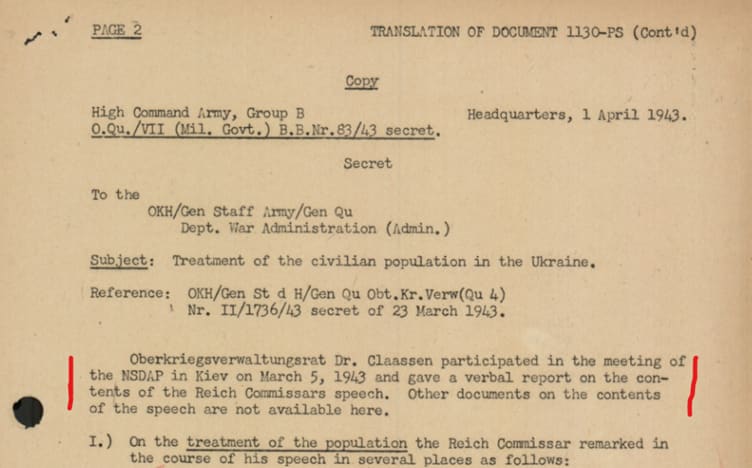
Put another way Fahndrich did not attend the meeting but rather Claassen did – Claassen was a member of the Eastern Ministry himself and was responsible for labour policy in Reichskommissariat Ukraine – it is clear that Colonel Fahndrich is reporting what Claassen verbally told him to his Wehrmacht superior Colonel von Altenstadt – referring to Colonel Hans-Georg Schmidt von Altenstadt who was killed on 25th July 1944 during the opening phases of Operation Bagration but who was a staff officer in Army Group B in the Ukraine with Fahndrich at the time – who then forwarded on Fahndrich’s written report on Claassen’s verbal report to the Reich’s Eastern Ministry Political Department specifically its head Georg Leibbrandt’s deputy Otto Brautigam where it has also been initialled as received/seen/read by Wilhelm Kinkelin; Koch’s boss at the Eastern Ministry as well as Leibbrandt and Brautigam’s direct subordinate. (4)
We can see this from Cohn’s notes on the cover letter: (5)
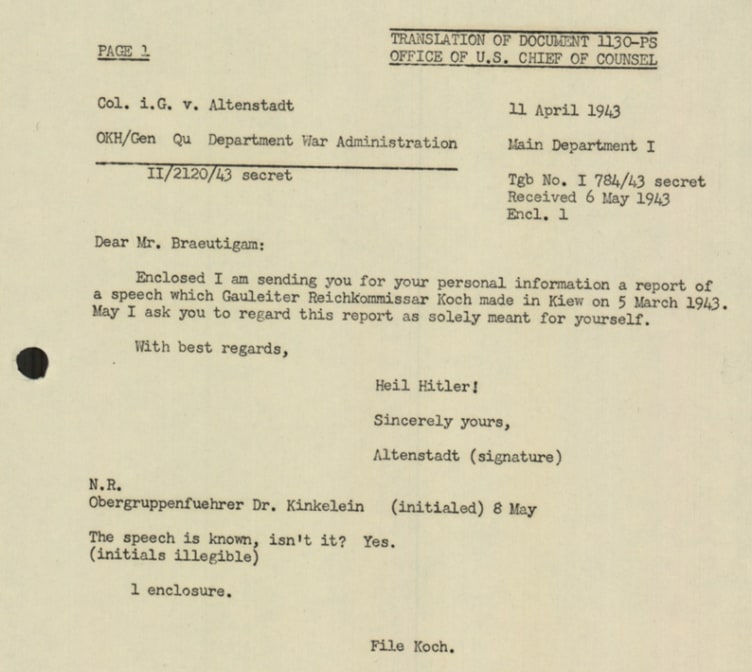
Now we can already see that this piece of evidence for what was said/occurred at the NSDAP meeting in Kiev on 5th March 1943 is already starkly different from what it is presented as both by mainstream ‘Holocaust’ historiography as well as historians and writers discussing the ‘Nazi treatment of Ukrainians’ in that this isn’t a direct quote of Koch, but rather is Claassen’s verbal rendition of what was send to Fahndrich who then wrote it down in a report to von Altenstadt who then forwarded it to Koch and Claassen’s bosses at the Eastern Ministry: Brautigam and Kinkelin.
This means of course that this claim is second hand hearsay – he said, he said – and is not good evidence of anything let alone the specific wording of Koch’s speech and may also reflect Claassen and/or Fahndrich’s misunderstandings of Koch’s words and/or meaning.
However, in this instance while the document makes sense the exact transcription and translation is far from clear as the original copy of PS-1130 is heavily fire and smoke damaged and as far as I am aware no effort has been made to check Cohn’s rendering of what he could make out from the original German document.
To give a sense of how difficult this is then please see the below page of the original German document that PS-1130 is and from and the page whence the famous quotes attributed to Koch come from, below: (6)
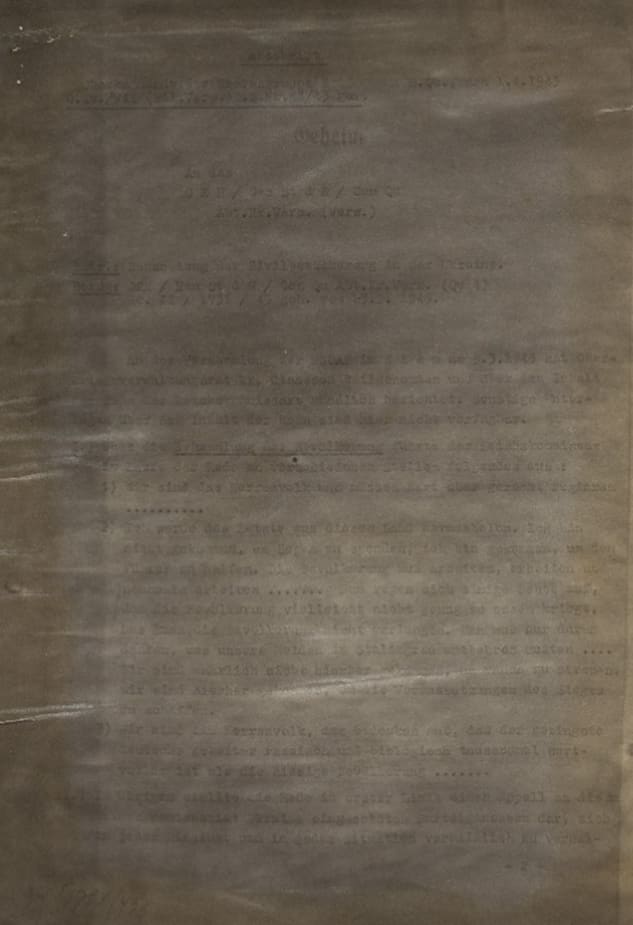
Further we learn from the ‘Staff Evidence Analysis’ of PS-1130 that the above fire and smoke damaged document is not an original German document but rather some kind of copy: (7)
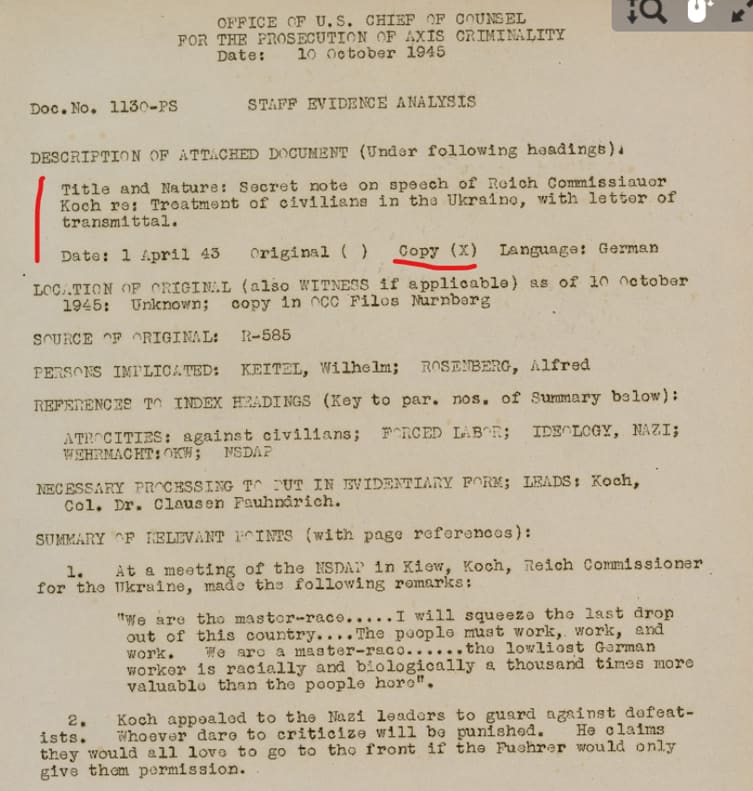
It also appears that Fahndrich did not type this memo himself but rather it was typed on his behalf by an anonymous German officer who we can only tell was a Lieutenant at the time and whose name Cohn couldn’t decipher in November 1945 either: (8)
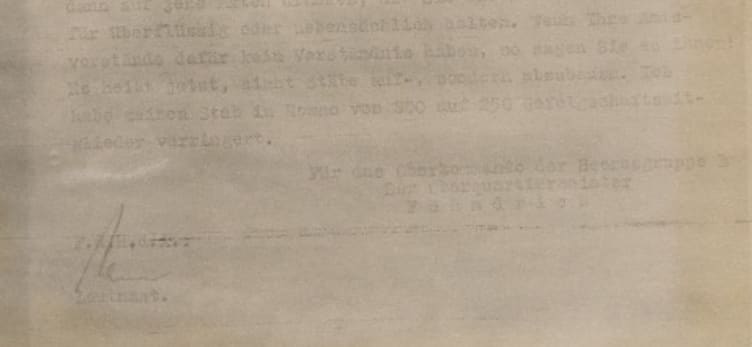
It might seem that I am belabouring the point here a bit, but what I am doing is ensuring that you, my reader, understand that the alleged Koch quote from PS-1130 is being falsely presented without the accompanying context of where the claimed quote is actually coming from and thus it is being massively misrepresented as something it is not (and was never supposed to be).
Nothing makes this more obvious on this point than the fact that only the first part of Fahndrich’s written summary of Claassen’s verbal summary is provided not von Altenstadt’s cover letter to Brautigam in the Eastern Ministry or the rest of Fahndrich’s written summary of Claassen’s verbal summary (i.e., the second part and the bulk of the document).
The cover letter is useful as it explains why this communique is being made although an open question remains – and will probably always remain – about why von Altenstadt felt it necessary to forward Fahndrich’s summary of Claassen’s verbal summary to Brautigam in the Eastern Ministry when Brautigam – as well as Kinkelin – would likely have been well aware of the contents of Koch’s 5th March 1943 as it would likely have been pre-approved or at least copied to them for comment and/or information. As such then it probably represents the typical inter and intra-organizational politics and networking that are common in any large organization but were especially common in the Third Reich’s ministerial organizations.
However, the real problem for the usual malicious interpretation of Koch’s alleged words is the second part of Fahndrich’s written report which summarizes Claassen’s verbal summary as follows:
‘II.) Furthermore, the speech was primarily an appeal to all party members stationed in the Reich Commissariat of the Ukraine, to conduct themselves perfectly in every respect and in any situation. In this connection the Reich Commissar said the following among other things.
1) … In the days of the crisis, one could differentiate between three groups of people.
1.) The group of those, that went about asking where one might be able to buy another suitcase;
2.) The group of slogan manufacturers with the main slogan: “One has to wait and see.”
3.) The group of real National Socialists, who said: “Now of all times we will not move an inch from here!”
With this third group we say: Whoever wallows in defeatism, who gripes, will have trouble with this National Socialist community, gathered here; he will get a slap in the face… We owe such conduct to the front, which we would prefer to join if the Fuhrer would give us permission… There is not a single place at the front, at which the Russians could have forced us to retreat. The Russian has not be able to force his will upon us…
2) … Nowadays, one often hears: “Had we”, or “Were we.” I only tell these people one thing: Had one had more faith in Adolf Hitler and had one taken a firmer grip at the sword, everything would have been different…
3) … We have brought you, my fellow party members to the Ukraine as personalities but not for the purpose that you should write your papers in a paper war. I have no objection if you want to get yourselves a rubber stamp, say “Not important for the war.” This stamp you can then apply to those files which you consider superfluous or unnecessary for these times. If your superiors do not understand this, tell them so. It is not the question to build up staffs, but to decrease them. I have reduced mine in Rowno from 800 to 250 staff members.’ (9)
We can see from the above that it is not surprising that proponents of the malicious interpretation of these alleged Koch quotations don’t cite the rest of Koch’s alleged comments that we get from Fahndrich via Claassen. Since Fahndrich’s comment that ‘the speech was primarily an appeal to all party members stationed in the Reich Commissariat of the Ukraine, to conduct themselves perfectly in every respect and in any situation’ alone is starkly at odds with the genocidal interpretation of Koch’s alleged words and directly suggests that they are being misinterpreted as something they are not (or in the words of one ‘Holocaust’ historian: ‘might confuse people’).
Thus, when we look at the whole of Fahndrich’s written summary of Claassen’s verbal summary that is PS-1130 it should read as follows:
‘Oberkriegsverwaltungsrat [approx. ‘Senior Wartime Administrator’ – KR] Dr. Claassen participated in the meeting of the NSDAP in Kiev on March 5, 1943 and gave a verbal report on the contents of the Reich Commissars Speech. Other documents on the contents of the speech are not available here.
I.) On the treatment of the population the Reich Commissar remarked in the course of his speech in several places as follows:
1) We are the master race and must govern hard but just…
2) I will draw the very last out of this country. I did not come to spread bliss. I have come to help the Fuhrer. The population must work, work, and work again… for some people are getting excited that the population may not get enough to eat. The population cannot demand that. One has only to remember what our heroes were deprived of in Stalingrad… We definitely did not come here to give out manna. We have come here to create the basis for victory.
3) We are a master race, we must remember that the lowliest German worker is racially and biologically a thousand times more valuable than the population here…
II.) Furthermore, the speech was primarily an appeal to all party members stationed in the Reich Commissariat of the Ukraine, to conduct themselves perfectly in every respect and in any situation. In this connection the Reich Commissar said the following among other things.
1 ) … In the days of the crisis, one could differentiate between three groups of people.
1. ) The group of those, that went about asking where one might be able to buy another suitcase;
2. ) The group of slogan manufacturers with the main slogan: “One has to wait and see.”
3. ) The group of real National Socialists, who said: “Now of all times we will not move an inch from here!”
With this third group we say: Whoever wallows in defeatism, who gripes, will have trouble with this National Socialist community, gathered here; he will get a slap in the face… We owe such conduct to the front, which we would prefer to join if the Fuhrer would give us permission… There is not a single place at the front, at which the Russians could have forced us to retreat. The Russian has not be able to force his will upon us…
2) … Nowadays, one often hears: “Had we”, or “Were we.” I only tell these people one thing: Had one had more faith in Adolf Hitler and had one taken a firmer grip at the sword, everything would have been different…
3) … We have brought you, my fellow party members to the Ukraine as personalities but not for the purpose that you should write your papers in a paper war. I have no objection if you want to get yourselves a rubber stamp, say “Not important for the war.” This stamp you can then apply to those files which you consider superfluous or unnecessary for these times. If your superiors do not understand this, tell them so. It is not the question to build up staffs, but to decrease them. I have reduced mine in Rowno from 800 to 250 staff members.’ (10)
When we read the whole thing rather than just section I of Fahndrich’s summary – which incidentally you can clearly see was deliberately taken out of its original context in PS-1130 from the red coloured marking notes from the Nuremberg Trial documentation – (11) then it is obvious that what Fahndrich is summarizing in writing from Claassen’s verbal summary of what Koch actually said in Kiev on 5th March 1943 is:
Point I.1: We Germans must expect the highest standards of ourselves, and we must govern Ukraine with a firm hand but also justly.
This also echoes comments Himmler makes is several months later in his Posen speech of 4th October 1943 to similar effect regarding how Germans should treat Poles well and that Germans must always exemplify the values of National Socialism in their conduct with them.
To wit:
‘If we make contracts, we must keep them. If I make a contract with an agent, even if he is a contemptible character, then I keep the deal. I stand for this attitude without condition. When I decree that anybody in the Generalgouvernement who informs on a Jew concealed in some hideout gets one third of the Jew’s fortune. It often later happens that a Secretary Hueber, or an Untersturmfuhrer Hueber, a person who – if he can get away with it – indulges in unauthorized private travel, who orders anything from a new pencil to a new telephone, that is somebody who never saves, suddenly starts to save for the German Reich. He says for example, ‘The Jew has 12,000 RM. Why should I give 4,000 RM to the Pole who turned him in? No, I’ll save the money for Germany. The Pole gets 400 RM.’ In this manner, a subordinate goes off on his own bat and breaks the word of a whole organization. These are things that must be impossible.’ (12)
In essence Koch is saying the same thing about the Ukrainians as Himmler was to say about the Poles several months later: the German administrators of the Ukraine must govern in a firm but fair manner.
Point I.2: I will do whatever is necessary to win the war. We didn’t liberate Ukraine from Stalin’s Bolsheviks without substantial cost to ourselves; the Ukrainian people will have suffer privations too like we Germans and that will mean they won’t always get enough to eat. We have to remember the heroes of Stalingrad who endured far more privations than we and the Ukrainians ever will in and in order to ensure the final victory we have to cut back and suffer too in order to ensure the final victory.
The immediate context to Koch’s speech on 5th March 1943 to the NSDAP in Kiev is Goebbels’ famous ‘Total War’ Speech (sometimes called the ‘Sportpalast Speech’) of 18th February 1943 and Koch’s speech is almost certainly his own echo of Goebbels’ own which we can see from reading the second unusually unquoted part of Fahndrich’s summary.
In the context of point I.2 Koch is directly echoing Goebbels here who declared on 18th February 1943 that:
‘Now is not the time to ask how it all happened. That can wait until later, when the German people and the whole world will learn the full truth about the misfortune of the past weeks, and its deep and fateful significance. The heroic sacrifices of heroism of our soldiers in Stalingrad has had vast historical significance for the whole Eastern Front. It was not in vain. The future will make clear why.’ (13)
We can clearly see that Koch is echoing Goebbels here but also, we can see what Koch is talking about in terms of ‘Ukrainians not always getting enough to eat’ in Goebbels’ speech where he declares that:
‘It is time to get the slackers moving. They must be shaken out of their comfortable ease. We cannot wait until they come to their senses. That might be too late. The alarm must sound throughout the nation. Millions of hands must get to work throughout the country. The measures we have taken, and the ones we will now take, and which I shall discuss later in this speech, are critical for our whole public and private life. The individual may have to make great sacrifices, but they are tiny when compared to the sacrifices he would have to make if his refusal brought down on us the greatest national disaster. It is better to operate at the right time than to wait until the disease has taken root. One may not complain to the doctor or sue him for bodily injury. He cuts not to kill, but to save the patient’s life.
Again let me say that the heavier the sacrifices the German people must make, the more urgent it is that they be fairly shared. The people want it that way. No one resists even the heaviest burdens of war. But it angers people when a few always try to escape the burdens. The National Socialist government has both the moral and political duty to oppose such attempts, if necessary with draconian penalties. Leniency here would be completely out of place, leading in time to a confusion in the people’s emotions and attitudes that would be a grave danger to our public morale.
We are therefore compelled to adopt a series of measures that are not essential for the war effort in themselves, but seem necessary to maintain moral at home and at the front. The optics of the war, that is, how things outwardly appear, is of decisive importance in this fourth year of war. In view of the superhuman sacrifices that the front makes each day, it has a basic right to expect that no one at home claims the right to ignore the war and its demands. And not only the front demands this, but the overwhelming part of the homeland. The industrious have a right to expect that if they work ten or twelve or fourteen hours a day, a lazy person does not stand next to them who thinks them foolish. The homeland must stay pure and intact in its entirety. Nothing may disturb the picture.’ (14)
We can see that Goebbels’ theme here is shared sacrifice and that is also Koch’s theme in talking about how the Ukrainian people will also have to share the burden of sacrifice with the Germans and that might mean ‘not getting enough to eat’ – remember Ukraine was the breadbasket of the Soviet Union and the Third Reich relied heavily on the country’s agricultural bounty to help it feed its civilians and soldiers as well as the Ukrainian people – and so the Ukrainian and German people will in time create a shared bond in national suffering to ensure the final victory over Stalin and his Bolsheviks.
This link to Goebbels’ speech is also extremely obvious in points II.1 and II.3 of Fahndrich’s summary in that point II.1 splits up the people into profiteers and cowards (point II.1.1), fair-weather friends and the politically uncommitted (point II.1.2) and ‘real National Socialists’ (point II.1.3). The first group Goebbels himself attacks as ‘slackers’ in his 18th February 1943 speech while praising the third group – the ‘real National Socialists’ as Koch calls them but Goebbels refers to them as ‘the most radical’ – and demanding the second group – who Goebbels refers to as being ‘not radical enough’ – buck up their ideas with the objective of trying to shame/demand/force the first and second groups of people to be the third group of people (the ‘real National Socialists’) in Koch’s speech.
We can further see Koch echoing Goebbels’ demand to only focus on ‘essential war work’ in his 18th February 1943 speech in point II.3 of Fahndrich’s summary where we see Koch making a joke – which in itself is still quite funny – about bureaucrats creating bureaucracy for its own sake and then Koch demands an end to pointless bureaucracy in the Reichskommisariat Ukraine. To illustrate this, he declares that he has cut the number of his staff in the Reichskommisariat Ukraine’s administrative centre in Rowno (the modern Ukrainian city of Rivne) by nearly 70 percent from 800 to 250 people. Thus releasing 550 people from his office to be conscripted into the German military or to do essential war work elsewhere so as to release a more able-bodied man for military service.
Koch’s reference to those of who talk in terms of ‘Had we’ or ‘Were we’ and then his statement that their problem is a lack of faith in the leadership of Adolf Hitler in point II.2 – also related to the group of doubters he refers to in point II.1.2 – is clearly also a reference to a common National Socialist slogan of the mid to late war era about the need for ‘faith in the final victory’ – this is incidentally first found in Goebbels diaries sometime circa 1929 – that is also found in Goebbels’ 18th February 1943 speech where he states that:
‘Fifth: The English maintain that the German people have lost faith in the Fuhrer.
I ask you: Is your confidence in the Führer greater, more faithful and more unshakable than ever before? Are you absolutely and completely ready to follow him wherever he goes and do all that is necessary to bring the war to a victorious end?’ (15)
As well as:
‘When the war began, we turned our eyes to the nation alone. That which serves its struggle for life is good and must be encouraged. What harms its struggle for life is bad and must be eliminated and cut out. With burning hearts and cool heads we will overcome the major problems of this phase of the war. We are on the way to final victory. That victory rests on our faith in the Fuhrer.’ (16)
Once again we can see how adding in the historical context to the alleged Koch quote(s) – which remind is second hand hearsay but are probably genuine at least in essence as Claassen and Fahndrich had no reason to lie especially in a classified document sent from Army Group B to the Political Department of the Third Reich’s Eastern Ministry – completely changes the meaning imputed to them at the Nuremberg Trials – which as we’ve already seen is a good example of deliberate and malicious misquoting in order to ‘prove’ a pre-ordained conclusion – and which has been maintained ever since as ‘fact’ by historians and writers who probably didn’t bother to check the original document – one suspects many historians merely took the quote and the accompanying reference from previous historians without checking it (a well-known bad habit among historians that David Irving in particular was at pains to point out several times but which was also alluded to by many others like Robert Faurrison) – and then gets retailed as ‘the truth’ on the strength of its constant repetition by authorities.
This is particularly true of the last and probably the most famous quote taken from PS-1130 which is the partial alleged quote from Koch via Claasen and Fahndrich that is point I.3 which reads:
‘We are a master race, we must remember that the lowliest German worker is racially and biologically a thousand times more valuable than the population here…’
Now this sounds absolutely damning to most people in showing the ‘racial supremacism of the Germans towards the Ukrainians’ (as well as Slavs in general) but as we can already this is an alleged excerpt from Koch’s 5th March 1943 speech that lacks both what is said before it as well as the rest of the quote (indicated by the ‘…’ in PS-1130). Thus, reading it as a stand-alone statement is simply dishonest and as we’ve already seen Koch isn’t actually attacking the Ukrainians in his 5th March 1943 speech but rather is haranguing the members of the NSDAP in Kiev about how they need to work harder.
So, if we read this statement in the context of what we already know from the rest of PS-1130 and its immediate historical context – such as Goebbels’ 18th February 1943 ‘Total War’ speech – then we can see that what Koch’s actual meaning was something like:
‘We are a master race, we must remember that the lowliest German worker is racially and biologically a thousand times more valuable than the population here and so a thousand times more is expected from each of you because you are a German worker not a Ukrainian worker.’
Now this doesn’t mean that Koch didn’t have strong racial views that likely included anti-Slavic sentiment as we know from Dr. Markull’s famous letter – which is falsely claimed to contain an ‘anti-Slavic quote’ from NSDAP boss Martin Bormann and which is actually Markull explicitly being sarcastic in the letter – (17) to his boss Georg Leibbrandt on 19th August 1942 which contains a reference to Koch’s views on Ukrainians being negative and that this is considered a problem by the Eastern Ministry.
As Markull writes to Leibbrandt that:
‘But there is no real need to assume a fictitious decree as was done in Paragraph 1. The above-mentioned concept of our role in the East already exists in practice. The Reich Commissioner for the Ukraine has expounded his views of the Ukrainian people governed by him in three successive speeches at the inauguration.’ (18)
What Markull is saying here is that Koch held strong racial views that included anti-Slavic sentiment towards the Ukrainians and upon his appointment as Reichs Commissar of the Ukraine on 1st September 1941 promptly made three speeches in a row that were politically inadvisable and not in accordance with the views of Koch’s bosses at the Third Reich’s Eastern Ministry, which in in turn is probably why Fahndrich forwarded his written summary of Claassen’s verbal summary of Koch’s 5th March 1943 speech to Brautigam and Kinkelin at the Eastern Ministry so that they could evaluate what was being circulated about it within Reichskommisariat Ukraine.
In truth Koch was probably talking partially from the euphoria of the ‘drive across Russia’ that was nearing its apogee around the time of his appointment as Reichs Commissar of the Ukraine and so got rather… shall we say… carried away in the common belief of those months that the war in the East had been won and that a peace deal would soon be reached or Stalin’s regime would collapse (as it almost did).
This doesn’t detract from Koch’s views but it does put his allegedly genocidal anti-Slavic sentiment – there is no evidence that he held such views just standard anti-Slavic racial sentiment that was common among NSDAP members and German society in general of 1920s to the 1940s – in the context of his own words which shows that he might have held strong anti-Slavic views, but these views didn’t preclude him from governing the Ukraine in a way that was – in his own words – ‘hard but just’.
So thus, we can see that all three of the quotes attributed to Koch at Nuremberg (as well as subsequently) are in fact only partial alleged Koch quotes that have been stripped out of the context they were said as well as often the sentences they were utterly as part of.
Thus, they mean very little in and of themselves because we need the rest of the sentence – which we can only get by looking at the historical context and the all important second part of PS-1130 that gives us some idea about the purpose, subject and thesis of Koch’s 5th March 1943 speech – and in addition to this is the fact that all three of these quotes – and the rest of PS-1130 for the matter – are not the direct Koch quotes that they were presented as at Nuremberg (as well as subsequently by many historians and popular writers) but rather are second hand hearsay with Fahndrich writing down what Claassen verbally told him about what was said in Koch’s speech.
In other words: they would not be admissible in any modern court of law as ‘Koch’s words’ because there is no evidence that he actually said those words, but yet if we look at the historical context – provided by Dr. Markull’s letter of 19th August 1942 – it is clear that these words could well have been Koch’s and the meaning of what Koch is talking about is provided by Goebbels’ 18th February 1943 ‘Total War’ speech which we find Koch echoing points and themes from in his 5th March 1943 speech, which have then been verbally summarized by Claassen to Fahndrich who has then in turn summarized them in writing to von Altenstadt who has then forwarded Fahndrich’s summary on to Koch’s bosses at the Third Reich’s Eastern Ministry: Brautigam and Kinkelin.
Put simply: the quotes attributed to Koch are second hand hearsay and while probably real in substance. The meaning that they were given at Nuremberg was deliberately malicious and not what Koch meant at all as is made abundantly clear by simply reading the second part of PS-1130 which Nuremberg prosecutors didn’t bring up for the simple reason that it clarified Koch’s alleged ‘genocidal quotes’ to actually be Koch demanding everyone work hard and sacrifice more to help ensure total Axis victory over Stalin’s Soviet Union.
The truth is that simple.
References
(1) Proceedings of the Trial of the Major War Criminals Before the International Military Tribunal, Vol. 3, p. 405
(2) https://nuremberg.law.harvard.edu/documents/455345-cover-letter-and-an-outline?mode=image&q=evidence:%22PS-1130%22
(3) Idem.
(4) I have outlined ‘who is who’ on this in regard to Erhard Wetzel’s 7th February 1942 Letter to the Eastern Ministry on ‘Generalplan Ost’ as explaining this allows us to place communications like this in their proper historical context and in so doing see them for what they are not as ‘standalone evidence’ that can be easily and maliciously misinterpreted: https://karlradl14.substack.com/p/source-texts-on-generalplan-ost-1
(5) https://nuremberg.law.harvard.edu/documents/455345-cover-letter-and-an-outline?mode=image&q=evidence:%22PS-1130%22
(6) https://nuremberg.law.harvard.edu/documents/3746-cover-letter-and-an-outline?mode=image&q=evidence:%22PS-1130%22
(7) https://nuremberg.law.harvard.edu/documents/3744-cover-letter-and-an-outline?q=ukraine
(8) https://nuremberg.law.harvard.edu/documents/3746-cover-letter-and-an-outline?mode=image&q=evidence:%22PS-1130%22
(9) https://nuremberg.law.harvard.edu/documents/455345-cover-letter-and-an-outline?mode=image&q=evidence:%22PS-1130%22
(10) Idem.
(11) Idem.
(12) From: https://www.holocausthistoricalsociety.org.uk/contents/naziseasternempire/himmlersspeechatposen.html
(13) From: https://research.calvin.edu/german-propaganda-archive/goeb36.htm
(14) Idem.
(15) Idem.
(16) Idem.
(17) On this please see my article: https://karlradl14.substack.com/p/is-the-martin-bormann-the-fertility
(18) Proceedings of the Trial of the Major War Criminals Before the International Military Tribunal, Vol. 11, p. 543
Karl’s SubstackRead More








 T1
T1