As part of my series of articles addressing the basis of the claims that Christopher Columbus – the great Genoese explorer – was in fact ‘secretly jewish’ and more pointedly a Marrano; I have already explained that much of the ‘case’ is rooted in overstatement, misstatement and occasionally just making things up. (1)
I’ve already addressed the myths that Columbus took along ‘lots of Marranos with him’ as well as debunking the implication it was either Columbus’ decision or that it would have had anything to do with him being ‘secretly jewish’, (2) Columbus’ fictious ‘close relationship’ with Abraham Zacuto and Joseph Vecinho, (3) that he left on his first expedition (which discovered the Bahamas and thus the Americas) to ‘avoid the Alhambra Decree of 1492 expelling all jews from Spain’ (4) as well as the recent ‘jewish DNA’ claims. (5) This leaves by my count two other arguments used to suggest that ‘Columbus was jewish’, which are the claim that his voyages were funded by jews and that Columbus put a jewish symbol called a ‘Beth hei’ on his letters to his son Diego.
Now of these two arguments: the second is by far the strongest if it is true, but the problem is once again is that the case is once again usually overstated, misstated and/or simply has made up claims added to it. What I mean by that is the ‘Beth hei’ claim is a specific claim made on specific evidence, so we need to evaluate both what the argument is and on what evidence it is based on.
The origin of the ‘Beth hei’ argument is Simon Wiesenthal – who has a dubious historical record and has been shown to be an inveterate liar in unrelated events by the late Gerd Honsik – (6) however aside from Wiesenthal fibs and frauds on other issues; his 1973 book ‘Sails of Hope’ deserves to be taken seriously despite its mendacious author, because it is considered to be one of the best compendiums of arguments for Columbus having been a jew.
Wiesenthal explains his ‘Beth hei’ theory in ‘Sails of Hope’ as follows:
‘Close investigation of the Columbus letters will reveal another riddle. Twelve of the letters, all of them to his son Diego, bear a peculiar sign or cipher in the upper-left hand corner. The letters in question are those of November 21, 1504, November 28, 1504, December 3, 1504, December 13, 1504, December 18 1504, December 21, 1504, December 24, 1504, February 5, 1505, February 18, 1505, February 24, 1505, and two letters without apparent date. Scholars have long noted the sign without attributing any importance to it and had taken it as a mark by the Duke of Veragua’s archivist.’ (7)
Now for the sake of transparency these are the so-called ‘Beth heis’ that Wiesenthal is referring to: (8)
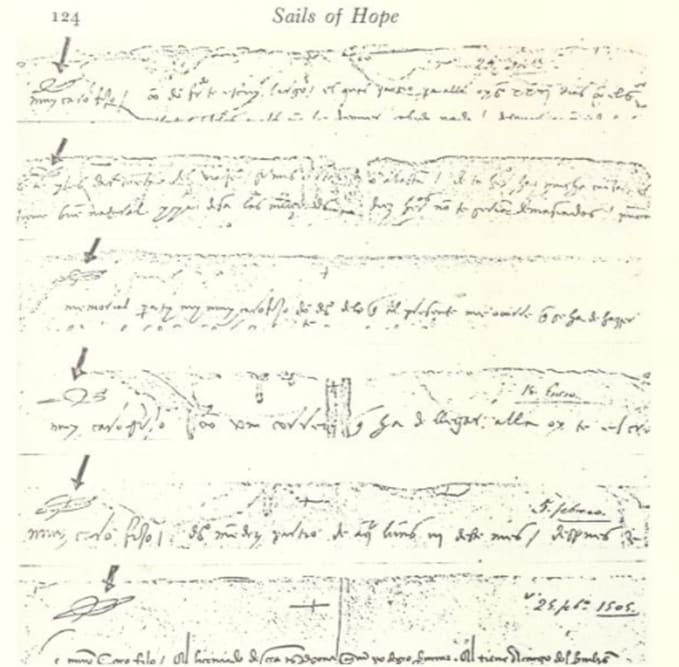
Now the problem here for Wiesenthal’s argument is really two-fold as what he is referring to are frankly squiggles without any obvious meaning and trying to read ‘meaning’ into it to is about as intellectually rigorous as trying to discern the theological importance of the image of the Virgin Mary appearing to appear on pieces of buttered toast (and yes this actually happens fairly regularly and no Catholic theologian I know of takes such claims seriously). (9)
That isn’t to say it couldn’t have some kind of meaning but frankly we don’t know where, when or who the mark comes from and such marks on important pieces of correspondence that have been archived are not uncommon, which is why – as Wiesenthal points out – Columbus scholars have simply ignored these marks, because in the first instance they look like meaningless squiggles and in the second because we don’t know when the marks were made. We cannot reasonably surmise without dating the ink itself that they came from around the same time as the letters were originally written. Hence the reasonable assumption that without additional evidence and/or verification that these marks were by the Duke of Veragua’s archivist.
Wiesenthal’s claims as to what these squiggles are is entirely speculative and based on his unsupported opinion that ‘they are from Columbus’ because he – and the German historian he is citing named Fritz Streicher – think they ‘are in Columbus’ hand’ (10) is admitted by Wiesenthal when he states later on that:
‘It is too much to hope that scholars will ever arrive at a conclusive interpretation of this signature. It remains one of the many riddles Columbus has left for us.’ (11)
Although Wiesenthal is ostensibly talking about another element that he tries to make into ‘evidence of Columbus’ jewishness’; his discussion here is also intermingled with his discussion of the so-called ‘Beth hei’ marks. (12) So, I believe that Wiesenthal was here admitting what he implies within his discussion on these so-called ‘Beth hei’ marks. When he states that fellow proponent of a ‘jewish Columbus’ Maurice David brought up the alleged ‘Beth hei’ marks to prominent Columbus biographer Salvadore de Madariaga, but de Madariaga reached a completely different conclusion to David and Wiesenthal in that these were a ‘the sign of the cross’ instead, (13) while Fritz Streicher believed they weren’t a ‘Beth hei’ at all but rather ‘a sign of familial affection between father and son’. (14)
The second problem with Wiesenthal’s argument here is that it is dishonest in implication in that he implies that all the letters from Columbus to Diego have the so-called ‘Beth hei’ mark, (15) but then goes on to qualify that this is not true and it is only some of the Columbus’ letters to Diego that have this feature on them.
Concerning this he writes that:
‘The other letters to Diego in which the triangle is present, but the signature reads El Almirante (the admiral) do not contain the beth hei mark. These letters were not so intimate, and presumably Diego could show them to others.’ (16)
To be blunt this is Wiesenthal trying to wriggle out of the obvious interpretation that because the so-called ‘Beth hei’ marks are not on all – or apparently most of – Columbus’ correspondence with Diego then they are likely something like an archivist’s mark not something Columbus himself did.
Wiesenthal has no evidence other than his own unsupported claim that the letters signed ‘El Almirante’ were intended to be ‘shown to others’ or ‘less private’ than the others. We don’t know why Columbus sometimes signed his name and sometimes signed himself ‘El Almirante’ in his letters to Diego.
Trying to assign specific meaning to such changes is ridiculous as it may well have been just whatever title/method of signing off Columbus felt was suitable and have no specific meaning whatsoever let alone be the ‘secret code’ that Wiesenthal claims it is.
We can thus see that the whole ‘Beth hei’ claim by Wiesenthal is simply the product of his and David’s imagination as well as confirmation/selection bias not deductive scholarship. It is simply not evidence for a ‘jewish Columbus’ since they cannot even prove the squiggles they claim to be ‘Beth hei’ were even written by Columbus and are simply assuming as much to make an argument.
Thus we can see that like so much of the ‘Columbus was jewish’ argument: the claim that Columbus wrote ‘Beth hei’ on the letters to his son Diego is an unsupported speculative claim that has subsequently been simplified into ‘Columbus signed his letters to his son Diego’ with a ‘Beth hei’ when the truth is only a few of Columbus’ letters to Diego have this squiggle on them and Wiesenthal and David are making a major speculation based on no published analysis, mischaracterizing the evidence and a molehill.
References
(1) On this please see my article: https://karlradl14.substack.com/p/was-christopher-columbus-jewish
(2) On this please see my article: https://karlradl14.substack.com/p/why-did-christopher-columbus-take
(3) On this please see my article: https://karlradl14.substack.com/p/christopher-columbus-and-his-relationship
(4) On this please see my article: https://karlradl14.substack.com/p/christopher-columbus-and-the-alhambra
(5) On this please see my article: https://karlradl14.substack.com/p/the-myth-of-columbus-jewishness-addressing
(6) Cf. Gerd Honsik, 1993, ‘Schelm und Scheusal: Meineid, Macht und Mord auf Wizenthals Wegen‘, 1st Edition, Bright-Rainbow: Madrid (You can read this in English translation here: https://www.islam-radio.net/historia/honsik/honsik.htm)
(7) Simon Wiesenthal, 1973, ‘Sails of Hope: The Secret Mission of Christopher Columbus’, 1st Edition, MacMillan: New York, p. 123
(8) Ibid., p. 124
(9) For example: http://news.bbc.com/1/hi/4034787.stm
(10) Wiesenthal, Op. Cit., pp. 123-125
(11) Ibid., p. 132
(12) Ibid., pp. 129-132
(13) Ibid., p. 125
(14) Ibid., p. 127
(15) Ibid., pp. 125-127
(16) Ibid., pp. 131-132
Karl’s SubstackRead More








 T1
T1